Ongoing investment in biomanufacturing across the Research Triangle is drawing more companies to the region and boosting the market’s research and development sector.
Large pharmaceutical companies, including AbbVie and Novartis, have committed hundreds of millions of dollars in the past year to expand their manufacturing operations in the region. Those investments are also attracting smaller biomanufacturing firms to the area, panelists said at Bisnow’s Research Triangle Life Sciences Summit in Raleigh this month.
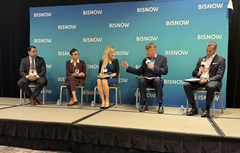
“The ecosystem has been buoyed up by the large groups that have come here, and it has become very ripe and fertile ground for the smaller, medium-sized companies coming behind it,” Jonathon Keener, a partner at Helix Ventures, said at the Brier Creek Country Club in Raleigh. “That's what we're most excited about because that diversifies our economy here.”
In January, contract development and manufacturing organization Alcami paid $6.7M for a 37K SF biologics lab facility in Durham. In April, pharmaceutical supplier NewLife Medicals expanded into Efland with its $4.8M acquisition of a 28K SF flex warehouse. And Ypsomed, a midsized Swiss medical technology company, is building its first U.S. manufacturing facility with a $200M investment in Holly Springs, with plans to open by the end of 2027.
Shifting trade policies and increased demand for U.S.-based production have prompted the life sciences industry to put more of its focus on manufacturing.
Manufacturing has become “a national priority,” sparking new demand from life sciences companies for “facilities that can support process development, pilot production and commercial-scale manufacturing,” Tyler Grimshaw, principal of architecture and engineering firm EwingCole, told Bisnow ahead of the event.
Raleigh-Durham’s life sciences market is showing signs of stabilization, according to a Cushman & Wakefield third-quarter report. Nearly 2.4M SF of new life sciences space has delivered since 2021. In the third quarter, vacancy in the market fell to 26.4% from 28% in the same quarter of 2025, reaching the lowest level in two years. This year, absorption turned positive again following occupancy losses in 2024.
The Research Triangle has seen a slew of large biomanufacturing real estate investments over the past year.
Last month, diagnostic imaging company Bracco Imaging announced a $230M investment in a manufacturing facility in Sanford, just south of the Triangle. In April, AbbVie announced a $1.4B investment to build a 185-acre pharmaceutical manufacturing campus in Durham, with completion slated for the end of 2028. And in May, Novartis announced plans to add a new $220M facility, spanning 56K SF in Morrisville, part of a $23B U.S. manufacturing and R&D commitment.
After a period of large-footprint commitments, smaller biomanufacturing companies are also coming to the Triangle.
“There's been a slowdown in some of the larger users — and there's definitely been an uptick in the more medium- to small-range-size users,” said Carolyn Coia, vice president of real estate at Research Triangle Park.
Part of that uptick is also due to the Research Triangle’s talent pool, flowing from North Carolina State University, Duke University and other universities in the area.
“What North Carolina is great at is producing the future employees” for pharmaceutical companies, said Michael Morgan, managing director of tenant representation at JLL.
Life sciences employment in the Research Triangle grew 21% from 2020 through 2025, reaching more than 58,000 workers across more than 650 companies, according to a 2026 Wake County Economic Development report. The region's employment concentration sits at 2.64 times the national average, outpacing national growth benchmarks, the report said.
Panelists expect continued life sciences growth as regional talent keeps bringing in companies.
“Once they come with their first initial investment, putting their toe in the pond, they realize what that talent can do for them, and they quickly double down,” Keener said.