Raleigh-Durham’s shift beyond life sciences is unlocking fresh opportunities for investors as advanced manufacturing and other sectors expand across the region.
The region is home to the nation’s largest research and science park and ranks among the top life sciences markets in the U.S. Between 2019 and 2024, companies in the industry secured nearly $4.4B in venture capital funding, the 13th-highest amount globally, according to CBRE.
But now, major commitments from tech, semiconductor and advanced manufacturing companies are reshaping the market and creating new demand across asset types. At the same time, a significant planned revamp of Research Triangle Park is paving the way for mixed-use opportunities for the first time since it opened nearly 70 years ago.
“Raleigh/Durham’s growth story is no longer just about universities and life sciences,” Garret Tripp, office managing partner at PwC Raleigh, told Bisnow in an email. “Those strengths, along with the region’s workforce, remain important, but major manufacturing commitments are creating new sources of demand.”
The Raleigh-Durham region was ranked the fourth market to watch in the U.S. in 2027, up from 11th place in 2026, according to ULI and PwC’s Emerging Trends in Real Estate 2027 report. It trails only Dallas-Fort Worth, Nashville and Miami.

Manufacturing investments in Raleigh-Durham are estimated at nearly $140B, according to the report, citing Industrial Sage data. In April, drugmaker AbbVie said it would spend $1.4B on a 185-acre pharmaceutical manufacturing campus in Durham, largely because of the area’s “ability to support future expansion.”
Beyond pharmaceuticals, Caterpillar Inc. plans to build a new advanced manufacturing facility in Sanford, roughly 40 miles south of Raleigh, to boost production of its compact track loaders and telehandlers. It is part of the company’s planned $1B investment in North Carolina to expand manufacturing capacity.
Siemens is growing its presence in Raleigh with a new 131K SF manufacturing facility that is expected to create 100 jobs by year’s end. And Forge Nano, which makes semiconductors for commercial and defense customers, broke ground on a factory expansion near Research Triangle Park that is backed by $100M in federal funding. That project is part of an effort to boost the U.S. supply chain of critical defense materials.
“There's just more emergence of companies that have mission-critical needs,” Matt Winters, senior managing director at JLL in Raleigh, told Bisnow.
“There's all these other industries beyond life sciences that we're seeing an uptick in, in terms of the number of projects that are considering the Raleigh-Durham area for future investment and expansion,” he said.
The area’s talent pool is a big reason for the surge in manufacturing. Professionals are moving to Raleigh-Durham to attend top universities and work at prestigious institutions and companies. The region’s relatively low cost of living, 6% below the national average, is also a draw.
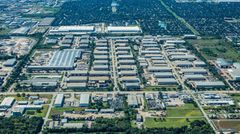
Population growth in Raleigh-Durham over the last few decades has prompted an initiative dubbed RTP 3.0, a 50-year vision to turn the 7,000-acre Research Triangle Park into a live-work-play environment. In June, new development standards for the park were approved, opening the door to residential and mixed-use neighborhoods.
RTP 3.0 is slated to mark a significant shift for the park, which was founded in 1959 and houses hundreds of companies across its labs, data centers, life sciences facilities and corporate offices. RTP officials began accepting applications for development proposals in July.
Tripp said the initiative could “improve the park’s ability to attract workers and companies while opening demand for a broader mix of real estate.”
The research park’s existing inventory is poised to continue to “attract demand from adjacent sectors,” including technology and advanced manufacturing, the ULI report says. RTP 3.0 is slated to create even more demand and is expected to draw in new types of companies, like retail, dining, and entertainment businesses.
“Everybody in the industry is excited to see some greater density and a wider range of uses to be allowed under the new plan,” Winters said.
In the meantime, several multibillion-dollar investments in the research, infrastructure and advanced manufacturing industries will “continue to deepen the region’s competitive advantage,” according to the ULI report.
The region’s market shift, coupled with RTP 3.0, “give the market a more diversified growth story than it had several years ago,” Tripp said.