Suburban Maryland’s life sciences corridor has some of the most important pieces of the research and development puzzle already built in: the National Institutes of Health, the Food and Drug Administration and a deep bench of research and talent from universities like Johns Hopkins University and the University of Maryland.
But more coordination is needed to fully harness the power of those scientific assets for the region’s growth and economy, panelists at Bisnow’s Mid-Atlantic Life Sciences and Biotech Summit said this month.
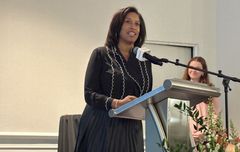
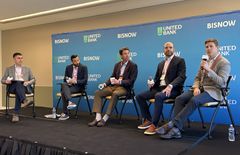
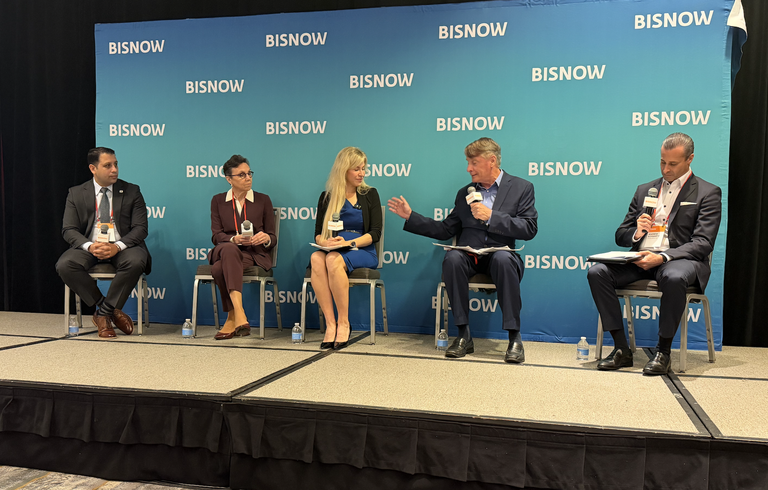
“This is our time to come together and to put ourselves on the map, and we do that by producing the science, by supporting our startups and by encouraging innovation and commercialization right here in this region,” Ecphora Capital Managing Partner Deborah Hemingway said onstage at the Bethesda Marriott.
There is inherently a pipeline that those in the industry call “bench-to-bedside,” whereby basic research produces insight that then leads to real-world uses like patient treatment and diagnostics.
But panelists said creating infrastructure around those collaborative efforts, concepts like innovation districts or centers of excellence, can boost the region from an economic development standpoint.
“It's a collective effort, and we need to be thinking strategically around how do we market ourselves as a region, and how do we attract the companies that would have never thought about being here in that sense,” said Prayas Neupane, Montgomery County Economic Development Corp.’s director of economic development.
From a real estate perspective, the idea would be to build structural hubs that can collate players across the life sciences spectrum — from academic institutions to private companies to hospital systems. In addition to enabling various players to collaborate scientifically, they would also help attract more companies and investment and provide a branding advantage for the region.
“So why couldn't we create a Purple Line innovation corridor north and south, so you can actually bring together from a marketing standpoint FDA and NIH and College Park and NOAA and all of these assets,” Association of University Research Parks Chief Strategy Officer Brian Darmody said.
The long-awaited Purple Line, which connects New Carrollton to the east and downtown Bethesda to the west, is tentatively set to open late next year.
Darmody noted that there are three Maryland medical schools. In addition to Hopkins and UMD, there is also the federal Uniformed Health Sciences University in Bethesda.
“We have these assets that are just sub-optimized because we don't have enough awareness of them, and I think if we collectively pull them together, that will make this region much stronger,” he said.
Some efforts to create these kinds of innovation hubs in the region are underway.
A 14-acre life sciences district next to the North Bethesda Metro station is in the works, set to be anchored by the University of Maryland’s Institute for Health Computing. The Washington Metropolitan Area Transit Authority selected Hines as the developer for the project last year.
MCB Real Estate, which is building Viva White Oak, a $2.8B mixed-use development next to the FDA, envisions 3M SF of office space with a focus on the life science industries.
Onstage, Darmody called the Viva White Oak effort “needed,” but he said the county still has to be working toward attracting companies to fill that planned development.
“Somebody, a new intermediary, whether it's Montgomery County EDC or a new regional enterprise, has to provide the strategy and the facilities and the financing to get more of that in the private sector,” he said.
Panelists said the field of quantum sciences could be an opportunity to create a specialized hub in the region, given its preexisting strength in the space.
But it's easier said than done, panelists said, as these efforts require the necessary coordination, funding, political will and patience from public and private partners to see them through.
“We need to do a better job of communicating and really talking, and then doing, doing the real work,” Athari BioSciences Inc. CEO and founder Susan Mitchell said. “It's hard work. It's hard. It's long, it's tedious, and it's costly, but if we want to be the center of excellence, because the mid-Atlantic region is ripe for it, we have the tools, we have the people, we just need to do it. Stop talking about it and do it.”