Trade wars, inflation and prolonged conflict in the Middle East made foreign investors increasingly cautious about the U.S., even as cross-border transactions rebounded globally.
But in the aftermath of Democratic Party victories in midterm elections across the country, overseas capital may once again be warming to American real estate, fund managers said at Bisnow’s New York City State of the Market event on Thursday.
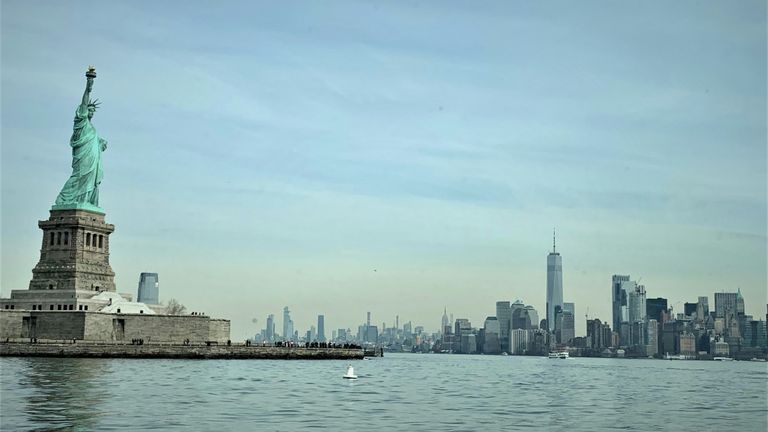
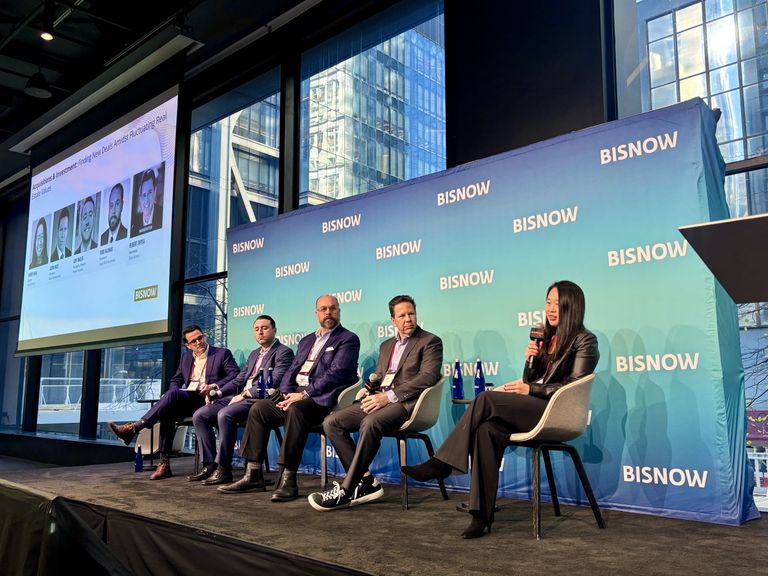
“The sentiment toward the U.S. was very, very negative, and even since two weeks ago, we've seen some thawing in those pools of capital that were pulling back from the U.S. for the past couple of years,” Vistria Group partner Sherry Wang said onstage.
That marks a sharp reversal from earlier this year, when Wang said some foreign funds rescinded mandates to invest in the U.S., citing geopolitical concerns even as they continued to “believe in the underlying real estate for the most part.”
In the first half of the year, cross-border investment in commercial real estate surged 56% to $71.8B globally, Reuters reported. Most of that increase came from Asia and Europe. Singapore ranked first among individual markets, attracting $8.7B in investment.
The U.S. captured a smaller-than-usual slice of the global market. In the 12 months leading up to September, the country attracted $28B, a 15% share of all cross-border investment, according to a report by Colliers. That lagged below its five-year average of nearly 19%.
Between 2022 and 2024, many investors held allocations in the U.S. steady, before decreasing their targets by 10 basis points in 2025, according to the Association of Foreign Investors in Real Estate.
In an AFIRE survey conducted throughout July and August, 53% of respondents, representing more than $4T in global assets, said they plan to decrease or not change their overall U.S. allocations.
That’s even though 58% of those same respondents had a positive view of the U.S. economy. Those with a negative outlook more than doubled from the same time last year, from 12.5% to nearly 27%, with more than 90% of respondents citing the U.S. political landscape as the reason why.
Few of the factors that stood in the way of dealmaking — like interest rates and construction costs — have changed since Election Day, but there is a greater sense of certainty and, in some parts of the U.S. economy, positivity.
In its first survey since the midterms, Oxford Economics found that U.S. consumer sentiment rose and year-ahead inflation expectations fell by a full percentage point to 3.7%, the most substantial decline since the start of the Iran war.
Having a blue Congress and a red White House is likely to create new hurdles that block laws, budgets or appointments from approval. For the real estate industry, that may not be such a bad thing, Legal 1031 Exchange President Todd Pajonas said during the event, held at Convene One Liberty Plaza.
“There's not going to be any change to the tax code, which drives a lot of business. There's not going to be huge swings in monetary policy. We're not going to see the huge tariffs. We're going to see an end, hopefully, to the conflict in the Middle East because there's not going to be the political will to do it,” Pajonas said. “I think the next two years are going to look somewhat better because of political gridlock.”
AFIRE CEO Gunnar Branson told GlobeSt earlier this month that his members expressed a similar sentiment to him on the day of the election.
Real estate played a prominent role in November’s election, with housing affordability and data center backlash taking center stage. Across the country, a series of Republican stronghold states flipped, including Texas, Georgia, Ohio, Iowa and Alaska, in some cases giving Democrats control for the first time in decades.
In New York City, where several candidates backed by the Democratic Socialists of America won, landlords especially fear tightening tenant protections.
“You look at COPA, that was just enacted. Every now and then — I don't even want to say it out loud — the commercial rent control bill rears its ugly head,” Besen Partners Managing Director Sam Finkler said. “It's really local policy agenda and interest rates that are going to play out over the next couple of years.”
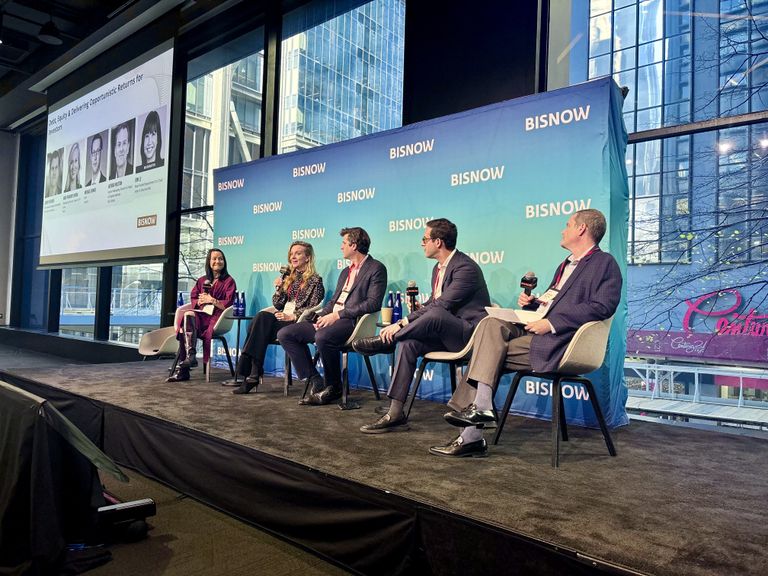
Even with increased regulatory scrutiny, New York City continues to be one of the most supply-constrained markets in the country. Foreign investors may take a moment to recalibrate, but they are unlikely to be dissuaded in the long run, panelists said.
“I don't think there's any foreign capital that has redlined, crossed off New York because of the political climate,” NAI Global Senior Managing Director and Head of Capital Markets Arthur Milston said. “In fact, I think most people view that typically as transient.”
Manhattan’s median rent reached $5,279 per month in October, up 6% year-over-year, while vacancy fell to 1.3%, the lowest level since March 2020, according to Corcoran.
The city has led the country in office recovery and is one of the few markets where new office supply is being delivered. Globally, the under-construction office pipeline was 580M SF in the third quarter, 45% below its 2017 peak and its lowest level in a decade, according to Cushman & Wakefield.
In New York City, where leases are breaking records and market rents average $156.64 per SF, 6.4M SF of new development is in the works. Another 2.5M SF of space is under renovation.
BGO Managing Director and Head of U.S. Debt Abbe Franchot Borok alluded to checks being written by investors from Canada and Asia, targeting the office sector.
“It's starting a little bit of a herd mentality,” Borok said. “[We will] start to see some of that foreign capital come back.”