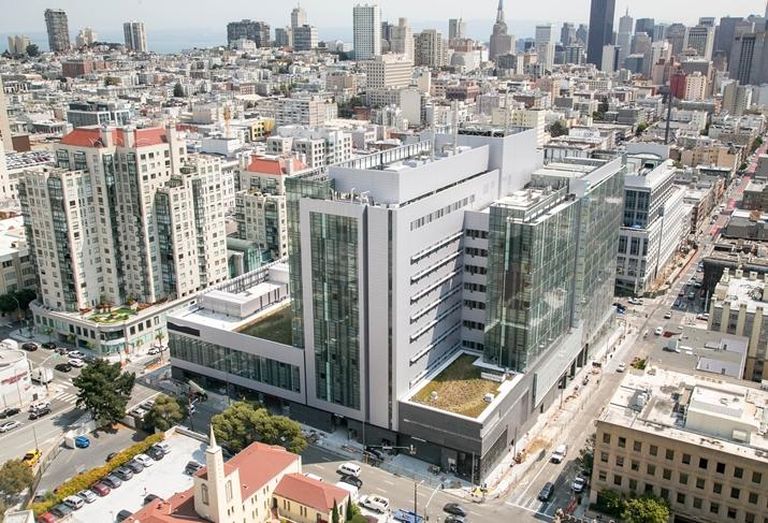
The new California Pacific Medical Center Van Ness Campus hospital is scheduled to open in March, and when it does, it will be the first building in North America to use a seismic wall technology that will help the building better ride out earthquakes.
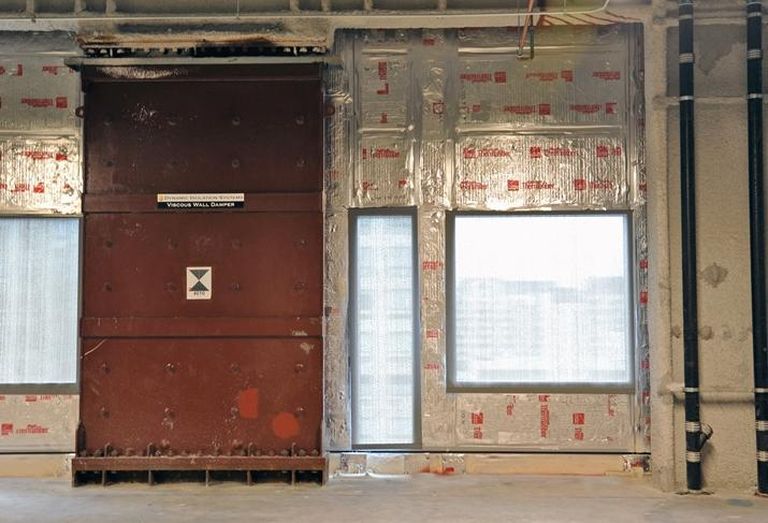
Sutter Health's 11-story CPMC will have 119 viscous wall dampers, a technology designed to absorb strong movement and reduce overall stress on the building. The technology uses a steel box filled with a viscous polymer that allows a vertical steel plate connected to the floor girder above to move freely and allow the fluid to absorb the energy during an earthquake. It has been used in earthquake-prone Japan during the past 25 years before its first implementation in the U.S. on this project.
Other kinds of damper technology, such as piston dampers, have been used in other buildings in the Bay Area and elsewhere in California. While the object is the same — to absorb energy during an earthquake — the viscous wall dampers differ in form (walls vs. pistons) and materials, Degenkolb Engineers Senior Principal Engineer Jay Love said. Degenkolb is the engineer of record for CPMC.
The viscous wall dampers absorb about 90% of the energy from an earthquake, decreasing building movement, particularly on the upper floors that would otherwise sway the most in an earthquake. Such technology is crucial for hospitals, which are critical in a disaster.
“With the latest seismic technology in place, the new CPMC Van Ness Campus hospital is prepared to continue to deliver healthcare services when the next ‘Big One’ strikes,” Love said in a statement.
The hospital is built to sustain itself for at least four days if cut off from the city utility system using three emergency generators, food, water and safe sewage storage.
"By employing viscous wall damper technology, we’ve created one of the most earthquake-resistant buildings in all of San Francisco,” said Larry Kollerer, Sutter Health’s executive director for facility and property services. “In the event of a major disaster, the new CPMC Van Ness Campus hospital is designed to not only remain standing, but to be operational to serve the needs of the community in a time of extreme crisis.”
The wall dampers have the added benefit of augmenting the structural strength of the building by fitting in the wall frame between windows. Without the dampers, the facility would have needed up to 60% more steel and more bracing frames in its column lines. With the cost of the dampers weighed against the cost of that additional steel, use of the wall dampers ended up saving 25% of the total cost of structural steel for the project.
The technology has been proven through testing to meet the stringent seismic requirements for hospital construction in California.