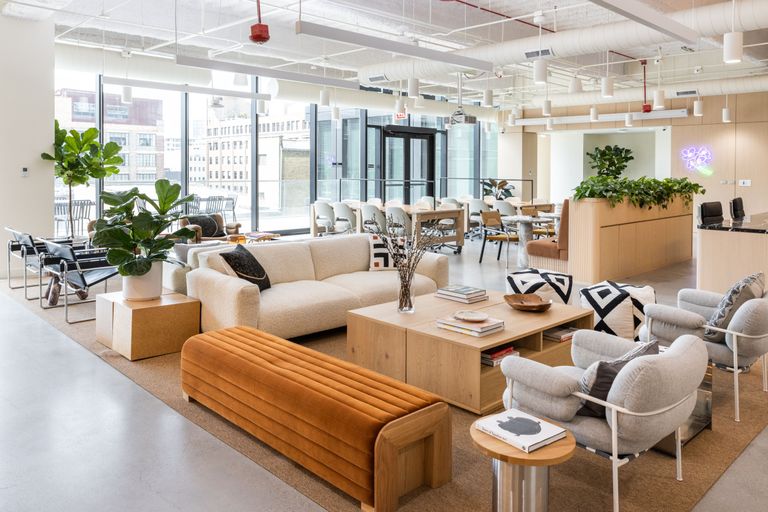
While the office market continues to redefine itself amid ongoing business and economic shifts, from return-to-office policies and evolving headcounts to persistent inflationary pressures, one type of space has emerged as a solution to many of these challenges: flex space.
Flexible offices have become a key part of modern workplace strategies, with 55% of global occupiers utilizing flexible office solutions in 2025.
The continued growth of artificial intelligence is expected to further drive this demand, as flexible offices give companies the ability to adapt to the changes that AI could bring to their workforce.
“Everybody needs flexibility because headcounts are always in flux,” said WeWork Regional President for North America Luke Robinson. “We've seen clients that did not include any flex as a part of their portfolio prior to the pandemic now having it account for 10% or 15%. Now, flexibility is a necessity for everybody.”
WeWork has always been a major part of the flex space conversation, and it is continuously innovating and evolving its offerings to meet this rising demand.
Robinson said that in the past few years, WeWork’s enterprise spaces — custom, turnkey office spaces for large teams and companies — have reached 90% occupancy across the United States and Canada. The company needed to find new ways to continue to meet the needs of enterprise customers with availability shrinking. Enter WeWork’s Managed Solutions offering.
Through the Managed Solutions offering, companies can come to WeWork with their specific requirements, from the amount of space they need to the neighborhood they want to be in, and WeWork will do the job of sourcing the workspace that meets their exact needs.
WeWork handles the entire process, from arranging tours of the space and negotiating pricing to executing the agreement. Rather than requiring a traditional, complex lease, WeWork provides the client with a simple, streamlined membership agreement designed to facilitate the transaction. From there, WeWork leads the design-build process, creating and constructing the space to meet the company’s needs and standards. This includes determining the space configuration, the number of private offices and meeting rooms, and the incorporation of personalized branding.
“We start by understanding how each client operates and what their space needs to achieve,” Robinson said. “What kind of space do they need, and how should it be designed to support the way they work? How much space do they need, for how long and on what timeline? With that knowledge, we create an entire, tailored solution built around their unique requirements.”
Once the location is ready, WeWork will take over operations, bringing in its community team, the company’s in-house hospitality staffers, to deliver the type of white-glove experience members expect from WeWork at every location.
One of WeWork’s main differentiators has always been its operations teams and how it manages and curates WeWork offices, Robinson said. WeWork teams are fully integrated into the space, offering technical support, hosting events and providing companies with whatever they need. Though WeWork provides outsized support, each location remains incredibly integrated with the company it serves. The spaces are designed and branded to match the firm that is leasing it, with company logos, colors and anything else it requests, Robinson said.
The membership agreements WeWork draws up for these properties typically run anywhere from two to five years, as opposed to a traditional 10- or 15-year lease. This gives companies the flexibility they need to scale up or down, without the risk of needing to break a long lease, Robinson said.
“It’s hard to know what your company will look like in 10 years,” he said. “I’ve seen companies sign long-term leases for space that no longer meets their needs after just a year or so. They then come to us for additional flex space because our solutions are adaptable and can adjust to their changing business needs. It’s much easier to estimate what your headcount will be for the next two years, and commit to a space for that length of time.”
Demand for the Managed Solutions product has been very strong, Robinson said. As the flexible office market continues to pick up, he expects the demand will continue to grow, especially in the age of AI and the impact it could have on companies’ hiring and space decisions.
“The AI boom has brought with it some uncertainty for companies about what the future may look like,” he said. “As companies adjust, they will need more options, and we’ve been lucky enough to partner with great landlords to provide our clients the solutions they need.”
This article was produced in collaboration between WeWork and Studio B. Bisnow news staff was not involved in the production of this content.
Studio B is Bisnow’s in-house content and design studio. To learn more about how Studio B can help your team, reach out to studio@bisnow.com.