Hospitals across greater Philadelphia face a challenging operating environment, and with federal support expected to dry up, executives are looking to the ancillary businesses they work with for help.
Architecture and construction firms that depend on these projects can do more to help keep capital budgets in check as healthcare systems respond to sustained patient demand, CEOs from across the region said Tuesday at Bisnow’s Pennsylvania Healthcare Real Estate Summit, held at the Crystal Tea Room in Philadelphia.
“You’ve got to help us in our ecosystem,” University of Pennsylvania Health System CEO Kevin Mahoney said. “Get on our team. We’re getting paid less.”
The Children’s Hospital of Philadelphia is spending nearly $2.6B to build a new patient tower in West Philadelphia, CEO Joseph Mitchell said. The 20-story building is due in 2028.
While he is proud of the project, Mitchell said the institution can’t afford to keep spending like this in the current climate.
“That’s just unaffordable in the long term,” he said.
“Partner with your clients to find ways to reduce these costs. It’s a two-way street.”
Hospitals' already strained operating margins are facing more issues from federal spending cuts that lead to an increase in uncompensated care.
Last year's One Big Beautiful Bill Act included a $1T cut to Medicaid through 2034, which is expected to cause more than 10 million Americans to lose their health insurance coverage over that period.
This is a particularly grave issue for cash-strapped rural hospitals. More than 100 have shuttered over the past decade, and another 700 are at risk of closing, according to a July report from the Center for Healthcare Quality and Payment Reform.
Hospitals face additional economic challenges when looking to build new facilities. Construction costs across Eastern Pennsylvania were up 2.2% month-over-month and 11.2% year-over-year in September, according to a report from the local branch of Associated Builders and Contractors.
Mitchell acknowledged that construction costs are ballooning across the U.S. and that health systems sometimes don’t pick the cheapest ways to do projects.
For example, CHOP has opted to utilize union labor on the tower. Last-minute changes to hospital projects that are commonplace in the industry also add extra costs, Mitchell said.
But ultimately, the executive said something has to break: “Can we find ways to limit astronomical growth in capital spending?”

Mahoney suggested that less traditional construction techniques could be part of the solution.
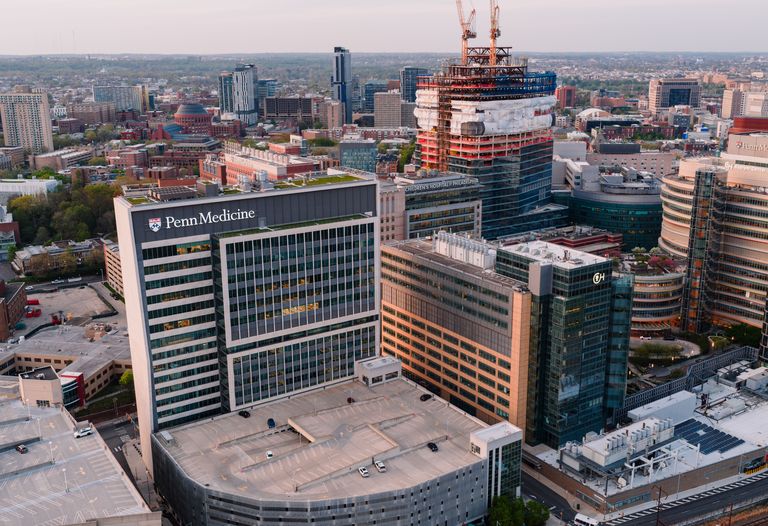
He said Penn Medicine’s 17-story, 504-bed Pavilion came online in West Philly in 2021 after the system spent $1.6B.
The project was 30% modular, Mahoney said. He thought projects should be closer to 70% prefabricated as a way to rein in construction budgets.
Penn Medicine signed a 40K SF lease for its first Delaware location in February. The space in suburban Wilmington will be focused on primary care and some specialty services.
Artificial intelligence is just as hot a topic in the design and building world as anywhere else, but Cooper University Health Care CEO Anthony Mazzarelli said healthcare systems aren't seeing the technology create shorter construction timelines or anything else that would save them money.
“That's how long that took two years ago. You just told me you're using all this AI stuff. How are you passing on that efficiency to us?” he said.
“We're the one throat to choke from the government when it comes to spending, but it's also going to hurt everybody else.”
Earlier at Tuesday's event, a different panel was asked about unconventional techniques that could be used to expedite projects. CHOP Assistant Vice President of Facilities Project Management and Construction Brian Gardner floated organizationwide standardized construction plans.
While designing and coming to a consensus on those plans can be an arduous process, he said the work pays off down the line and is one of the few meaningful levers healthcare systems can pull to shorten construction timelines.
"Standardization is probably one of the low-hanging fruits that organizations can work through because decisions come quicker,” Gardner said.
The CEOs’ pleas for cost savings come as regional hospital system players expect higher construction prices in Pennsylvania amid the data center boom.
Many of the contractors and suppliers that hospital systems depend on have been focused on getting a piece of the artificial intelligence data center boom, a trend that is already making it harder to build healthcare projects in other markets, like Houston.
“We’re already seeing it with the data centers, believe it or not,” Guthrie Senior Vice President Joseph Sawyer said.
He recalled being given a yearlong lead time for critical components such as generators and air handlers. Increased competition for construction workers is also straining construction budgets.
“How do we address, when we’re trying to do pro formas nationally, the impact of 50% labor increases because we can’t find enough qualified labor?” Limbach Vice President Jay Levin said.
KQT Health owner Todd Strine said he believes there is no end in sight and that it would behoove health systems to expedite their construction decision-making.
“Prices are going to go way up,” he said. “If you’re going to make a large decision, I think it’s better to do it sooner than later.”
See more photos from Tuesday's event below.