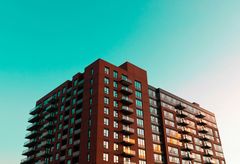
Miami's multifamily market has risen so high so fast, it seems like there’s nowhere else for it to go (besides down). Not so, according to the speakers at Bisnow’s Miami Multifamily Summit on Nov. 18, beginning at 7:30am at the Hyatt Regency.
13th Floor Investments managing principal Arnaud Karsenti tell us that South Florida has become a global destination among the private and institutional real estate investment communities. The days of low-hanging multifamily fruit from the past distressed cycle seem long gone, but opportunities to find and create value still exist. In many cases, that value has to be unlocked through the workout or development process, but it’s there for the taking by savvy investors and operators. Arnaud’s snapped with Suzanne Amaducci-Adams at a previous Bisnow event.
The dollar has been strong lately, theoretically making US properties more expensive for overseas buyers. Hunt Mortgage Group SVP Marc Suarez, who will also speak at the event, tells us that the dollar is always a factor, but because real estate at minimum is a three-to-five year hold, it's tough to pencil exit value on an acquisition based on the dollar. Foreign investors like South Florida because it's still less expensive and a "bigger bang for your buck regardless of exchange rates, compared to similar opportunities in other markets,” Marc explains.
Timing is a more important factor than the vagaries of dollar or other currencies (such as the Brazilian real), Marc adds. Pricing is being pushed in the direction where at some point, value may not exist anymore in South Florida, he says. Investors realize that, and that's why Miami and South Florida continue to attract foreign capital regardless of exchange rates and dollar value.
Grass River Property principal Chris Cobb, another speaker, tells us that everything east of I-95 is ripe for infill development. He points out that the history of development in Miami started at the water's edge (late 19th century), moved inland (to the west) for 100 years until it hit the Everglades, and then in the 21st century, development started moving back toward the sea. While vacant land can be found almost anywhere, the vast majority of the buildable land in Miami-Dade County has already had something built on it. Many of these one- and two-story buildings will need to come down to make way for larger buildings.
Chris also says that a main challenge for the region remains transportation infrastructure. “While we have a complete network of roadways, most are only two lanes, and all result in vehicle congestion in the town and city centers,” he says. Metrorail, People Mover and Tri-Rail, can only do so much. Chris says South Florida needs more trolleys and buses, bicycles and sidewalks. “The next 100 years is going to see four times more development east of I-95 than west of I-95,” he predicts. Sign up for our Miami Multifamily Summit here.