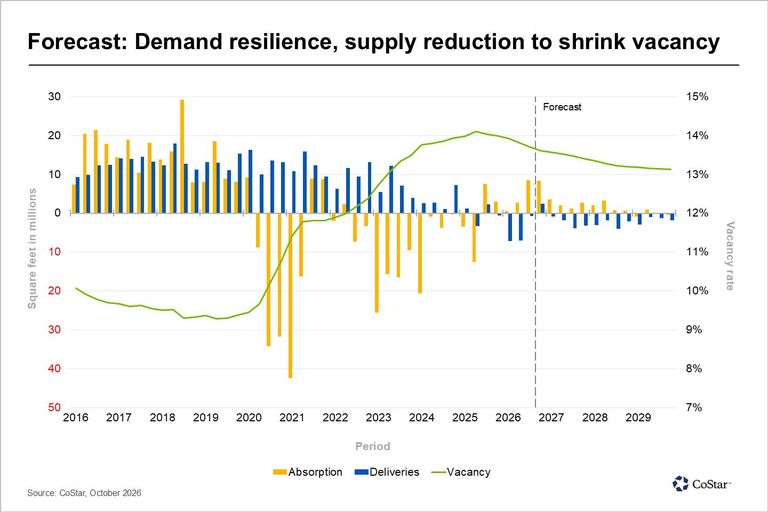
American office buildings are filling up faster than previously predicted, with a lack of new construction expected to drive vacancy lower through the next year.

CoStar Group revised its office predictions through the end of next year to reflect rising demand for increasingly hard-to-find high-quality space. The ubiquitous online real estate marketplace now expects lower vacancy rates due in large part to an all-but-dead construction pipeline.
“The latest forecast calls for a continuation of the slow-but-steady revival, with an ongoing supply-side adjustment offsetting historically weak office demand growth,” Phil Mobley, national director of office analytics at CoStar Group, said in a statement.
CoStar projects absorption to be around 20M SF in 2026 and 9M SF in 2027, up from 13M SF and 5M SF, respectively, from its previous forecast released in August. Office vacancy is expected to end the year around 13.6%, just below the previous 13.7% forecast.
High-quality properties will continue to drive pricing higher, with CoStar predicting asking rents will climb 2.5% in each of the next few quarters before rising closer to 3% annually.
The upward revision to the rent forecast was more to do with a shift in inventory accounting than an expected boost in activity.
“The upgraded projection for office rent growth has less to do with the overall reduction in supply caused by the removal of non-competitive space and more to do with the dramatic slowdown in new construction,” Mobley said.
The office market has continued to rebound from pandemic-era lows, driven by demand from tech firms and the more general push from tenants into high-quality spaces. Leasing activity totaled 63.8M SF in the third quarter, up 4% from last year and on track to exceed a 2022 record, according to CBRE.
Absorption was positive for the 10th consecutive quarter at just under 5M SF at the end of September, with the construction pipeline a paltry 1.5M SF, down 76% from the prior year. Rent growth is accelerating at its fastest pace since 2016, according to CBRE.
Analysts at CoStar said the risks on either side of its forecast seemed roughly in balance in terms of probability, but with larger downside risks in terms of size.
“Persistent inflation and higher interest rates could slow economic growth further and precipitate additional business cost-cutting even in an environment of continued economic expansion,” Mobley said. “Furthermore, the recent productivity gains evident in knowledge work could accelerate with further adoption of artificial intelligence, resulting in lower demand for some types of knowledge workers.”