
To encourage people back to the workplace, a global property owner installed a gym in a high-rise office building. As soon as it opened, the vibrations caused by exercise equipment rendered the floor below completely unusable.
This has become a common scenario, CALMFLOOR Chief Operating Officer Steven Senior said. Not only are gyms and other dynamic uses of space increasing vibrations in existing buildings, but it has become clearer how detrimental the impact of vibrations can be on productivity.
Property owners have been looking for an alternative to the traditional solution of adding more steel and concrete into a building to dampen vibration. Today, CALMFLOOR’s active vibration control technology can provide an instant solution, Senior said.
“Asset owners can either spend millions on structural modifications or plug in our out-of-the-box active mass dampers and use the building within a matter of hours,” he said. “Not only can we save huge costs, but we negate any additional requirement for steel and concrete. Technology is the innovative answer to building design that construction has been crying out for.”
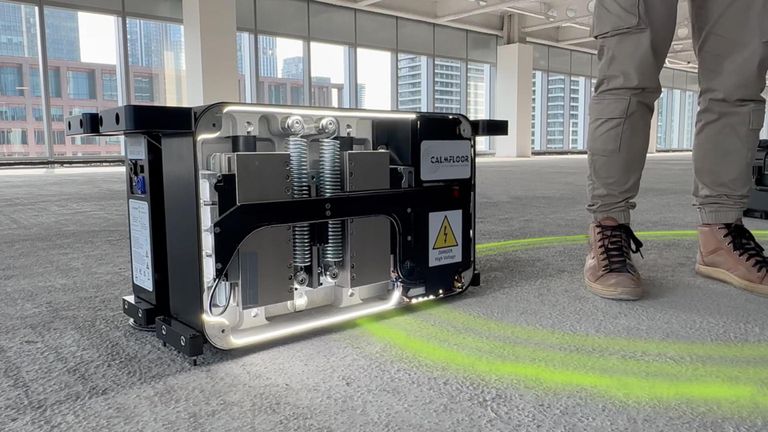
CALMFLOOR’s solution works like noise-canceling headphones. A unit is installed discreetly either under the floor or on a beam or soffit, which then creates vibrations that counteract all unwanted vibrations in the building’s structure. The solution continuously monitors all vibration frequencies in the floor and reduces them by up to 90%, Senior said.
This technology tackles two challenges facing real estate: how to make existing properties fit for today’s use and how to design lighter, more efficient buildings. It was born from technology developed at the University of Exeter in the UK and has taken years of refinement, Senior said.
“Customers have been astonished by the results,” he said. “Engineers can be skeptical about whether a 150-pound active mass damper can really control the whole floor, but this is why we offer a try-before-you-buy option. We can literally turn up at a property with two units in the trunk of a car and within an hour show the impact we can have.”
The success of CALMFLOOR’s solution has led to a U.S. expansion for the UK-based company, which will open its first sales office in New York in April. In the fourth quarter, the company will convert a convertible loan note of $10M, largely committed by a U.S. investor.
“We're really excited about our U.S. launch, as we're already experiencing huge demand from many organizations based there,” Senior said. “We'll be able to build on our success and support the agents and resellers there that are already driving our growth.”
There is an increasing need to reduce vibrations across property asset classes, Senior said. The growing life sciences sector is fueling office-to-lab conversions, but existing offices weren’t built with the tolerances acceptable to use sensitive lab equipment.
“Hospitals similarly need to reduce vibrations that were acceptable when they were constructed,” he said. “Today’s imaging equipment is far more accurate, but also more sensitive to vibrations. However, it is too costly to redevelop a hospital or install weighty damping products.”
While CALMFLOOR was founded to tackle the challenge of vibrations in existing buildings, the technology can revolutionize how new buildings are designed, Senior said. Architects and engineers are under pressure to design lighter properties to keep costs down and minimize embodied carbon while reducing vibrations.
“Our product could save 30% of the steel in a building’s frame while making it perform better,” he said. “Lighter floors means lighter foundations are needed, which brings huge savings. This is simply by building in technology from the beginning.”
Technology will allow developers to explore other methods of construction, such as greater use of timber, which is generally considered to be more sustainable, Senior said. This is exactly the research and development the construction industry needs to meet today’s building standards and the challenge of reducing raw material use, he said.
This article was produced in collaboration between CALMFLOOR and Studio B. Bisnow news staff was not involved in the production of this content.
Studio B is Bisnow’s in-house content and design studio. To learn more about how Studio B can help your team, reach out to studio@bisnow.com.