Strong performance from JLL’s leasing and capital markets businesses helped the company record strong revenue growth in the third quarter and beat analyst estimates, it announced Wednesday.
The brokerage blew past analysts’ consensus earnings estimates, and its stock surged following the Q3 earnings results, up about 12% as of Wednesday afternoon.
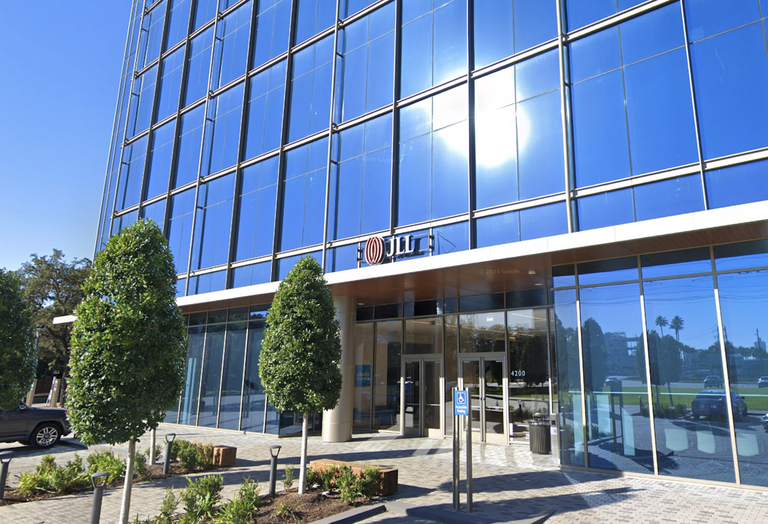
JLL CEO Christian Ulbrich downplayed the impact of elevated interest rates on the company’s capital markets business during its third-quarter earnings call, pointing to a strong deal pipeline and his confidence that deals will close on planned timelines. Ulbrich said rates are just one component of capital cost, and property income and rent growth projections can have a far bigger impact on deals than higher debt financing costs.
“While bond yields have risen sharply, the interest rate outlook has been well telegraphed and is working through the market in a measured way,” Ulbrich said on the call with analysts Wednesday morning. “Investors are recalibrating their underwriting to adjust for higher borrowing costs and tighter credit structure.”
Adjusted earnings per share was up 50% year-over-year to $6.76, beating the consensus analyst estimate of $6.15. JLL announced it intends to execute a new $500M accelerated share repurchase imminently, bringing full-year repurchases to more than $1B.
JLL’s revenue was up 12% in Q3 to $7.3B. Leasing advisory growth was up 27% to $941M, led by U.S. growth in industrial, office and data centers, while capital markets services was up 21% to $736M.
“This was a good print, in our view, especially considering the concerns/fears surrounding capital markets (interest rate implications) and leasing (tough comps),” analysts from JPMorgan Chase wrote in a note. “On both fronts, we think JLL provided some comfort with a generally positive tone on where the business stands and its own market share gains and margin expansion.”
Ulbrich said very few of the company’s capital markets deals “are actually collapsing,” and not many deals are being renegotiated. He said JLL’s capital markets segment is still a very healthy business, especially in the U.S.
“The pipeline in itself is actually still growing,” Ulbrich said. “What is happening is that deal time to close is getting a bit longer. It's more intense price negotiations.”
On the leasing front, Chief Financial Officer Kelly Howe said the company is seeing an increase in transaction volume and deal sizes across asset classes.
In office, JLL’s U.S. clients in the technology and artificial intelligence industries are looking for large swaths of space, she said. Additionally, growth rates in gateway markets have been significantly higher than in nongateway markets, leading to larger office deal sizes. On the industrial side, some of the brokerage’s clients are looking for larger blocks of high-end warehouse space, contributing to deal growth.
Data center leasing can be “a bit lumpy” from quarter to quarter, Howe said, but in Q3, the asset class contributed 5% to total leasing revenue.
“We feel good about the underlying drivers of our leasing business,” Howe said. “We think we've got momentum going into the fourth quarter.”
JLL’s capital markets revenue was up about 21% through the first three quarters, but the company’s full-year guidance projects revenue in the midteens, with implied fourth-quarter growth flat up to low single digits.
Howe and Ulbrich said tough Q4 2025 comps were the driver behind its forecast. The company’s capital markets business brought in $854M during the fourth quarter last year.
Ulbrich said the company still has a lot of confidence that most of its capital markets deals planned for Q4 will close then and that not many will fall into 2027.
“The question around the increase in interest rates is something which makes it a bit more unpredictable,” Ulbrich said. “Our forecast is probably a bit on the cautious side.”
Ultimately, rate predictability is more important for markets than the actual yields, Ulbrich said. If volatility declines and the rate environment becomes more predictable, then capital markets will “immediately” start to increase transaction volumes, he said.
“Volatility is worse than the absolute level we are on,” Ulbrich said. “People can live with 5% interest rates. We had many, many years where we had to live with that type of interest levels, and we would have said at the time that's fairly low. Now we have to get used to those types of levels again.”