The Washington Commanders have selected a trio of builders to construct their 65,000-seat football stadium planned along D.C.’s Anacostia River.
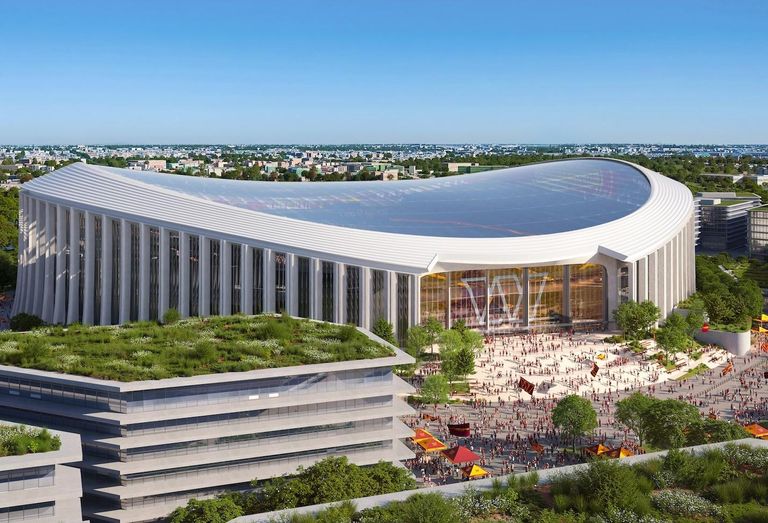
A joint venture between Clark Construction Group, Mortenson and Smoot Construction Co. is set to build the stadium anchoring the 180-acre RFK campus, the team announced Tuesday. Construction on the 1.8M SF stadium is expected to begin in the spring of 2027, with completion targeted for spring 2030. Preliminary site work began in June.
D.C.'s professional football team is returning to the RFK campus more than three decades after it left the city in 1997 to play in Landover, Maryland. The Commanders are putting $2.7B into constructing the new stadium, and D.C. is contributing $1.1B for adjacent infrastructure and a sports complex.
Selecting the joint venture “was about finding a team with the experience, local commitment, and shared vision necessary to deliver one of the most important projects in our franchise's history,” Matt Haas, the Commanders’ head of construction, said in a press release.
“Their combined experience building some of the most iconic venues in professional sports, together with their strong presence in the DC region and commitment to community impact, made them the clear choice for this transformational project,” he added.
Clark and Smoot, along with Hunt Construction, were the construction team behind Nationals Park. The 41,000-seat Navy Yard baseball stadium was built between 2006 and 2008. Clark is also revamping Monumental Sports & Entertainment’s Capital One Arena downtown, expected to deliver in 2027.
Mortenson is in the midst of building out the Continental Coliseum, an NBA stadium in Oklahoma City, as well as the Denver Summit FC Stadium in Colorado and the Athletics' ballpark in Las Vegas.
“With this decision, we’re one step closer to transforming 180 acres of land on the banks of the Anacostia into a Super Bowl-ready stadium, and then housing, entertainment, park space, and more,” D.C. Mayor Muriel Bowser said in a statement.
Clark Construction is also behind the $400M White House ballroom project. A federal appeals court halted construction on the 90K SF project late last week.
In January, the Commanders and their architect, HKS, released renderings of the domed stadium encased in classical-style white pillars. In June, D.C. released a draft master plan for the rest of the 180-acre site, which is envisioned to include six distinct districts and between 5,000 and 6,500 homes, as well as hotel and retail uses, sports fields, parks and parking.
D.C. Director of Planning Anita Cozart told Bisnow at the time that her office expects to submit a revised master plan to the D.C. Council in early fall and hopes the body will approve it by the end of the year.