Building housing is a challenge for developers nationwide. But in the data center capital of the world, the cost of land is just one more hurdle.
Loudoun County is considering new opportunities to deploy public lands to help developers build more housing, specifically for lower incomes. Those kinds of public-private partnerships that take the land out of the cost equation can go a long way in making projects viable, panelists said last week at Bisnow’s Loudoun County State of the Market event.
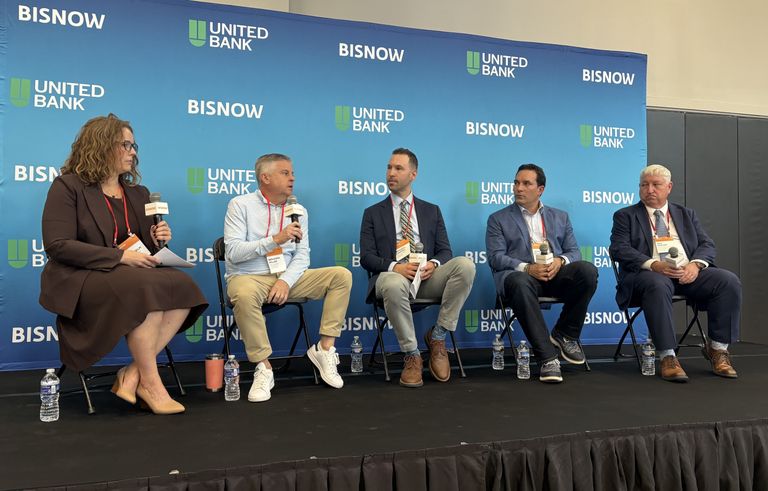
“If you look at the capital stack, at the end of the day, you’ve got to make it pencil,” Ben Miller, a principal at Virginia-based affordable housing developer Wellington Community Partners, said onstage at the event, held at Loudoun Station in Ashburn. “But to not have to worry about paying for land is a huge chunk of the capital stack.”
The challenge for developers like Miller's firm is that in a region where data center sites are going for around $4M per acre, it's much more profitable to sell land to tech giants than any other asset class.
That dynamic may soon change. The Loudoun County Board of Supervisors is slated to vote this month on a resolution that would pause legislative data center applications for up to 12 months. But for now, the high-value sales are continuing.
“I can't blame the owners for selling to the data centers,” Rappaport Senior Director of Leasing and Brokerage Greg Hull said. “You seeing what they're offering? I would do the same thing.”
But if the land is publicly owned and provided to them at little or no cost, non-data center developers can get a leg up. The county is looking to do just that to spur more housing for lower-income households.
“To get to the zero to 30[%] and the below 50[%], you know, really serve the different levels and the needs within the county, when we put land into the deal that doesn't have to be paid for, that helps things cancel a lot better, so that's what we're really looking for when we can use county land,” Eric Keeler, director of Loudoun County’s Department of Housing and Community Development, said onstage.
In January, Loudoun created an interactive map showing the parcels owned and leased by the county and its public school system. The county owns 256 parcels, equating to 5,248 acres of land, and the school system owns 114 parcels, or 3,214 acres.
At the time, Keeler and one of his colleagues presented data to Loudoun’s Transportation and Land Use subcommittee showing that 174 of the county-owned sites would be potentially suitable for development, as would 25 of the sites owned by Loudoun County Public Schools. They also presented at a joint meeting of the county board of supervisors and school board in September.
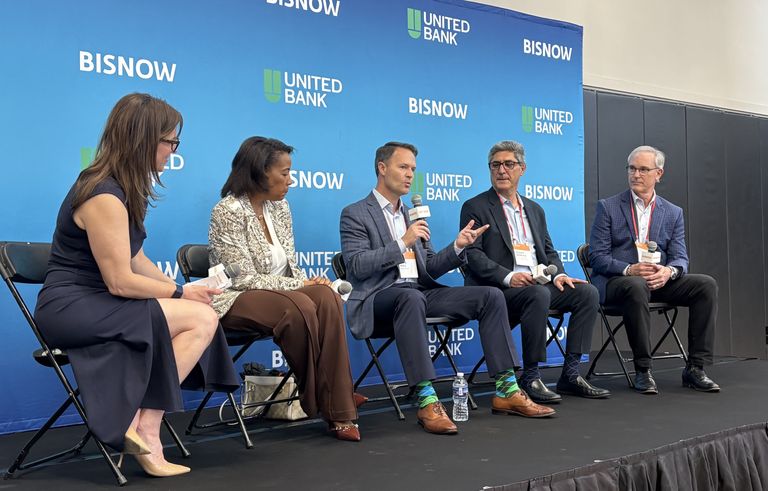
At Thursday's event, Keeler said developers have been using the dashboard as a resource and coming to the county to talk about opportunities.
“We have a division now within the county that actually oversees all of that component,” he said.
Miller said his firm is involved in some of those discussions with the county. But free land isn’t a cure-all.
“Sometimes I get frustrated when I'm not getting building permits, and I'm like, 'But you guys are part of this deal. Why can't I get permits?'" Miller said.
Miller's firm is already working on one such project. It's set to break ground on the redevelopment of the old Arcola Elementary School in Sterling early next year, with plans to rehabilitate the school and build 73 affordable units on the site. The developer and its partner, Cornerstones, also got a $4.9M loan from Loudoun County for the project.
Arcola was the first multiclassroom school in the county but was sitting dormant and dilapidated, Miller said. “So for the county, it was a win-win.”
Keeler spoke about some other county-owned sites that Loudoun is considering for affordable development uses. A joint venture between Enterprise Development and LT Development Group plans to build 140 multifamily and townhouse units at a county-owned commuter lot in Ashburn. Separately, county discussions are underway to redevelop the Cascades Library and Senior Center in Sterling into senior and family attainable housing.
“We are at a tipping point where we need to also make sure that we are not just relying on the development community and we got to go find those parcels out there,” Keeler said. “And that's why we put in the county land and the school land.”