Private real estate values have yet to catch up following the recent increase in interest rates, creating a discrepancy that could prompt investors to shift their attention to publicly traded landlords.
Rising interest rates generally lead to higher capitalization rates, but there is presently a disconnect between private cap rate appraisals and market reality, analysts said at Nareit’s annual REITworld conference this week, held in Downtown Atlanta.
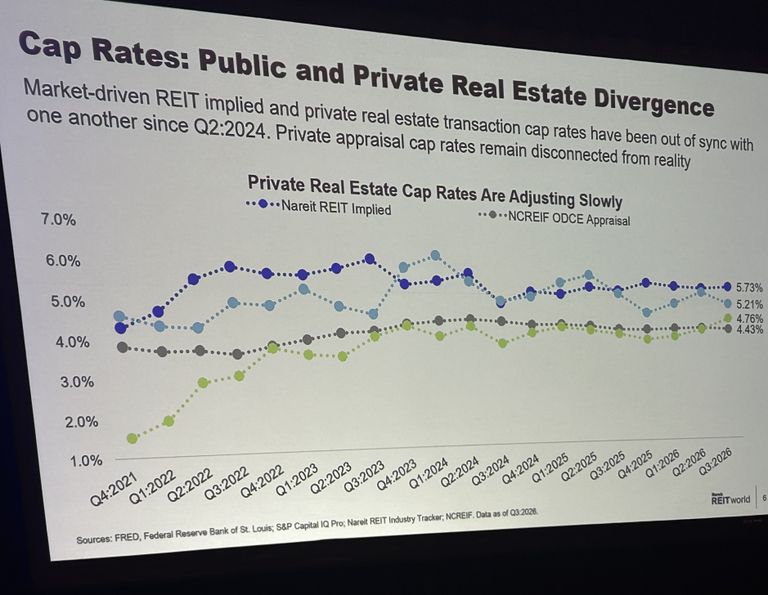
For the first time since at least 2022, private appraisal cap rates have slipped below the 10-year Treasury rate, according to data compiled by Nareit and presented at the conference.
In the third quarter, Nareit’s implied REIT cap rate — which only captures public REITS — averaged 5.7%. An index tracking private appraisal cap rates, from the National Council of Real Estate Investment Fiduciaries, averaged 4.4%. During the same quarter, the 10-year Treasury rate averaged 4.8%, according to the Nareit presentation.
Some analysts said the gap suggests that private real estate funds are opting to wait before repricing their properties, as opposed to share prices of REITs, which respond in real time to market sentiment.
“We kind of assume that [private equity] were hopeful that the market would come to them, that rates would drop, and that they wouldn’t have to mark their assets to market anymore,” Edward Pierzak, Nareit senior vice president of research, said onstage on Tuesday.
Not marking a portfolio to the current market “impedes the price discovery process, limits transaction liquidity, and hampers investors’ abilities to redeem capital,” Pierzak said in a follow-up email to Bisnow on Wednesday.
“Yet history shows that these valuation divergences always converge, and when that happens, REITs outperform private real estate,” he said.
The divergence between Treasury yields and private equity cap rates began in 2022 when the Federal Reserve first began raising interest rates. Private equity has adjusted its cap rates slowly since then, Pierzak said. But now, with the rate hike in September and a December hike all but certain, the pressure is on to ensure their appraisals are up to date.
“When you look at not only at the end of the third quarter, but you look today, the 10-year Treasury is actually quite a bit higher than that private appraisal cap rate,” Pierzak said.
In the third quarter, the 10-year Treasury yield spiked about 85 basis points, pushing the average REIT cap rate up 40 basis points, equating to a roughly 7% value loss, according to a November study by CenterSquare.
Steve Sakwa, senior managing director for New York-based Evercore, said his firm estimates that cap rates among private market players are likely 25 to 50 basis points higher than their appraisal, depending on the property type. That difference may present an opportunity for some REITs to sell their assets to private equity players to pay down their own debt or buy stock back to increase share price value, he said.
“If you look at where the private market is, there’s still a decent disconnect,” Sakwa said during a separate panel on Tuesday.

Fluctuating Treasury bond yields and elevated inflation are putting pressure on borrowers and debt markets and stifling deal activity. REIT stocks are trading closer to their underlying asset values than they have in several years, leaving the sector in an M&A holding pattern, Bisnow reported last month.
But public REITs overall have been performing better than they have in years.
U.S. equity REITs have generated an average 16.2% return so far this year, their best performance since 2021 and nearly doubling the S&P 500, according to an FTSE Nareit Real Estate Index report. REIT total returns were just 2.9% in 2025 and 8.7% in 2024, compared to 18% and 25% for the S&P 500 in the same years, according to the report.
REITs have benefited from investors’ pivot away from technology stocks, Sakwa said.
“When money comes out of a very crowded trade, it goes into the rest of the market,” he said. “There's a real flow of money that's coming out of tech.”
High valuation expectations in the broader market are luring investors to REITs, said Jiyang Zhang, a portfolio manager for Cohen & Steers Capital Management.
“Part of the benefit is we have underperformed for a number of years as an asset class. Valuation is really cheap, and the bar is really low,” Zhang said. “So there's more things that can go right than wrong in our asset class.”