Jensen Huang resigned as Nvidia’s CEO Thursday, removing the dealmaker who turned the world’s leading artificial intelligence chipmaker into one of the global data center industry’s most consequential tenants, lease guarantors and financiers.
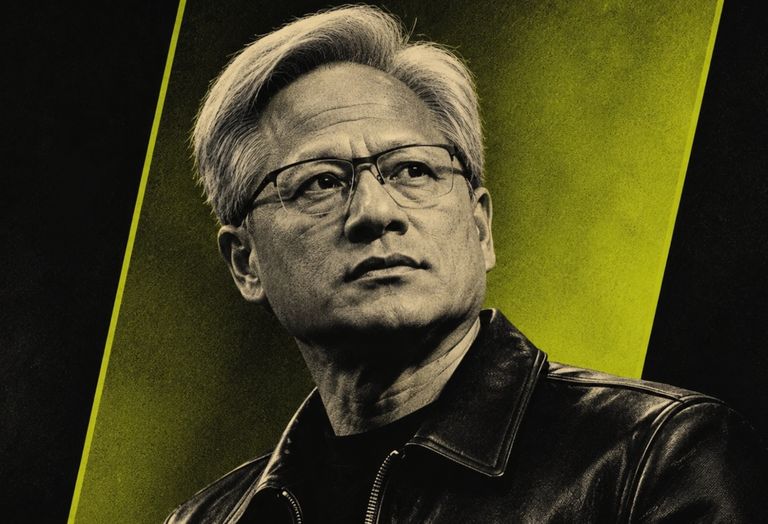
Huang also left Nvidia’s board, effective immediately. His exit came after reports that he had liaisons with a former executive of Singapore data center firm Megaspeed, whom U.S. intelligence suspects of spying for China, and with an Nvidia executive who reported to him. He also allegedly had a relationship with a second Nvidia employee, Reuters reported Thursday afternoon.
Huang co-founded Nvidia in 1993 and ran it for all 33 years. Longtime Chief Financial Officer Colette Kress is now interim CEO, according to a securities filing that gives no reason for his departure.
Huang sold AI as the 21st century’s industrial revolution, with data centers as its factories. McKinsey estimates investors will need to spend $6.7T on data centers globally by 2030 to keep up with demand for computing power. Nvidia’s chips are the costliest piece of that spending and helped turn data centers from a niche property type into a mainstream institutional asset class.
For commercial real estate, the immediate question is what becomes of the commitments Huang made, from up to $108.5B in lease guarantees to stakes in power developers and data center platforms.
Huang personally marketed the build-out to heads of state from the Persian Gulf to London to the Oval Office, and in August, Nvidia struck a deal with Apollo, BlackRock, Blackstone, Brookfield, Goldman Sachs and KKR, agreeing to deploy at least $500B in financing for the development of AI infrastructure.
Shares tumbled about 14% in early trading on Thursday, erasing roughly $590B in value and pushing Nvidia below $4T for the first time since 2025.
The shock lands on a sector that was already recalibrating. After three straight years at No. 1, data centers lost the top spot in ULI’s 2027 outlook, one of commercial real estate’s most closely scrutinized annual reads on where investors plan to park their money.
American voters rejected data centers in nearly every local measure on last week’s midterm ballots. And with Democrats assuming control of the Senate in January, the prospect of tougher scrutiny from Washington has already rippled into commercial real estate’s hottest asset class.
Six things will show how much of Nvidia’s role in CRE survives Huang.
1. Nvidia Still Owes What It Signed
Nvidia has promised to cover up to $108.5B in data center leases if certain tenants can’t pay. About $3.5B of that backs smaller AI cloud companies, while the rest, up to $105B, backs OpenAI's planned campus at SB Energy’s Ports-Pike site in southern Ohio, which has been billed as the world's largest AI data center.
The Ohio guarantee kicks in only if OpenAI defaults and SB Energy can’t re-lease or sell the buildings at full value, and OpenAI has agreed to pay Nvidia back for anything it covers. The first buildings aren’t due until 2028, and these are signed contracts that won’t disappear just because the CEO did.
Those guarantees are only as strong as Nvidia’s credit, and the market is starting to test it. The cost of insuring Nvidia’s debt against default has roughly tripled since midsummer and hit a near record Thursday, Bloomberg reported. Even so, it remains about half what investors pay to insure Oracle’s debt, a sign the market still sees Nvidia as a strong credit.
The bigger risk for CRE may be contagion. LightBox Head of Data Strategy Manus Clancy, who named AI his biggest potential black swan for 2027 on a webinar last week, warned that a credit scare in the sector would pull real estate with it. If spreads on data center and tech debt blow out, “mark our words that CMBS and risk premiums will widen too,” he said.
2. The Tenants Nvidia Propped Up Are Feeling It
AI cloud companies like CoreWeave and Nebius, which rent out computing power and have signed many of the industry's biggest new leases, fell hardest Thursday. CoreWeave dropped 13.6% in early trading, while Nebius fell 20%, partly on its own guidance.
Few are more tied to Nvidia than CoreWeave. Nvidia is its second-largest shareholder and has agreed to buy up to $6.3B of computing capacity CoreWeave can’t sell through April 2032. Nvidia also reportedly became the official tenant for a Texas campus built by Hut 8 and operated by another AI cloud company it is backing, Lambda, giving the developer the investment-grade lease it needed to borrow. Nvidia’s appetite for backing companies like these may not survive Huang.
3. The 'Bank Of Nvidia' May Close
Nvidia has become one of the AI boom’s biggest investors, holding $99B in stakes in other companies as of July, with another $25B promised, a record that earned it the Wall Street nickname “the bank of Nvidia.”
Its biggest deal is the $500B Wall Street agreement, and when bond investors got nervous about it, Huang personally talked them down. Those deals are still preliminary, though, and Nvidia’s own filing warns they may never be finalized. Huang’s big numbers have shrunk before. Months after Nvidia unveiled plans to invest up to $100B in OpenAI, he said the figure “was never a commitment.”
Baird’s Ted Mortonson told MarketWatch that Nvidia’s commitments will now be treated as potential liabilities, and the person now in charge may already agree. Kress disagreed with Huang over some of Nvidia’s riskiest bets and worried about the financial risk, The Information reported Thursday.
4. Nvidia Moved Into The Dirt
Over the past year, Nvidia stopped just selling chips to data centers and started helping build them. It bought into Cloverleaf, which lines up utility power for developers, put $1.5B into SB Energy as part of the Ohio deal, and reportedly committed up to $3B to Lancium, the power developer behind OpenAI’s flagship Stargate campus in Abilene, Texas.
It also teamed with Corning on three U.S. fiber plants, tested small data centers with homebuilder PulteGroup and joined KKR’s $10B Helix platform. Its answer to the local backlash against new data centers is a plan to retrofit old telephone buildings owned by Apollo, The Information reported last week.
Developers counting on Nvidia money may soon find out whether Huang’s successor shares his taste for land and power.
5. Washington Is Coming For The Buildings
This scandal started inside a data center. In late 2024, a Commerce Department official found Nvidia chips still in their boxes at one of Megaspeed's Malaysian facilities, The New York Times reported. Commerce later halted its probe, and the Justice Department took over with a criminal inquiry, according to the Times. Separately, companies tied to Alice Huang, the former Megaspeed executive, invested in Chinese AI lab DeepSeek and promised it Nvidia chips, The Information reported.
Sens. Elizabeth Warren and Chris Coons asked the administration Wednesday to preserve all records of Nvidia’s chip exports to China, and the White House was already drafting a ban on Chinese data center components. For data center owners, whose chips sit inside a building and where they end up may soon matter as much as how much power it has.
6. Tuesday Is The First Real Test
Nvidia reports quarterly results Tuesday in its first earnings call without Jensen Huang, and investors will be listening for whether data center demand is holding up. Meanwhile, the board has hired an outside firm to find a permanent CEO, Bloomberg reported, and MarketWatch named Kress and Ian Buck, who runs Nvidia's hyperscale and high-performance computing business, as the leading internal candidates.
The biggest renters of data center space, including Microsoft, Amazon and Meta, don’t answer to Nvidia’s board, and even Bernstein’s Stacy Rasgon, who downgraded the stock Wednesday, said the business is intact. Tuesday’s numbers should say more about the data center boom than anything Nvidia’s board says this week.
Ryan Wangman contributed to this story.