The state of America’s infrastructure is “bleak,” according to the American Society of Civil Engineers, which graded the overall state of the country’s roads, bridges and other critical civic works with a mere “C” in its most recent assessment.
Unfortunately, it gets worse: At the lower end of the organization’s grading curve are America’s more than 92,000 dams, which earned a collective “D+” from the country’s preeminent civil engineering group.
None of this is news to professional engineer Gregory Johnson, water discipline leader with Colliers Engineering & Design, who specializes in waterway structures such as dams. The ASCE estimated that nearly 17,000 U.S. dams that generate electricity, supply drinking water or protect downstream communities from flooding have “high-hazard potential.” In the course of his work, Johnson helps to reduce that threat, one dam at a time.
“If a dam fails, it can wipe out an entire city,” he said. “And yet highways and bridges get all the money, while many of our dams are really old and in need of help. People love living next to the water, which emphasizes the importance of keeping dams safe.”
One Dam Thing After Another
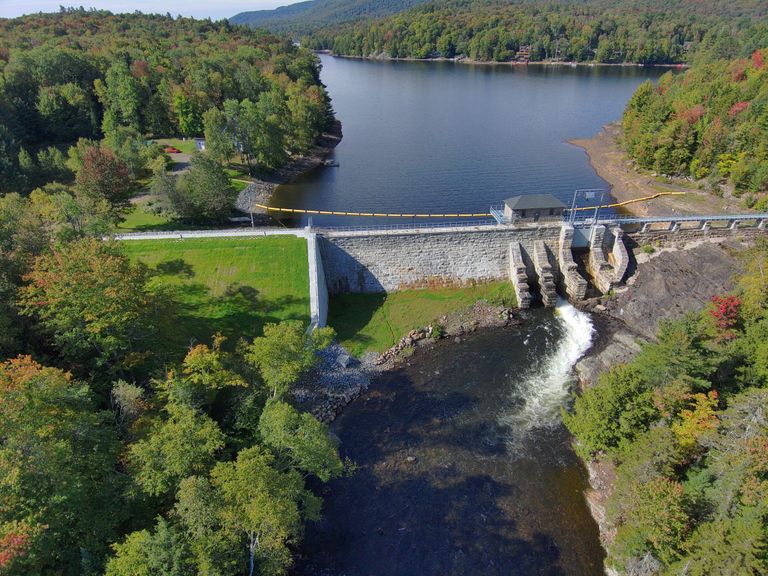
Colliers Engineering & Design recently completed a major project to address serious deterioration on a historic dam in upstate New York and prepare the structure for its next century of operation. The Indian Lake Dam is a 550-foot-wide, 47-foot-tall structure managed by the Hudson River-Black River Regulating District and consists of a concrete masonry dam and earthen embankment. Built in 1898, it straddles the Indian River and helps provide flow regulation and flood control for the Upper Hudson River Watershed.
After more than a century of use and deferred maintenance, the high-hazard structure was showing its age through what Johnson called a “trifecta of dam safety issues”:
Its spillway, meant to pass water over the dam to prevent the embankment from overtopping and failing, had inadequate capacity.
The structural stability of the dam itself was compromised — Johnson said the dam had the potential to “tip over in a flood.”
The dam’s earthen slope was also at risk of failing under certain conditions.
Simply put, Johnson said some areas of the dam were “among the worst ones I’ve seen” in his more than 30-year career in engineering. And it didn’t take an engineer to see that the dam needed serious TLC.
“Everybody knew that water would pour out the face of the dam on the downstream side,” he said. “The regulating district would get calls now and then from concerned residents after a storm saying ‘the dam is about to fail.’”
Collaboration Leads To Success
Addressing these concerns required the owner’s initiation of a proactive intervention to fortify the dam structure, as well as the participation of a range of engineering disciplines, including structural, geotechnical, water resource, mechanical and electrical engineers. Fortunately, Colliers Engineering & Design has all those skill sets in-house, which allowed it to apply the same collaborative, multidisciplinary approach to the dam that it has on high-stakes projects ranging from building construction or restoration to emergency infrastructure repairs.
Starting in 2018, the Colliers Engineering & Design team began a comprehensive engineering assessment that included records review, detailed field surveys, subsurface borings, dam breach and structural stability analyses, and hydraulic evaluation. The team carefully examined the dam's mass concrete core, stone masonry exterior, elevated access walkway and other important elements.
What it found corroborated concerns about the dam while also pinpointing areas that needed attention. In one example, core samples obtained by boring into the concrete portion of the dam revealed the true extent of deterioration.
“Everything was broken up into little tiny pieces, which was why the dam leaked so much,” Johnson said. “The original, low-quality cement used in the concrete had eroded away. We performed leakage improvements and installed a complex retaining wall to strengthen the dam.”
Repairing the dam's gatehouse required creative collaboration among the owner and engineering and contractor teams, who ultimately used divers to place concrete under 30 feet of water during the harsh Adirondack winter. Other actions that Colliers Engineering & Design oversaw to improve safety and increase hydraulic capacity included sluice gate modifications that replaced original wooden elements, the creation of an auxiliary spillway and the repointing of masonry both above and below the water level.
The “trifecta” of issues that had concerned Johnson at the outset were also addressed. Spillway capacity was increased by improvements that included raising the crest of the earth portion of the dam, structural stability was improved with the addition of anchors built into bedrock, and the slope of the dam’s embankment was flattened to improve its stability.
The $18.3M project was completed this year and presents lessons for dam owners facing similar challenges. For one, Johnson said close collaboration among stakeholders allowed the team to “work out challenges together” and apply solutions that any single entity might not have thought of or had the resources to carry out.
“It's amazing what you can do with creative thinking and engineering and construction technology,” he said. “It wasn’t AI that fixed this. It was good old ingenuity, hard work and having the right people at the table.”
The work also underscored the importance of proactively addressing America’s aging dams. Fortunately for the Indian Lake Dam, Johnson said New York state understood its critical importance and was willing to invest in a major fix to enhance it and reduce potential risk to public safety.
This article was produced in collaboration between Colliers Engineering & Design and Studio B. Bisnow news staff was not involved in the production of this content.
Studio B is Bisnow’s in-house content and design studio. To learn more about how Studio B can help your team, reach out to studio@bisnow.com.