
The rise of artificial intelligence has placed unprecedented demand on data centers for higher-density, faster-to-deploy infrastructure.
As AI infrastructure expands, developers and operators are facing a broader set of constraints: power availability, water use, land sensitivity, air emissions, community opposition, supply chain transparency and long-term adaptability.
By 2027, the leading AI system is expected to operate on 576 graphics processing units within a single filing-cabinet-sized rack, consuming the equivalent power of 500 typical U.S. homes. For an industry already grappling with the environmental impact of rapid growth, rising energy demand is making the path to sustainable scale increasingly complex.
“The fundamental challenge isn’t new: The industry has always had to balance growth with the realities of power, resources, communities and long-term performance," Tate Director of Sustainability Kimberlee Glinka said. "And AI is amplifying the scale, speed and complexity of that challenge."
Tate delivers integrated infrastructure solutions for high-density data centers and understands the increasingly important role that sustainability needs to play in the industry, Glinka said.
Hyperscalers and large data center operators are under increasing pressure to show measurable progress against sustainability goals, and customers are asking suppliers to help translate environmental, social and governance commitments into practical design, specification, procurement and delivery decisions. Additionally, Scope 3 emissions, embodied carbon, water efficiency, circularity and supplier transparency are becoming part of infrastructure evaluation.
Tate helps data center clients move sustainability from a goal to reality by supporting sustainable decisions throughout the building process, Glinka said.
Right now, that means offering a growing portfolio of lower embodied carbon solutions and working with customers to design systems that support their sustainability goals. As compute technologies continue to evolve, adaptable design will become increasingly important, giving the surrounding physical infrastructure greater flexibility to respond to changing power, cooling and density requirements over time.
A Responsible Framework
The data center sustainability conversation is about more than carbon alone; it also involves water, land, transparency and public trust, Glinka said. The benefits of digital infrastructure extend well beyond the communities where data centers are built, while many of the impacts are experienced locally. As development accelerates, that makes transparency around power, water, infrastructure and economic benefits increasingly important.
“As AI data centers become larger, denser and more complex, sustainability needs to be considered throughout the development process, beginning with site-level decisions and extending through infrastructure design, material and supply chain choices, manufacturing and adaptability as requirements change," Glinka said.
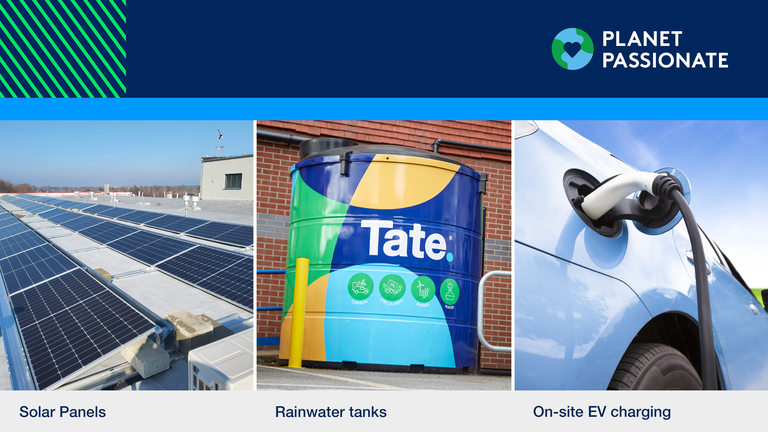
Tate’s network of facilities allows regional manufacturing, making use of resilient local supply chains and supporting long-term workforce development in smaller, rural communities across the country. The company’s Planet Passionate commitments reinforce this approach, driving measurable improvements in efficiency, waste reduction and sustainable operations across its footprint.
Supporting The Future of Cooling
As AI workloads drive higher rack densities and greater heat loads, cooling is becoming an increasingly important part of data center infrastructure planning.
That means the infrastructure surrounding cooling systems is even more critical. Structural support, access, routing, containment, airflow separation, manifold coordination, cable management and installation sequencing all play key roles, said Sinéad Lalor, Tate director of engineering.
Customers are looking for partners that can reduce complexity across systems, not just provide individual components, Lalor said.
Tate supports the physical layer required for high-density AI environments, with capabilities across structural systems, containment, airflow management, manifolds, manufacturing and installation that can help customers coordinate increasingly complex builds.
“Tate acts as an integrated physical infrastructure partner that helps make the deployment of power-dense, cooling-intensive infrastructure faster and easier to coordinate,” Lalor said.
Prioritizing Adaptability
In a fast-changing AI market, designing for adaptability can create more opportunities to reconfigure, expand or upgrade existing infrastructure as requirements change, extending its useful life where possible and reducing unnecessary replacement.
One way to build greater adaptability into physical infrastructure is through modular design, which can provide more flexibility to reconfigure or expand systems.
Depending on the application, that could mean adding capacity incrementally or reconfiguring infrastructure around changing density or cooling requirements.
Tate is exploring these principles in its infrastructure solutions, Lalor said. One example is PowerStack, Tate’s modular infrastructure platform designed for incremental scalability. Its design allows capacity to be added as demand grows, while providing greater flexibility to respond as requirements change.
“There is a practical sustainability benefit to adaptability,” Glinka said. “When infrastructure can be reconfigured, expanded or upgraded as requirements change, there is greater potential to keep existing systems and materials in service longer. That can reduce unnecessary replacement, along with the materials and embodied carbon associated with it.”
Sustainable Speed
Although speed-to-market is a top priority, it doesn’t have to come at the expense of sustainability, Lalor said.
“Faster timelines can increase project risk if design, manufacturing, integration and installation are not coordinated early,” Lalor added. “Factory-controlled manufacturing, preintegration and clear installation planning can reduce field labor, rework, delays and site disruption.”
Tate’s integrated delivery model means that solutions are preassembled and tested at its manufacturing facility and delivered to the site, combining early coordination, manufacturing discipline and installation readiness to help customers reduce complexity and deliver more predictable outcomes. Bringing suppliers into the conversation early enables them to identify practical trade-offs and avoid late-stage changes.
Built By Design, Not By Default
The bottom line is that responsible AI infrastructure will be built by design, not by default. As the industry scales, the choices made around where and how infrastructure is designed, manufactured, deployed and adapted over time will shape both its performance and its sustainability, Glinka said.
Tate’s approach brings together lower-carbon materials, life cycle thinking, regional manufacturing and operational discipline to integrate sustainability more directly into infrastructure decisions.
“Meeting the scale and speed of AI demand will require us to make thoughtful infrastructure decisions from the outset,” Glinka said. “Sustainability is part of that equation, alongside performance, reliability and the ability to adapt as requirements change.”
This article was produced in collaboration between Tate and Studio B. Bisnow news staff was not involved in the production of this content.
Studio B is Bisnow’s in-house content and design studio. To learn more about how Studio B can help your team, reach out to studio@bisnow.com.