As South Jersey and the rest of the state contend with an affordable housing shortage, developers in the space say state-level rules are getting in the way of new supply.

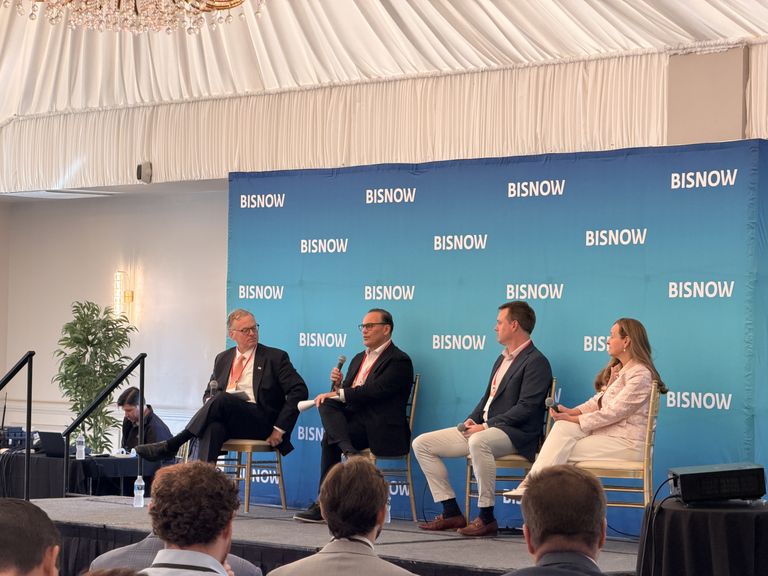
The regulatory framework coming out of Trenton drew the ire of builders who shared their frustrations during Bisnow’s South Jersey State of the Market event earlier this month.
“You're basically building less affordable housing because of the overregulation,” Pennrose Regional Vice President Lindsey Samsi said.
“The regulations are more designed around uncertainty rather than facts and technicality, which is making it very challenging overall, like at a high level, and just reducing the number of housing units that are being built,” she added.
There are 34 rental units available for every 100 extremely low-income New Jersey residents, who are defined as making 30% or less of the area median income, according to a National Low Income Housing Coalition report earlier this year. It calculated a deficit of 297,110 units statewide for that demographic.
The situation is even more dire for some parts of South Jersey, where Samsi said rents lower than the statewide average make it harder for projects to pencil.
In the state’s 3rd Congressional District, which includes most of Burlington County, there are only 19 units available for every 100 extremely low-income residents amid a deficit of 10,159 affordable homes, NLIHC found.
Affordable developers are seeing the supply-demand imbalance play out in real time.

“We have 17 projects, and every single one of them has a waiting list of between one and 200 people,” said Eastern Pacific Development President Hans Lampart, who specializes in low-income housing tax credit projects in South Jersey.
He singled out the state’s Department of Environmental Protection and the increasingly stringent stormwater management standards it has adopted in response to rising sea levels as a major barrier to supply.
Lampart is working on a South Jersey senior housing project that will potentially include around 80 units.
He said the state is mandating the installation of an $800K underwater stormwater management system, which the developer reported will add approximately $10K per unit to the project’s construction costs.
On another deal, Lampart said a state mandate requires larger stormwater retention ponds than what he built nearby just a few years ago, which is shrinking the potential footprint.
“We've actually lost lots because of the size of the basins that we now have to construct,” he said.
Lampart also took aim at the state’s Uniform Housing Affordability Controls, which govern the proportion of new affordable units that will be reserved for certain income levels.
While he and Samsi agreed that they work well with standard LIHTC rental projects, they said the regulations add a major complication when it comes to mixed-income projects with a for-sale component.
Lampart said it is extremely difficult to find creditworthy buyers at the prescribed income levels who are able to buy a home.
“It basically inhibits you from wanting to do a blended building,” Samsi said.
“We all want mixed-income, diverse communities, so it's counterintuitive at that point because the only way to make it work is to do a separately financed LIHTC transaction as part of your master development,” she said.
In some ways, Gov. Mikie Sherrill and the state agencies she controls are on the same page as these developers, Samsi said.
Sherrill’s office issued a report last month that found that New Jersey is short by as many as 253,300 homes, a number that could rise to 406,500 over the next decade.

The findings followed Sherrill’s April executive order that, among other things, directed state agencies to explore using state land for new housing and the potential elimination of administrative red tape.
Samsi and Lampart also commended the 2024 bill that clarified the obligations each municipality statewide has under the Mount Laurel doctrine, a 1975 New Jersey Supreme Court decision requiring local governments to use zoning to further attainable housing production.
“Most municipalities have finally recognized that they have an obligation and they need to stop putting their head in the sand and ignoring it,” Lampart said.
“We've found that municipalities are much more receptive, even through the planning board process, where you know it used to be a room full of people with pitchforks and torches,” he said.
But Samsi said the newfound support for affordable housing doesn’t necessarily extend to residents.
“I'm finding that municipalities are more supportive in this new obligation round, but not necessarily the residents and the communities,” she said.