It should be the golden age for the Orange County apartment market, and in many ways it is: rents are still rising along with demand, and capital is still cheap. But there are worries: land and construction costs, and a natural ceiling on rent growth, according to the speakers at our fourth annual Orange County Multifamily event at the Fairmont Newport Beach.
In multifamily right now, our speakers said, there are conflicting metrics. On the positive side, there will be 8.3 million new households between now and 2019, and cap rates are at record lows for multifamily in many markets, around 5%, so merchant builders ought to be building multifamily. On the other hand, land is very expensive, and there's a lot of volatility in the financial markets, with the anticipated uptick in interest rates. Still, development will work for solid locations. Snapped: our own Sean Spear kicking off the event.
Construction costs are also a worry, even when it comes to value-add renovation, which can be a cost-effective way to get rent bumps if done carefully. In some markets, high-ticket improvements and amenities aren't going to get higher rents. Another consideration is that there are also a lot of buyers now looking for value-add deals, and that's driving up the price. Snapped: Berkadia managing director Jackson Cloak, who moderated, and LT Global Investment VP Wei Huang.
The pace of rental increases over the last few years isn't sustainable, our speakers noted, especially in highly desirable markets. Orange County still has some runway ahead in terms of rental growth, but not quite as much as it once did. For one thing, while the job market's getting better, that doesn't necessarily mean increasing income among potential tenants who are beginning to form households. Pictured: TruAmerica senior managing director Greg Campbell and Raintree Partners managing director Aaron Hancock.
The capital markets outlook for multifamily deals is a bit of a squeeze: interest rates are rising, and cap rates are still falling, so it's harder to pencil deals. Even so, there's still a lot of demand for product, especially B and C product, which currently have a bit higher occupancies (in mid-90s in OC) than Class-A apartments, so those deals can work. Shown: Allen Matkins partner Matt Fogt, who also moderated, and Walker & Dunlop VP Mark Grace.
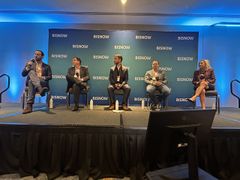
In the 2000s boom, retail started being included in core urban multifamily developments, the speakers recalled. Retail is still an important component in many developments—and in fact, many municipalities require it—but it's more competitive to get the space leased than it used to be, because the universe of retailers isn't as large as it once was, so there's a longer lead time to lease the retail component these days. Pictured: MG Properties Group CEO Mark Gleiberman and Equity Residential VP Daniel Golovato.