Blue Origin, the spaceflight company controlled by Amazon mogul Jeff Bezos, and partners Sierra Space and Boeing are planning to build a commercial space station, Orbital Reef, that they characterize as a mixed-use business park in space.
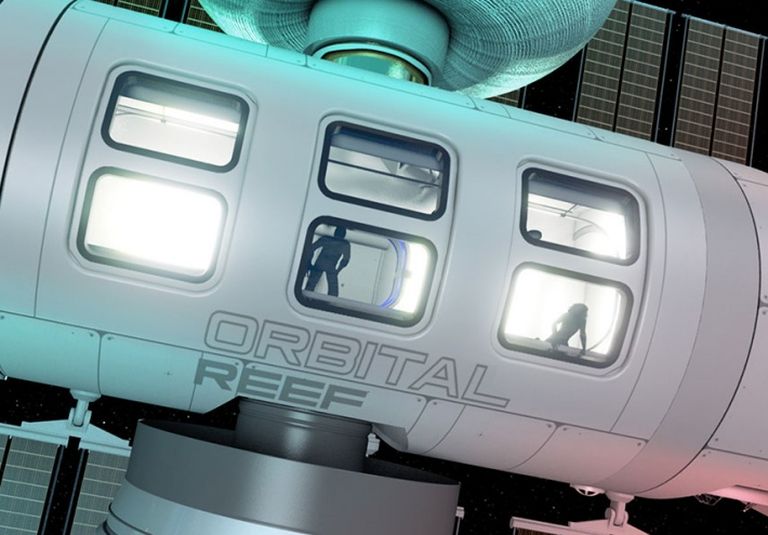
The space station is planned to at first consist of a main module and attached other modules, according to the partners, and will be built and serviced using Blue Origin's reusable New Glenn launch system, Boeing’s Starliner spacecraft and Sierra Space’s Dream Chaser spaceplane.
Though none of those vehicles has achieved Earth orbit yet — Bezos, actor William Shatner and others rode in New Glenn capsules in suborbital flights this year — the partners say Orbital Reef will be in space by the second half of the 2020s. The partners didn't provide an estimate of the cost of the space station nor a more precise timetable for its development.
The station is slated for low-Earth orbit at a bit more than 300 miles above the planet's surface, higher than the International Space Station's nearly 250 miles above the Earth.
Orbital Reef's developers say it will support as many as 10 people in about 830 cubic meters, which is roughly the size of the ISS. The station's goal is to offer research, industrial and other commercial customers such services as space transportation and logistics, space habitation, equipment accommodation and operations, including onboard crew, according to the partners.
"Designed to open multiple new markets in space, Orbital Reef will provide anyone with the opportunity to establish their own address on orbit," Blue Origin said in a statement.
"Seasoned space agencies, high-tech consortia, sovereign nations without space programs, media and travel companies, funded entrepreneurs and sponsored inventors, and future-minded investors all have a place on Orbital Reef," the company said.
Also participating in the venture are Redwire Space, Genesis Engineering Solutions and Arizona State University.
Blue Origin and its partners aren't alone in planning a private permanent presence in low-Earth orbit. Last month, partners Voyager Space Holdings, Nanoracks and Lockheed Martin announced plans for their own commercial space station, Starlab, which they say will launch in 2027. Starlab is designed to measure about 340 cubic meters and accommodate four space travelers.
Starlab will include a large inflatable habitat, a docking node, a power and propulsion element, a large robotic arm for servicing cargo and payloads, and a lab for R&D and manufacturing.
Axiom Space is also planning a commercial station, Axiom Hub One. Earlier this year, the company raised $130M in a new round of funding.