More companies are expected to add flex space to their office portfolios in 2022 as employers seek to accommodate historic shifts in the way people work.
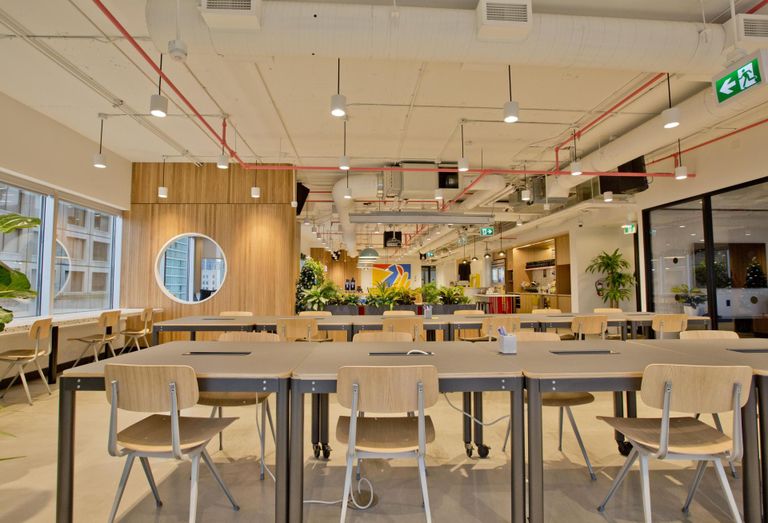
In a report released Feb. 7, CBRE said the North American flex market has slimmed down after rapidly expanding in 2018 and 2019. Since mid-2020, 144 flex office providers have reduced their footprint by about 12M SF across 669 properties covering 42 markets, per CBRE’s findings.
“The office market was extremely affected throughout the pandemic,” Julie Whelan, global head of occupier thought leadership for CBRE, said during a Feb. 7 media briefing. “We saw historical negative net absorption, yet the flexible office space market has only contracted by under 9% in the year leading up to Q3 2021, which is pretty resilient in our eyes.”
Whelan said Manhattan, San Francisco and Los Angeles — markets that had the most flex space as a percentage of overall office inventory pre-pandemic — are the areas where most of this contraction has occurred.
“It’s no wonder that those markets took the opportunity to really right-size throughout the pandemic after such intense growth leading up to the pandemic,” she said, noting that suburban markets across the board lost the least amount of inventory.
Markets with the most flex space as of Q3 2021 include Manhattan, Dallas-Fort Worth and Chicago. Those with the most flex space as a percentage of their overall portfolio include Miami, Manhattan and San Francisco, according to the report.
Despite an industry-wide contraction, some operators grew their footprint over the pandemic. Companies like Industrious, colab at Bell Works, Common Desk, Venture X and The Mark all expanded between 2020 and 2021.
“The reason there are still occupiers expanding in the market even during a period when other providers were perhaps contracting is because there is a lot of interest by tenants, especially enterprise tenants, in this tranche of space,” Whelan said.
A 2021 occupier sentiment survey by CBRE revealed that close to 20% of enterprise companies of more than 10,000 employees said flex space could eventually comprise more than 50% of their portfolio. Interest from companies across the board is going to challenge providers to meet anticipated demand, Whelan said.
“When you look at the size of the flex market being generally under 2% nationally … and you look at this type of growth from small, medium and even large companies looking to put into flex, that is going to be quite a tailwind for a lot of these flex providers to make sure they have the right amount of flex space in the right place at the right time,” she said.
Whelan said run-of-the-mill offerings, like access to transit or on-site gyms, are now seen as table stakes for any quality building. What differentiates one quality building over another are flexible offerings, with close to 80% of large employers indicating a desire for shared meeting space and another 75% saying they want flexible open space within their buildings, according to the occupier sentiment survey.
Continued job growth paired with a need for space that aligns with hybrid work will spur more demand for this type of product in 2022, Whelan said. Large companies are forming their return to office plans, and incorporating flex is now seen as a move that supports employee choice, said Brandon Forde, CBRE’s president of client solutions.
“All the big companies are telling us they are going to use flex more going forward, and they are going to use flex first as they come back,” he said.
There are still challenges facing the flex space, however, especially for large users. Factors like inexperience with the flex model, technological shortcomings and privacy requirements among enterprise companies could hinder the market moving forward.
Still, CBRE predicts that between 13% and 18% of the nation’s office portfolio will be penetrated by flex space in 2030. The lower end of that scale would require flex to grow by more than 500M SF off today’s base of 80M SF, Whelan said.
“That’s a lot, and it means there has to be momentum in attracting clients and enterprise users to this pace, and there will have to be traditional leases that convert over to flex,” she said. “We have the ability to do that now that we are in such a transformative environment in the open office market overall.”