
Amazon is opening up its unrivaled logistics network to the wider world of retailers and freight shippers, giving up a piece of its competitive edge in pursuit of profits.
The e-commerce behemoth launched Amazon Supply Chain Services this month, giving anyone access to its distribution, fulfillment and freight network. The new offering positions Amazon to compete with third-party logistics firms that have recently fueled industrial leasing activity.
“The model is simple,” Benjamin Gordon, founder of supply chain investor Cambridge Capital, said in an email. “Amazon starts with a solution for its customers. Then it scales up. Then it opens up the network to new companies, generating higher volume, lower cost per unit, and a competitive advantage.”
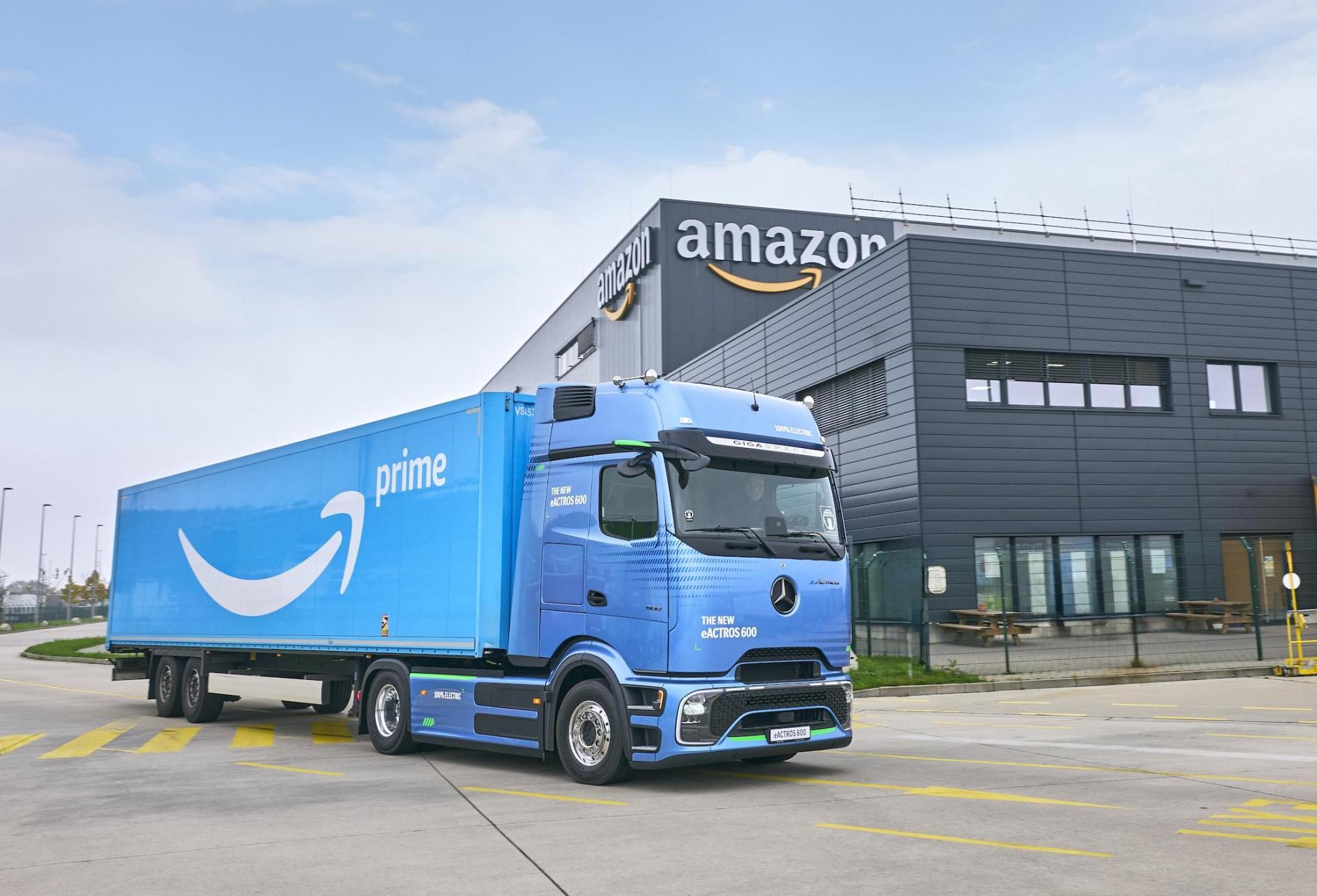
The launch of ASCS opens Amazon’s hundreds of millions of square feet in distribution space to the broader logistics ecosystem, and each new customer will potentially take space it would have otherwise leased itself.
Rapid uptake in ASCS won’t immediately unwind industrial demand — lease terms are years long, and global supply chain decisions take time — but any weakening of demand from 3PLs, the companies that handle warehousing and shipping for retailers and other firms that opt to outsource those operations, will weigh on overall leasing.
3PLs leased more than 30M SF of industrial space in the first quarter, a 65% jump from last year and roughly 20% of all U.S. leasing activity. Analysts at JLL flagged the growth of 3PLs as the most notable trend of the first quarter, during which industrial tenants moved into 51M SF more than they vacated and signed 145M SF in leases, according to JLL.
ASCS is a solutions package covering a product’s journey from factory to doorstep. It opens Amazon’s fleet of more than 80,000 truck trailers and 100 aircraft for domestic and global shipping and its roster of third-party providers operating tens of thousands of Amazon vans for local delivery while also offering companies consulting services around supply chain optimization.
How Amazon prices the ASCS services will ripple across supply chains and could ultimately reset the marketplace, but most analysts and supply chain experts expect a more targeted approach.
“I am not convinced that this is a market killer for all 3PLs,” said Emily Pfeiffer, an analyst at Forrester Research focused on logistics tech.
“Amazon could, single-handedly, choose to make it so, though,” through its ability and demonstrated willingness to operate business lines at a loss to capture market share, she said.
3PLs have been a bedrock sector for industrial leasing in recent quarters as other operators pulled back in the face of the White House’s tariffs and, more recently, the U.S. conflict with Iran. They are also among the handful of firms signing leases over 500K SF in this macroeconomic backdrop, helping boost big-box activity by 81% year-over-year amid a glut of inventory.
It isn’t an entirely new development. 3PLs were propping up an otherwise lackluster industrial leasing market in Savannah, Georgia, in late 2024, and Asian 3PL firms flocked to California’s Inland Empire in 2025 as suppliers looked for strategies to navigate tariffs.
Amazon’s entry into the marketplace could knock some smaller 3PL firms out of business or force operators to consolidate and compete at scale, ultimately dampening demand for distribution space, said Zac Rogers, an associate professor teaching supply chain management at Colorado State University.
But third-party logistics operators have a lot more to lose than Amazon, and Rogers expects them to find scrappy ways to differentiate themselves.
“They'll really have to fight people for it. The people already there, they're fighting for it — this is their only business,” Rogers said. “Amazon could lose logistics and still be one of the most profitable companies in the world. These other companies, if they lose it, they're going to be gone.”
ASCS is likely to make sense for a large number of small and midsized businesses, but for large firms, supply chains are also valuable caches of consumer data that they are unlikely to hand over to a competitor.
ASCS was built with a la carte services and scalability in mind. Any business can now access Amazon warehouses and its fleet of airplanes and freight carriers to deliver products, with the option to choose different shipping speeds through a unified platform that combines what had been disparate services across the Amazon shipping machine.
Amazon's integration of its supply chain with the ASCS offering is also designed to optimize the e-commerce giant’s own delivery network, said Dale Rogers, a professor in the supply chain management department at Arizona State University.
Amazon could slot 3PL customers into excess space along its existing freight and delivery network to boost revenue without significantly expanding its fleet and leverage excess capacity during off-peak times to boost efficiency, he said.
“It makes a lot of sense to level out that demand and get paid for that excess capacity,” he said.
Amazon already dwarfs the rest of the U.S. 3PL industry when carving out its $172B in 2025 revenue from marketplace commissions alongside fulfillment and shipping fees, according to consulting firm Armstrong & Associates. The remaining nine of the 10 largest 3PLs had $90B in combined revenue, led by the $15B generated by C.H. Robinson.
“The bigger ones are going to fight tooth and nail to hold on to the larger accounts, and I think some of those larger accounts might have incentives not to go with what’s essentially a competitor,” Zac Rogers said.
But some major brands are already signing on to Amazon’s program, with the company highlighting deals with Procter & Gamble, 3M, Lands’ End and American Eagle Outfitters as part of the ASCS launch.
Amazon has for years been marketing services that are part of ASCS to companies and found little success, said Satish Jindel, president of SJ Consulting Group and a founder of RPS, which became FedEx Ground in 1998. The inclusion of major brands in the announcement sent a signal that Amazon was generating value and customer interest by unifying its services, he said.
“It validates that they are able to market and attract customers for this value proposition that they have had,” Jindel said. “The attention that they are putting on it should help them penetrate those services at a faster pace.”
The impact of ASCS on industrial demand will be partly driven by how aggressively Amazon prices its offering. The brand has shown a willingness to make massive investments and operate at a loss if it means gaining market share, but it isn’t clear that Amazon is interested in dominating the 3PL space, which historically operates on thin margins.
“There are times when Amazon is very unconcerned about its own profit because its goal is to dominate a sector,” Pfeiffer said. “The potential is real for major market disruption. It is not guaranteed.”
)
)
)
)
)
)
)
)
)
)
)
)