As more workers return to the office with their expectations raised from working at home, many employers and building operators are planning to welcome them back with modernized facilities built using traditional construction methods.
But that approach might cost them.
Taking into account that 70% of office stock in the U.S. was built before 1990 — long before many office employees became used to hybrid work practices that emphasized flexibility and convenience — one study estimated the cost to build new meeting rooms to meet today’s needs could exceed $85B.
There is, however, an alternative. Using office pods instead of knocking down old walls and hanging new sheetwall to add meeting space could save office users more than $30B through the rest of the decade, according to the study conducted by Framery and CBRE Finland.
This is partly because pods “allow a new type of spatial planning,” Framery Chief Design Officer Joonas Vartola said. Pods designed and manufactured by his company allow for more design flexibility and cost-savings than traditional approaches, he said.
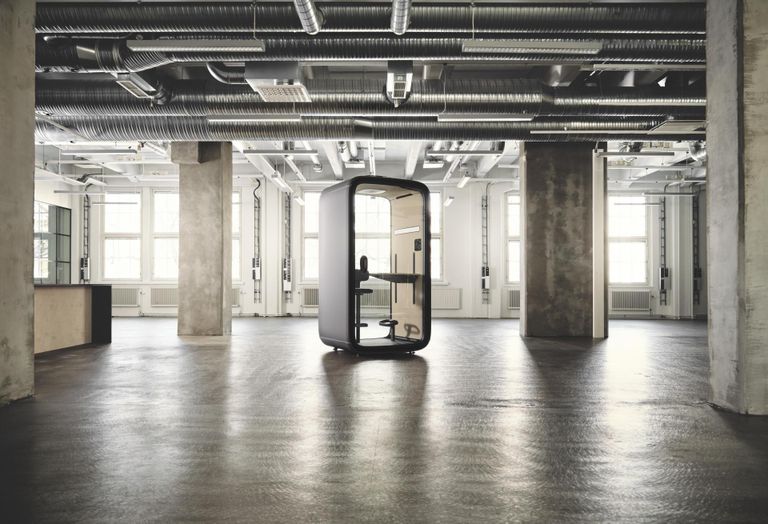
“Let’s say a company is moving to a new office space,” Vartola said. “Instead of hiring contractors for drywall, electrical and air, the company can save time and cost by dropping in pods that can accommodate up to six people."
Vartola described pods as a "plug-and-play" option that provides consistent performance and the flexibility to reconfigure the floor plan as needs change.
Framery has been designing and building office pods in Finland since 2010, when its founders introduced the concept as a way to provide convenient and distraction-free work areas in sometimes noisy office environments. The business picked up in 2020, when offices around the world began looking for solutions to keep employees safe and productive during the pandemic.
Vartola, an award-winning designer who previously worked at companies such as Tesla and Mazda and as a partner at design agency Ultra Design & Strategy, said the impact of Covid, followed by years of hybrid work for many, resulted in a permanent change in how people regard the office.
“Employees now understand that the workspace should give them more flexibility and freedom, and also space for focused work,” he said. “They learned new ways of working while at home, and that has created new demands for spatial planning.”
To meet those demands, Framery offers soundproofed and ventilated pods ranging from the Framery One Compact, a phone booth-style design to meet the needs of a single user, to the Framery Six. One of the company’s newest offerings, the Framery Six can seat teams of up to six in a unit that measures more than 7 feet tall, nearly 8 feet wide and about 8.5 feet deep.
Vartola described the customizable Framery pods as “flexible by design,” meaning they can accommodate the range of activities found in a typical workspace.
“They allow different room layouts and combinations of furniture for different applications,” he said. “This hybrid concept of shared, open space with closed, contained spaces enhances workflow and productivity and allows a much more dynamic usage of space.”
Since its inception, Framery has delivered more than 110,000 pods to customers in 104 countries. The company estimated about 70% of all Fortune 100 companies use its products.
One prominent user is PepsiCo, whose regional headquarters in Riyadh, Saudi Arabia, has integrated Framery’s four-person pods into its office. Exemplifying Vartola’s description of a hybrid office, the facility manager there said the pods allow PepsiCo to provide focus areas for employees “while maintaining the collaborative spirit of our open-space design.”
Key to the utility of the pods is their incorporation of technology. For users, each pod is equipped with an 8-inch touchscreen that allows them to adjust lighting and airflow and extend their calendar reservations for the unit if needed.
For managers, the pods collect data and analytics to allow them to better manage usage and placement, letting them see which space configurations are working efficiently and which require adjustments. The technology also allows them to monitor bookings to ensure anyone who wants to use a pod can do so.
“With our smart office solutions, we can sync any existing office space with the exact needs of the people who use it,” Vartola said. “Our digital and physical product offerings work hand in hand.”
Vartola said Framery’s pods will continue to evolve to meet users’ needs. Just as other types of technology are becoming smaller and slimmer, he said he looks forward to seeing this trend play out with pods, influencing the materials Framery uses, the way it manufactures the products, and how users interact with them.
“We sit somewhere in between furniture, consumer electronics and spatial design, and we are learning constantly about how best to meet the needs of today’s office workers,” he said.
This article was produced in collaboration between Framery and Studio B. Bisnow news staff was not involved in the production of this content.
Studio B is Bisnow’s in-house content and design studio. To learn more about how Studio B can help your team, reach out to studio@bisnow.com.