When the construction of the City of London’s tallest tower, 22 Bishopsgate, was hit by months of delays, developer Stuart Lipton said, “Wind is not [a] huge [issue], it is the issue.” This is the case across the construction industry, GIA Director Chris Harley said.
As a rule of thumb, developers factor in 10% to 20% of downtime in a construction plan due to wind making lifting machinery, such as cranes, inoperable. But modern technology is working to cut that figure. GIA is bringing advanced computer analysis to reduce wind-related project downtime and improve site safety.
“Winding off has always been baked into construction programmes, but people are starting to look at projects through a different lens,” Harley said. “Suddenly, rather than be accepted, wind is being challenged. While we can’t take wind away, we can deal with it far more scientifically.”
There is 4.2M SF of office space under construction in central London. When the average construction cost of an air-conditioned office with more than six storeys is estimated at £872 per SF, any delay is going to be costly. Extreme weather in the UK extends project timelines by up to 21%, costing the country £2.2B each year.
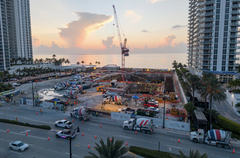
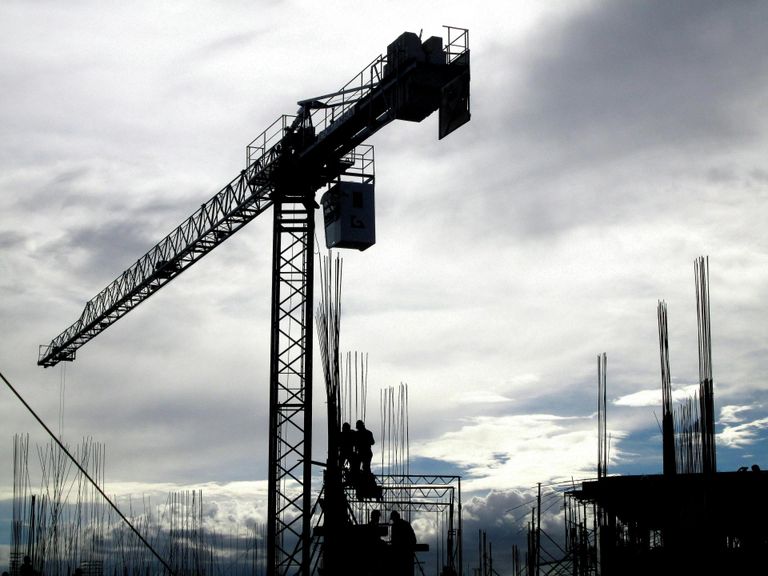
“Any construction project, particularly of tall buildings, will be impacted by wind,” Harley said. “Cranes lifting materials high in the air or having to climb as the building grows will often be winded off when winds are too strong. Sometimes the team will have to deconstruct the crane and begin again in another location.”
As construction costs have risen, attention has refocused on where money can be saved. London has been ranked as the most expensive construction location in the world, so all savings count.
Some organisations are already attempting to use weather data to inform project decisions, Harley said. During the project to create HS2, weather stations were installed on-site and data was collected to predict the best time to lift the 140-tonne segments to build the Colne Valley Viaduct.
GIA’s method builds on this innovation, Harley said. By leveraging technology available today, far more in-depth insights can inform commercial strategies and enhance site safety.
“By modelling local conditions and combining them with historical weather data, we can give a more accurate understanding of the likely conditions on-site throughout the construction timeline,” he said. “We can potentially tell contractors week by week the likelihood of a project being winded off or where to put a crane to reduce the chance of that happening.”
GIA uses several techniques to provide wind analysis to the built environment, including computational fluid dynamics. By modelling the build at each stage of construction, the team blows wind from different angles to determine the best location for cranes.
As well as data about weather conditions at different points of the year, the team brings in information about the site, such as whether it is in a built-up area that affects wind flow. Locations such as the City of London are notoriously challenging for construction projects due to the proximity of other tall buildings, Harley said.
“We take the same structured approach to understand what the conditions will be on-site as we do during planning the design of a building,” Harley said. “But instead of just looking at the impact of wind, light and so on, on the final build, we look at what will happen during construction.”
This type of modelling has been made possible by advances in high-performance computing, Harley said. The construction industry is learning from progress in other industries such as motorsport, where fractions of a second of performance make a real difference.
“The acceleration of compute performance means that it is now far more cost-effective to carry out this kind of analysis than just a few years ago,” he said. “People now have access to compute that was just not available previously, giving them the potential to simulate to a much higher level of accuracy.”
The technology GIA is using is new, which means the team has yet to see the full benefits of this approach to predicting wind. As the technology develops, they will be able to provide even more detail to contractors, down to even the best time of day to plan lifts, Harley said. GIA is in talks with developers and crane operators who are all excited about the potential of wind analysis.
“There is potential that once this kind of analysis is adopted, it becomes standard practice,” he said. “As we have seen in the uptake of CFD use within internal building performance, it has the potential to become an integral part of construction development. When it is possible to use information this way, why wouldn’t you always use it? Technology has made this possible.”
This article was produced in collaboration between GIA and Studio B. Bisnow news staff was not involved in the production of this content.
Studio B is Bisnow’s in-house content and design studio. To learn more about how Studio B can help your team, reach out to studio@bisnow.com.