As transit-oriented and mixed-use development become increasingly hot in the Bay Area, one thing remains a challenge for developers: providing the required parking. Bisnow caught up with Ann Cheng, GreenTRIP program director for TransForm, a Bay Area organization focused on transportation reform.
GreenTRIP helps cities and developers with strategies that help reduce parking requirements to create healthier and more affordable communities and commutes, Ann tells us.
GreenTRIP started a parking database that looks at multifamily sites around the Bay Area, with data going back to November 2013, about a year ago. The database weighs parking supplied against parking used, giving cities, developers and community members a chance to look at similar projects to see how much parking is actually needed—and what the cost is for unused parking.
Average data collected for the Bay Area shows 28% of parking spaces go unused, nearly 1.2M SF at a construction cost of $198M.
Statewide, the biggest news to date is Gov. Jerry Brown's signing of AB 744, which requires cities to lower parking requirements for affordable, senior and special needs housing near public transit, Ann tells us.
In particular, the new law encourages affordable housing by stating:
Cities can't require more than half a parking space per bedroom on market-rate properties when the development includes at least 20% low-income or 11% very low-income housing and is within a half-mile of major transit for affordable units;
Cities can't require more than half a parking space per unit (regardless of how many bedrooms) on projects that are entirely low-income housing if within a half-mile of major transit;
Cities can't require more than half a parking space per unit for senior housing that uses paratransit or is within a half-mile of a bus line with at least eight stops per day; and
City requirements are capped at 0.3 spaces/unit for special needs, low-income housing developments regardless of location.
The statewide law moves to improve parking requirements on a broader scope even as cities continue to examine their local policies. Many cities have changed their parking policies through station area specific plans, precise plans and priority development areas over the years, Ann tells us. Some are now looking to make it part of their citywide parking codes.
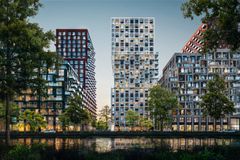
Ann tells us Berkeley responded when the GreenTRIP certification program launched in 2008 by making a similar code requirement for its downtown plan area: reducing parking to one space for every three units while adding requirements for transit passes and better car-sharing opportunities. Berkeley's Garden Village, shown above, is a prime example of a project that did away with a plan for parking and replaced it with bike parking, transit passes and car-sharing.
She says Berkeley City Council is considering a new citywide affordable housing policy that would significantly reduce parking for projects that include income-restricted affordable housing.
San Jose significantly reduced its citywide parking code requirements for places near transit and within urban village areas as well as projects with key traffic reduction strategies, such as transit passes and car-sharing, a few years ago, Ann says.
In the past few years, TransForm has advised and supported improved parking requirements with Great Communities Collaborative cities, including Concord, El Cerrito, Richmond, Santa Rosa, Pittsburg, Walnut Creek, San Leandro, Mountain View and Sunnyvale, as they develop plans.
Oakland Mayor Libby Schaaf (seen here talking with moderator Robert Ogilvie at our recent Oakland Bisnow event) says her city plans to reduce parking requirements near transit. Menlo Park is considering changes to its downtown plan that would reduce parking for new developments, since city officials estimate there is twice the amount of parking needed near Caltrain.
As former mayor of El Cerrito, Ann has seen parking requirement changes from the other side. In 2011, she moved the city council to support significant parking requirements reduction within a half-mile of BART as part of the San Pablo Avenue Specific Plan. That means a parking study may be required if proposed parking is less than one space for every two units, she says.