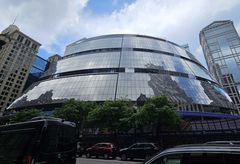
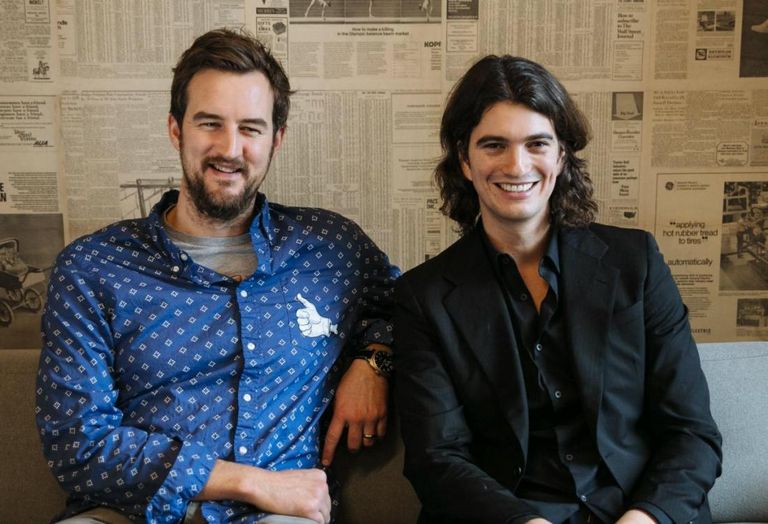
Over the last few years, it’s been hard to avoid hearing about co-working and WeWork’s absurd success. The $17B co-working giant (which just raised $260M in a new funding round) is expanding all over the globe, and new co-working companies are popping up every day to challenge Miguel McKelvey and Adam Neumann's (below) throne.
But in the last few months, the wax on co-working’s wings has begun to melt. Not only has Sunshine Suites—one of NYC’s first co-working providers—shut down (even its phone number and email application are inactive), but WeWork has its own share of issues, including a labor dispute, halted hiring, workers cut and cut profit projections.
Adam and a WeWork spokesperson insist these mischaracterize the company’s position, while claiming its largest month ever in September, with 10,000 desks leased.
Co-working isn’t coming to a karmic collapse for its hubris. Office experts believe co-working’s facing its first watershed moment, which is forcing the new office format to mature and evolve into something even stronger.

A firm believer in the co-working trend, CBRE New York Tri-State Region CEO Mary Ann Tighe says companies like WeWork are a “critical ingredient” for the office market and helped solve the “incubator problem” with smaller, flexible leases for fledgling companies.
This flexibility, CBRE vice chairman Ken Meyerson adds, might even lead tenants large and small to choose co-working over traditional leases to save capital.
But the nature of co-working, Mary Ann says, is changing from its “fairly generic” offering of beer and conference rooms to spaces tailored for every industry and location.
“It’s simply the natural fallout of any new business concept,” she told Bisnow. "We’ll start seeing more forms of co-working than we can ever imagine."
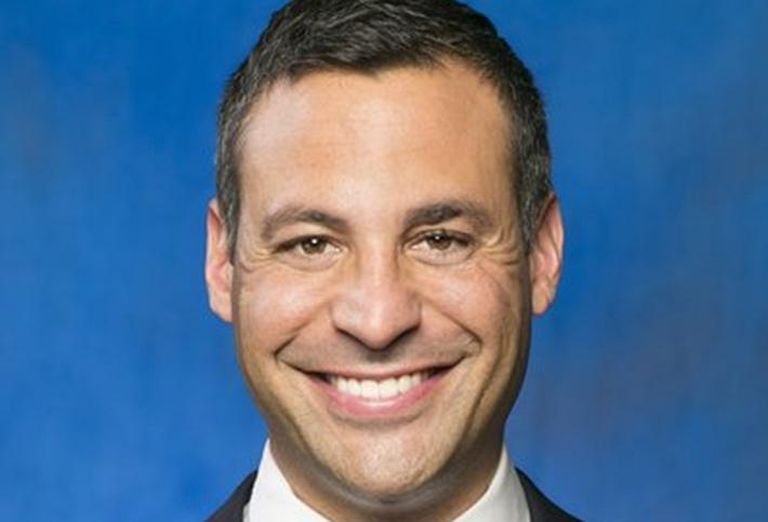
Eastern Consolidated investment sales and leasing senior director Jeff Nissani (pictured) believes WeWork has created a product that newer companies (like BarWorks) can repackage, while Spector Group principal Scott Spector says this variety has been around for years, pointing to the difference between WeWork’s TAMI-focused design and Regus’ simpler, more traditional spaces.
While WeWork's spokesperson says certain industries gravitate to WeWorks in different neighborhoods—financial firms Downtown, for example—he insists industry-tailored spaces remove the cross-industry connections that make co-working so appealing.

But what about NYC? There are almost as many co-working spaces as Starbucks these days, and there can’t be that much demand, can there?
Doubtful, CBRE vice chairman Howard Fiddle (pictured) says, believing co-working’s low barrier of entry has caused it to grow too big, too fast.
“It’s not going to disappear anytime soon, but there’s simply too much,” he told Bisnow.
Jeff compares WeWork to Starbucks, which had to remove many locations because they “expanded to the point where they became their own competition.”
While WeWork does its research on where it should expand to try and guarantee a strong ROI, it believes more offices only strengthens its network.

Having worked with several co-working companies, Scott says the businesses, like Industrious and The Yard, are being strategic and intelligent with their growth.
Co-working firms, he says, have very tight numbers when it comes to capital expenditure, so they’re hyper-focused on the financials of any expansion. Rising construction costs and real estate taxes have made budgets even tighter, Jeff adds.
These tight numbers are also causing co-working companies to deviate and find tenants with big coffers to take significant chunks of built-out space for four to five years.
“These larger companies, like a Deloitte or McKinsey, will be a partner in the overall deal since they can take on the burden,” Scott (pictured) says.
But Jeff wonders if these leases will ever gain popularity, as many companies still plan to move to a traditional lease when large enough. Whether this will be a constant wall for co-working, or whether the newer, evolved co-working spaces will change this assumption, is still to be seen.