Demand for U.S. retail remains red hot, and the nation's largest mall owner is achieving strong rent growth and preparing for new development as a result.
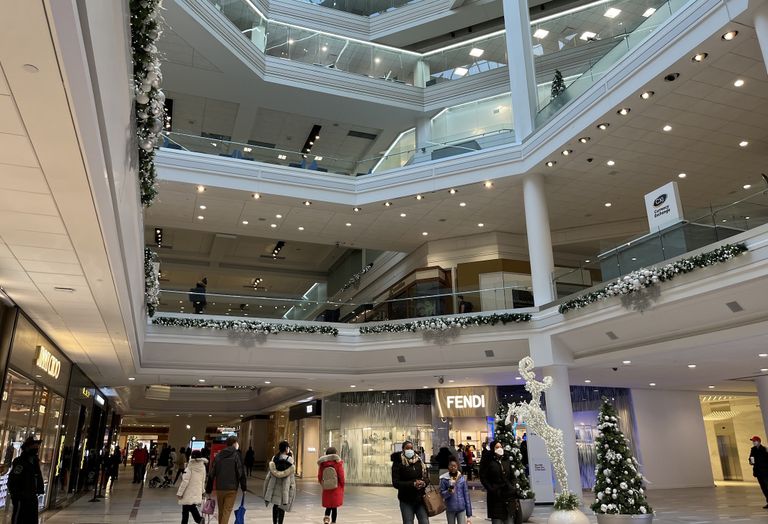
Simon Property Group, which has a 254-property portfolio totaling 206M SF, reported in its third-quarter earnings Thursday that its average base rent for malls and premium outlets was up 6.1% year-over-year.
The landlord signed 1,200 leases totaling more than 4.3M SF during the third quarter, with new leases representing 25% of its total deals. Base rents on those new leases were up 17% year-over-year, and it recorded a 10% decrease in the tenant allowances it provided.
Occupancy across its portfolio stood at 96.5% at the end of the third quarter, tied for the highest level since 2016.
This strong leasing demand came as its retailers last quarter recorded a 14.8% year-over-year increase in sales — a signal of the robust in-person consumer spending that has continued to boost the retail real estate sector.
"What we've seen is traffic is up and sales are up," Simon CEO Eli Simon said during the REIT's Thursday earnings call.
The REIT's leasing pipeline is up 30% year-over-year, with national retailers specifically up 40%.
Simon said the most active tenants are in the athleisure, junior brands, luxury, watches and jewelry segments. And it said the restaurant segment, which had previously been flat, had its best quarter in three years.
This performance enabled Simon to increase its full-year earnings guidance by 10 cents per share, and its stock price ticked up by about 1% Friday morning following the earnings report.
Now, the REIT is working to open more stores in its malls as the retail sector gears up for its busiest time of the year.
"What we're hearing from the retailers is optimism for the holiday season, which is our Super Bowl, our time to shine," Simon said. "We're focused on getting these stores open and continuing to add these new relevant retailers to our portfolio."
Across the country, retail demand has significantly outpaced new supply, with little new construction coming. The market posted 10.2M SF of positive net absorption in the second quarter, according to JLL.
In September, Green Street reported that mall values were up 13% year-over-year, leading all commercial real estate sectors. And that was driven by top-tier properties like those that make up the bulk of Simon's portfolio.
To meet the demand in the market, Simon has been focusing on its acquisition and development pipelines.
The REIT has roughly $1.2B in development underway, with approved projects reaching $1.4B. Simon said Thursday it plans to break ground next week on the Sagefield, a ground-up development south of Nashville.
The development would include 80 retail shops and restaurants across 100 acres. Simon expects the property to open by the end of 2028.
The REIT didn't disclose preleasing demand for the development but said this type of project wouldn't be happening without demand.
"If there’s no tenant demand, I don’t really care where rates are and what hypothetical spread we can build to," Simon said. "First and foremost is, do we have tenant demand? And the answer is yes."
The developer's other projects include the Brea in California, which Simon said is set to fully open in the next week or two. And Simon said it has a shadow pipeline of roughly $4B in development "behind it."
The REIT also has several international projects in the works, including expansions in Florence, Italy, Japan and Malaysia.
Simon said the REIT isn't as concerned about the high interest rate environment as other developers because it can fund projects from its cash flow — which the CEO called "a competitive advantage."
"When the world turns, if we have the tenant demand and we like the math, we can still do it when others can’t, which makes it even more valuable real estate when we’re done," Simon said.