SoftBank has taken a $3.7B write-down on data center power equipment it no longer plans to use.
The massive charge drove the Japanese technology investment giant to a roughly $7B quarterly loss, its first in nearly two years. SoftBank’s sprawling exposure to artificial intelligence and digital infrastructure in the U.S. makes the firm a bellwether for turbulence facing the tech sector, and this week’s write-down is being closely watched by a sector that has spent years — and billions of dollars — locking up scarce equipment well in advance of finalized development plans.
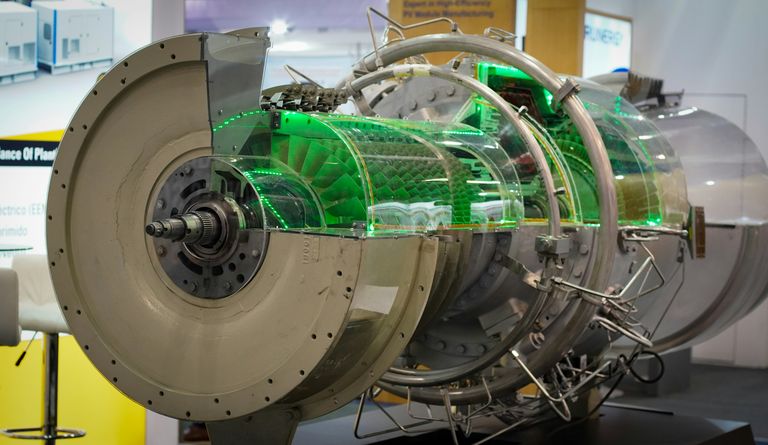
The $3.7B hit stems from massive orders for long-lead-time equipment placed by SoftBank and its subsidiaries as they pursued gigawatts of data center development across the country, executives said Monday on the company's quarterly earnings call.
Amid supply chain woes that have led wait times for turbines, transformers and other critical data center components to span years instead of months, the company committed billions of dollars to securing equipment well before it would be needed, often before project plans were finalized. Securing those orders required nearly $10B in upfront payments.
But following what SoftBank executives called a review of its project portfolio, the company is now backing out of a portion of these purchase agreements while remaining on the hook for deposits and other advance payments totaling $3.7B.
The pullback comes amid growing uncertainty around the huge pipeline of data center development in the U.S., particularly in markets like Texas and Ohio, where SoftBank has large-scale projects planned — and where the political environment has become far less friendly following the midterm elections.
While SoftBank Chief Financial Officer Yoshimitsu Goto declined to comment on the election’s impact on the firm’s data center plans during Monday's call, he said the canceled equipment orders don't mean the company is downsizing any of its current projects or development objectives.
Goto remained bullish on the firm’s development trajectory, attributing the write-down to rapidly changing equipment requirements in a rapidly evolving industry. Some equipment the company once expected to need is no longer the best fit, he said, while other components have proven more difficult to procure than anticipated.
Still, Goto warned that similar shifts in procurement strategy could result in additional losses.
“What kind of equipment will be better suited going forward? It might be the equipment that we thought would be needed turned out to be challenging to acquire more so than we thought before,” Goto said. “I cannot promise it's not going to happen again.”
SoftBank’s announcement of the write-down and quarterly loss triggered sell-offs of major data center power providers like GE Vernova and Bloom Energy.
Analysts said SoftBank’s write-down could indicate a broader vulnerability across the data center industry. The strategy of locking up long-lead equipment years in advance is common among large data center developers as they scramble to avoid project delays caused by component shortages and an unpredictable supply chain. This means SoftBank is likely not the only company determining that some of its early purchases no longer meet its needs and considering walking away from billions of dollars in advance orders.
“The most aggressive buyer in the turbine queue simply wrote off its deposits,” GLJ Research founder Gordon Johnson wrote in an investor note this week, Bloomberg reported. “SoftBank is a sophisticated buyer with access to every lender in the world. If it bought before it knew what it needed, we doubt it was alone.”
SoftBank’s equipment write-down is raising eyebrows in part because the company sits near the center of the AI infrastructure boom, with major investments spanning data center development power generation, AI labs and chips.
Through its data center development subsidiary SB Energy and the Stargate joint venture with OpenAI and Oracle, SoftBank has two major projects in active development and three others planned.
The largest is in Pike County, Ohio, where SB Energy is developing a campus that could eventually reach as much as 10 GW of capacity. The site has already been leased in its entirety to OpenAI in a 20-year agreement, and it could become one of the largest data center clusters in the world. Located at a former government enriched uranium manufacturing site, the project has a price tag approaching $500B, with SB Energy also investing more than $33B in new natural gas generation to serve the site.
Its other major project is an under-construction gigawatt-scale campus in Milam County, Texas, that has been leased to OpenAI as part of the Stargate initiative.
SB Energy has encountered rough waters in recent months. The firm had planned an initial public offering in September but has delayed the listing amid general market headwinds and concerns that it would fall short of a targeted valuation between $50B and $60B. The firm still hopes to go public in December or in early 2027.
SoftBank’s exposure to digital infrastructure extends beyond SB Energy and Stargate. In September, the company closed on its roughly $4B acquisition of DigitalBridge, giving it ownership of one of the most prominent data center and infrastructure investors.
The company has also sunk significant capital into major AI developers, most significantly OpenAI. Earlier this year, SoftBank invested an additional $30B in the firm, bringing its total investment to $64.6B and its ownership stake to 13%. As of September, OpenAI represented 21% of SoftBank’s holdings.
SoftBank also carries considerable equity interest in other AI and computing giants, including Arm Holdings, Intel and Perplexity.