Construction spending is up across the country, even as a tough economic climate bears down on development, but finding workers continues to be an issue as large numbers of openings go unfilled and billions of dollars in government spending heads down the pipeline.
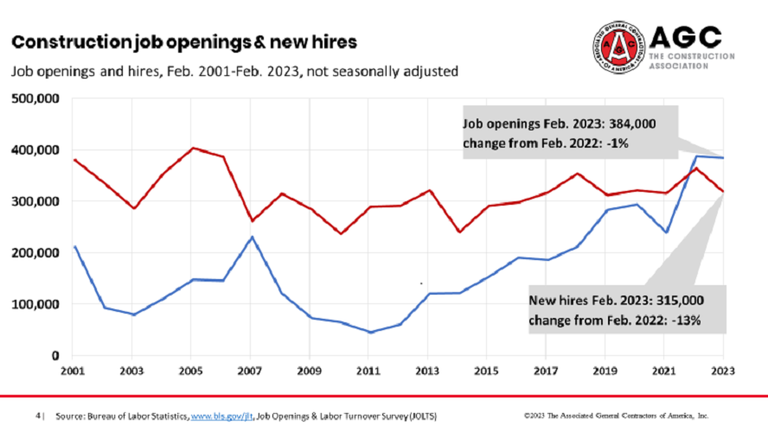
Overall construction spending was up 6% year-over-year in February, according to the U.S. Census Bureau, but because of difficulty finding workers, there were more job openings at the end of February 2023 than people hired in the entire month, according to U.S. Bureau of Labor Statistics data.
Job openings at the end of February 2022 and February 2023 were at record levels, according to Associated General Contractors of America Chief Economist Ken Simonson.
At the end of February 2023, there were 315,000 new hires in construction but 384,000 job openings, BLS data showed.
“That implies that contractors and homebuilders wanted to hire more than twice as many employees as they were able to bring on board,” Simonson said.
The data showed a 13% decline in construction employment year-over-year but just a 1% decline in job openings year-over-year.
Simonson said members of his organization frequently say they both need more qualified workers and have trouble finding them. The disconnect is preventing employment numbers from rising and, crucially, increasing project costs as projects take longer to finish and existing workers have to be paid overtime, Simonson said.
March BLS numbers show a slight drop in construction employment: seasonally adjusted employment totaled 7.9 million, a decrease of 24,000 from the revised February total but an increase of 196,000, or 2.5%, from the previous March.
Though slight, the drop was the first such decrease in 14 months. However, those numbers, along with data on job openings, indicate that “there is still growing demand for construction,” Simonson said.
“You figure contractors aren't going to be hiring people or posting openings unless they expect to have enough work for them to do, so to me that's a ‘real’ indicator” of the outlook for the industry, Simonson said.
Construction spending also rose, but as an indicator of market health, it’s less straightforward than it might seem, experts told Bisnow.
Construction spending rose 6% overall in February, with nonresidential construction up 17%, according to the U.S. Census Bureau, but Simonson and Associated Builders and Contractors economist Zach Fritz both noted that those numbers are not adjusted for inflation, which makes it harder to interpret them accurately.
“Construction spending, I'd say, is up superficially, but that kind of masks what's really going on,” Fritz said.
Breaking out the types of construction that contribute to the overall numbers, residential construction spending in February fell 5.5% over the same period the year before, while nonresidential construction saw a boost from major manufacturing projects that are direct results of the $280B CHIPS and Science Act of 2022, Fritz said.
The CHIPS Act’s first round of funding, launched in late February, opened up $39B worth of grants and loans for expanding existing semiconductor factories or building new facilities. According to Census Bureau data, spending on manufacturing construction projects was up 53%, with projects in the computer and electronics sector seeing a 146% increase in spending.
Major manufacturing projects are also a large piece of the employment puzzle.
A lot of construction employment shortages are regional, Fritz says, as, for example, residential construction chases population growth to certain areas or large-scale manufacturing projects require a lot of workers to converge on a few locations where plants are being built or expanded.
“The headline numbers can obscure the severity of labor shortages because when you look at the country as a whole, it might not be as bad as if you're trying to find people who can help you build a factory in Columbus, Ohio,” Fritz said.
Simonson said he expects the jolt of demand for certain types of construction, such as those related to the CHIPS Act, will balance out the decline in other areas of construction that have slowed down, such as single-family homes, apartments and office projects.
“These huge categories of manufacturing infrastructure and alternative power should provide enough demand for construction that the total figure will be positive,” he said.