Buying an older multifamily property in Houston comes with a steep price tag down the balance sheet.
Insurance costs nearly twice as much as for pre-1980s versus newer assets locally and 1.4 times the national average for the same vintage — if a policy can be secured at all.
That creates additional challenges for landlords already dealing with heightened operating costs and lower rent potential than their more modern counterparts and can lead to decommissioning of sorely needed affordable units.
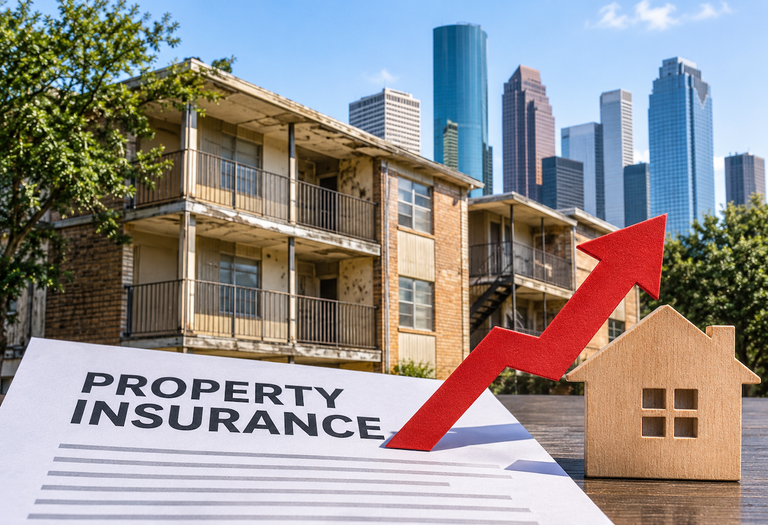
Houston multifamily stock built before 1980 prices at roughly two times stock built since 2015, according to data provided to Bisnow by Advocate Technologies, a commercial insurance data platform. Insurance costs account for 7% of gross rents for buildings built prior to 1980, compared to just 3.7% of gross rent for post-2000-built properties.
“A large share of affordable and workforce housing is sitting in these older buildings,” said Katie Dowson, who leads media and growth for Advocate Technologies.
“Higher insurance rates are landing hardest on the properties with maybe the least room to absorb them in a refinancing situation or an updated deal valuation.”
Analysts say the recency of severe weather events paired with aging infrastructure and outdated building codes cause insurance underwriters to price premiums for pre-1980 multifamily properties about 1.4 times higher than the national average. Meanwhile, Houston properties built in 2000 or later are being priced roughly 26% lower than the national average.
“The amount of insurance carriers that will consider multifamily built prior to 1980 is very slim,” said Mark Rafail, principal broker of Houston-based Rafail Insurance Agency. “Only about 10% of the insurance carriers, or markets we have access to, will entertain it.”
Advocate’s data shows just 48 carriers writing for Houston multifamily property insurance over a two-year period, compared to 482 carriers nationally.
On the pricing side, each decade of newer construction in Houston reduces the premium rate by about 14%. The per-decade rate reduction is less than 2% nationally, making the age of the building about eight times more powerful as a pricing variable in Houston than the rest of the country, per Advocate.
Carriers charge more to cover older buildings because of aging systems and infrastructure, like plumbing, electrical and roofs, that are more likely to fail and need costly replacements, Dowson said. They were also built before modern building codes that help protect from severe weather damage.
“Older roofs and buildings just tend to perform worse in hurricanes and flooding and freezes,” she said. “So a market with Houston's weather exposure is where you'd expect that age to matter a little bit more.”
Financial distress is already widespread in Houston’s multifamily industry. And as occupancy has fallen in the last few years and operating costs have spiked across the board, from the cost of debt to utilities, multifamily landlords have sometimes decided the insurance policy is where something has to give, said Rajeev Thorat, managing partner for Impex Strategic Initiatives, a subsidiary of Houston-based real estate investment company Impex Capital Group.
“Everybody was under pressure from all sides,” Thorat said. “So anybody who offers the cheapest or lower premium, they go ahead and buy it.”
It's a particularly meaningful line item as the price of insurance for multifamily units in Houston surged 57.3% from 2021 to 2024, according to the National Apartment Association.
Houston property owners that didn’t secure sufficient insurance coverage are still feeling the impacts of 2021’s winter storm that caused widespread electricity failures, deaths and property damage like burst pipes, plus back-to-back windstorms in 2024 that led to concentrated property damage and prolonged power outages.
Thorat invested in a property in Katy where the sponsor repaired a burst pipe in 2021, but insurance refused to reimburse them, citing the policy’s fine print. The financial fallout has halted distributions to investors for the last three years.
“They have got a lawyer. They keep fighting. Nothing is coming out,” he said. “Five years passed. I don't see light at the end of the tunnel.”
At another Houston property, 130 of the 580 units are out of service because of a similar situation from Hurricane Beryl, where the sponsor is trying to get an insurance payout before making the repairs. This exemplifies how important it is to understand exclusions such as named storms, not just go with the cheapest possible policy, Thorat said.
The landscape of multifamily insurance has changed over the decades, Rafail said. It was once somewhat standard for a multifamily policy to automatically include all liabilities, but now a more litigious environment has made underwriters and carriers more cautious, he said.
The rising cost of liability insurance is a national issue that is limiting affordable housing production, Fairstead General Counsel Seth Hoffman said. Fairstead is an affordable housing owner, operator and developer with 30,000 units throughout 28 states.
“Increased costs in affordable housing are a real challenge, and insurance is a driver of that,” Hoffman said. “The more expensive it is to do affordable housing, the less of it gets done, and insurance plays a role in that, absolutely.”
Fairstead operates its own properties and has a national track record of preservation and quality property management, which helps reduce premium pricing, he said. But even Fairstead has seen liability insurance prices double since 2023.
The company first hired a staff member to work on insurance in 2023, and that team has now doubled in size, Hoffman said.
“It's such a critical issue to Fairstead that we have two full-time staff members who do nothing other than work on insurance,” he said.
To keep a handle on costs for its properties, Impex recently signed with Lockton after months of negotiations, Thorat said. The insurance firm will inspect and come up with coverage at a reasonable premium for any property Impex brings it, and it is building a master policy for Impex's portfolio.

Upgrading properties and adding features like leak detectors and alarm systems can also minimize risks and lower premiums. But as construction costs have surged in recent years, people are less likely to renovate and improve their properties, Advocate Technologies Senior Operations Data Analyst Joanna Yiannourakou said.
“That's an assumption that insurers are also making,” Yiannourakou said. “Repair is no longer something that the average American can afford. So then that drives risk even higher for them.”
Operators should constantly monitor their expenses to make sure an already razor-thin margin doesn't compress further, Thorat said. A move as simple as setting an insurance bill to autopay can be detrimental to long-term financial performance.
Sometimes an adjustable monthly payment or a long-term policy will be possible, but it is on a case-by-case basis, as evaluated by the insurance companies.
“The onus is on the sponsors or the owners to ensure they are closely monitoring the insurance terms and conditions,” Thorat said.