What could it take to improve the stretch of the Kennedy Expressway that cuts through the West Loop, creating an eyesore, noise pollution and traffic congestion near its on and off ramps?
:no_upscale():quality(75))
Groups of college students from around the region came together recently to answer that question as part of the annual Harold E. Eisenberg Foundation Real Estate Challenge. The project, called Cap the Kennedy, was proposed by the local developer Fifield Cos, an event sponsor, and the goal was to create a more functional connection between the West Loop and the Loop's CBD. Fifield has proposed developing a 15-acre park over the Kennedy Expressway between Lake Street and Jackson Boulevard.
:no_upscale():quality(75))
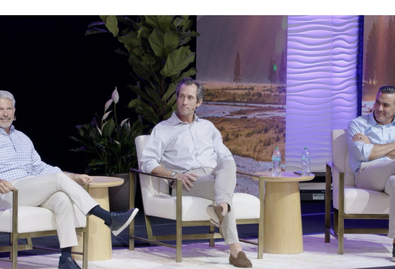
Five grad students in real estate from Roosevelt University won the competition with their plans for a mixed-use entertainment and commercial district and tech incubator, to be built over six blocks over the expressway. The plans, dubbed “the Landing,” would include an elevated pedestrian walkway with a park, several restaurant and retail options, a tech incubator and school (similar to Merchandise Mart’s 1871), and a glass-enclosed garden that can be used year-round. Judges, who included Fifield chairman and vice chairman Steve and Randy Fifield, executive VP Alan Schachtman, and Laube Cos principal Mike Laube (pictured reviewing student projects) said the Roosevelt University team’s proposal was the most economically viable, and also did a good job of tying their plans to ways people already use the neighborhood, which has become a popular tech hub and cultural destination in recent years.
:no_upscale():quality(75))
The Roosevelt team beat out teams from University of Illinois-Chicago, University of Illinois and Marquette University for a third year in a row. In past years, competitors have been tasked with planning the redevelopment of the former US Steel site on the city’s Far South Side, a vacant factory site, and the abandoned Marshall Field Warehouse on Irving Park Road. Roosevelt University’s Marshall Bennett Institute of Real Estate director Jon DeVries said the winning team created a project that was most likely to succeed in the real world.
:no_upscale():quality(75))
A winning project has to be feasible and has to excite the different groups who would rally together to get it approved by the city, financed and built, he says. Roosevelt’s fit that bill, particularly thanks to its idea for an indoor winter garden. (Pictured, judges and students with their trophy.)