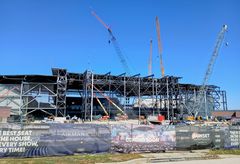
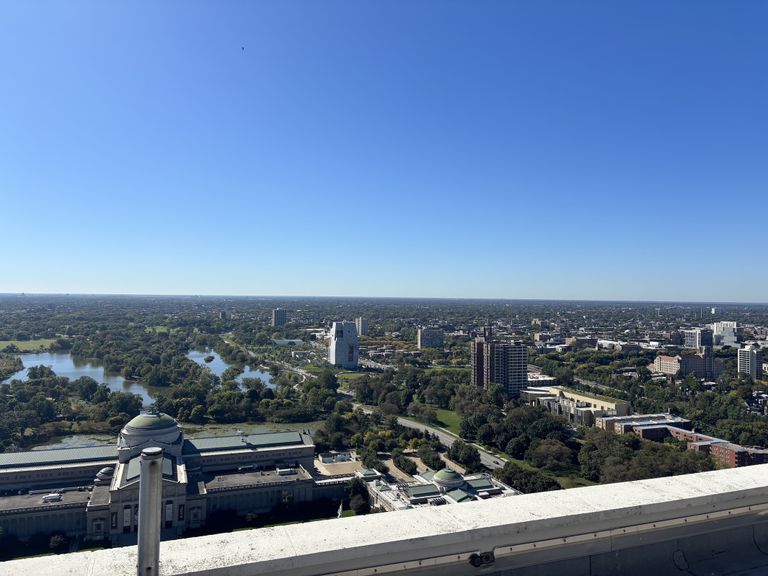
In the first 100 days after the Obama Presidential Center opened in June, more than 175,000 visitors from 50 states and 39 countries filed into its museum.
Thousands have hopped on buses and Divvy bikes to get to the museum, buying heaps of T-shirts and “Obama Burgers,” injecting life into a neighborhood some people claimed was “not ready for that investment,” said Michael Strautmanis, chief corporate affairs officer at the Obama Foundation.
“There are people who are coming up with new ideas for restaurants,” he said last week at Bisnow's Chicago State of the Market event. “They're coming up with new ideas for stores because that stimulative tourism dollar has walked into their community.”
The Obama Center's instant success gives other Chicago developers working on big projects across the city reason for optimism, panelists said at the event held at Navy Pier. Still, difficulties landing financing in the current market environment and ever-present concerns over volatile Cook County taxes are standing in the way of a broader wave of development.
Part of the driver behind the success is the expanded access to historically disinvested communities, which stand to benefit as projects break ground.
GMA Construction Group CEO Cornelius Griggs said the Obama Center and the $7B 1901 project near the United Center employ people across the city and provide opportunities for workers to make more money in construction jobs.
“When you take large megaprojects like 1901, and you place that in a neighborhood that's been disinvested in for over 75 years, you create real opportunity for people in those communities,” Griggs said.
He also pointed to the expansion of the CTA Red Line, which will add four new stations along a 5.5-mile stretch of the South Side, as a provider of new access to downtown for underserved communities. Griggs called on developers to follow transit expansion with new projects.
One of the biggest challenges in crafting a megaproject in an established neighborhood is how to not make it feel “almost like Disneyland,” Magellan Development Group President J.R. Berger said.
Magellan is developing a mixed-use project next to the University of Tennessee's football stadium. The secret to success is to find ways to connect the project to the local community every day, not just on a game day for a sports-focused development, Berger said.
For investors considering markets across the U.S., Chicago doesn’t exist in a vacuum, said Melrose Ascension Capital CEO Nick Melrose. Property taxes, governmental fiscal issues and the perception of crime hinder some investment — even though Chicago multifamily fundamentals are strong, he said.
When investors are active, they are usually preferring to invest in in-place assets in favor of new development, he said.
"It's all a basis game," Melrose said. "You can’t build cheaper than what you're buying into, and the long-term fundamentals — you're going to ride that wave successfully.”
The type of multifamily projects that are getting built are increasingly conversions, as office space in Chicago has largely traded at deep discounts in recent years.
Riverside Executive Vice President Mike Potter tracks residential supply across downtown and said about 4,500 units are under construction, including conversions and new construction.
“One in three residential units that gets delivered over the next two or three years will be a conversion product,” Potter said. “It's not really a small niche. It's actually become a very important category.”
Rep. Mike Quigley, who is running for Chicago mayor, spoke at the event about his target for housing in the city over the next four years: 50,000 units. He called on the room of developers to dramatically increase the supply of housing, saying it was possible if the city speeds up permitting and updates building codes.
“The city of Chicago can grow its way out of this problem,” Quigley said. “We need to build, baby, build.”
Developers said the lack of building is less attributed to permitting issues than it is to difficulties landing financing to get projects off the ground, Berger said.
“There's 8,000 units in Fulton Market and West Loop that have been approved through entitlements and aren't under construction,” he said. “We have a finance issue. It starts there before you even get to permitting.”
One of the biggest problems in the city and in Cook County overall is that there hasn’t been enough development of anything over the past 10 years, said Siegel Jennings partner Molly Phelan. To get development investors back to the city, the government needs to provide better incentives, she said.
Phelan said at the moment, there isn’t enough critical mass to feed the retail the city needs for a vibrant downtown.
“If we would get out of our own way and let investors come into the city, provide jobs, provide development and provide a tax base, that's going to make our city great again,” Phelan said.