Construction managers have a lot on their plates.
Just one project has owners, developers, partners, owner's representatives, architects, engineers and project managers working alongside subcontractors, suppliers and vendors — all with different responsibilities, personalities and priorities. Add thousands of pieces of material and equipment and an enormous number of decisions that have to happen in the right sequence, and what’s left is the construction manager in the middle of it all.
“I always say that a construction manager’s work product is everybody else’s work product,” said Joseph D. Honan, senior vice president and co-founder of 4D Development Corp., a New York-based construction management firm. “We are not fabricating the steel, installing the mechanical systems or drawing the plans. Our product is the finished building, and that building is the collective result of everyone else’s work.”
Honan said this is why construction managers cannot operate with a “not my job” mentality. Their responsibility isn’t simply one aspect of the build — it’s the overall outcome.
He said that for 4D, sometimes that means managing subcontractors, and sometimes it means pushing the architect or engineer for information. Other times, it could mean managing the developer or owner and saying, “We need this decision by this date, and this is what happens if we do not get it.”
“That willingness to take ownership of the entire process is a major part of how we approach construction management at 4D,” Honan said. “Successful construction management can be reduced to any one category. Cost, schedule, safety, quality, leadership, communication, site organization and morale all work together.”
This approach allows for a more streamlined site as well as a safer one, he said.
A clean, organized site is safer. Preplanning work creates safer and more efficient operations. Treating the trades with respect creates better communication, while better communication creates better coordination and positively impacts cost, schedule, quality and safety.
Ultimately, he said, culture drives the project.
“If everyone understands what they own, communicates openly and works toward the same objective, the project operates differently,” he said. “That culture has to be managed every day.”
One of the ways that 4D puts that philosophy into practice is through cost management and communication with ownership.
When a potential cost issue arises, the company does not want it sitting for weeks while everyone waits for a perfectly complete change order package, he said. The minute the team knows there may be an issue, they want it identified, tracked and communicated.
If it is a design issue, the architect and engineer are involved, Honan said. If it is a subcontractor issue, the subcontractor is brought into the conversation. If an owner decision is needed, ownership needs to understand what decision is required, when it is expected to be made and what happens if it is delayed.
“Our goal is to communicate developing costs and risks in real time and reinforce that through a weekly reporting process,” he said. “Ownership receives a current picture of open cost items, developing exposures, pending decisions and other project risks so everyone is working from the same information.”
Every meaningful issue should have an owner, a due date, a current status, a next action and a path to closure. That, he said, is what accountability looks like in practice: creating a process where an issue cannot quietly disappear between meetings.
Honan said this also creates transparency for the client by bringing them into the process while there is still an opportunity to influence the outcome.
“An owner should never be hearing about a meaningful cost issue for the first time when the formal change order arrives for approval,” he said. “By then, you may have already lost the opportunity to mitigate it, redesign around it or negotiate it differently.”
The project team should have real-time visibility into developing issues, ownership should have a consistent weekly picture of cost and risk, and everyone involved should understand what needs to happen to keep the project moving, he said.
That same philosophy applies to schedule, procurement, design coordination, requests for information, submittals and field operations, he said. There should always be an answer to the same questions: What is open? Who owns it? When do we need it? And what happens if we do not get it?
“A lot of problems in construction happen in the spaces between individual scopes,” Honan said. “Everybody may be doing their own job, but nobody is looking closely enough at where one person’s work touches somebody else’s. That is why our philosophy goes beyond traditional MEP coordination.”
4D aims to understand every interface possible, from structure to architecture, waterproofing to facade, electrical to millwork, equipment to utilities, finishes to rough-ins, access, logistics, material deliveries and sequencing, he said. The goal is to build the project in their heads long before it is built in the field.
This becomes especially important in multifamily construction, where repetition multiplies mistakes very quickly, he said.
“On a 101-unit building, if you fail to coordinate something that repeats in every apartment, you did not make one mistake,” he said. “You may have made the same mistake 101 times.”
The time to solve those issues is before installation, during preconstruction, design review, shop drawings, submittals, coordination, mockups, procurement planning and preinstallation meetings, he said.
That is why bringing the construction manager into the project early creates so much value. Many of the decisions that determine whether a project will be successful happen months before construction begins.
“There is another phrase I have always used in construction: Good management is quiet management,” Honan said. “You see the problems that happen. What you do not see are all the problems that did not happen. That value can be difficult to quantify because the best evidence of good management is often the absence of a problem.”
As projects become more complex, the construction manager’s role in accountability will only become more important, Honan said. Buildings have more systems, more technology, more complicated energy requirements, more sophisticated ownership structures and more complex supply chains.
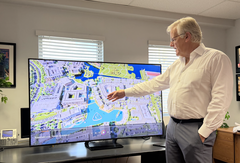
Technology will continue to help track information, visualize buildings, identify conflicts and communicate more efficiently, but it does not replace ownership, he said.
Ultimately, construction is still a people's business.
“I think that is one of the things that differentiates 4D,” he said, “We are not just reporting the history of the project. We are trying to manage the future of the project.”
This article was produced in collaboration between 4D Development and Studio B. Bisnow news staff was not involved in the production of this content.
Studio B is Bisnow’s in-house content and design studio. To learn more about how Studio B can help your team, reach out to studio@bisnow.com.