Miami is living large in shrinking units.
Between 2013 and 2022, the average new Miami apartment was 912 SF, about 3% bigger than the national average. But South Floridians used to spacious units are going to have to learn to think smaller.

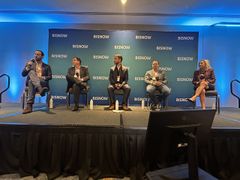
“The same people that are willing to pay whatever they were paying for rent for an 800 SF, one-bed [apartment] are now going to have to understand that they may only be getting 550 SF,” Marc Chasin, vice president at Eden Multifamily, said at Bisnow’s South Florida Annual Housing Summit on Wednesday.
Coconut Grove-based Eden Multifamily develops market-rate apartments, and the market at the moment has more appetite for micro-units, he said onstage at the Mayfair House in Coconut Grove.
“If you take three 500 SF units, that's 1,500 SF. As opposed to two 750 SF units, those will move off the shelf much faster when you're actually going to make your sales,” Chasin said. “Even if you're selling them at the same price per foot, effectively, you make the same amount of dollars, and you make your sales much quicker.”
The reason is that buyers and renters focus more on the total price tag of the condo rather than the price per SF, developers said. That allows builders to create more housing units and make a better return.
“Actually, it is more expensive to build a smaller unit, but also the price per square foot that you can get when you sell is actually a lot higher than a larger one-bedroom,” North Development Chief Financial Officer Arturo Vidal said. “So for us, a studio, even though it's, per square foot, more expensive to build, the delta on what I can sell it for is actually higher than my increased cost.”
Costs are top of mind for developers attempting to bring housing to South Florida. Doron Broman, the founder and CEO of Moderno Development, said the price of construction has stabilized, but it isn't expected to drop going forward, according to Oxford Economics.
“At least [costs] are not moving up,” Broman said. “We're dealing with a 50% increase over the last three years, which made underwriting almost impossible.”

That has prevented developers from getting started on projects. Chasin said Eden is focusing its multifamily efforts on other markets. Lauren Goebel, development director at Texas-based Hanover Co., said the last South Florida apartment building her firm got financed was a high-rise in Fort Lauderdale in late 2022.
“I'm sure most of us in this room have struggled with rising costs over the last couple years, combined with interest rates going up, cap rates going up,” Goebel said. “It's been quite difficult to underwrite new multifamily opportunities in South Florida.”
Miami condo prices have risen 123.7% over the last 10 years, according to Miami Realtors, but that growth has slowed as the pool of buyers at higher price points has thinned. Median condo prices rose just 1.2% year-over-year.
The rapid increase in costs and values has stratified the market, developers said, with new residential units divided between short-term rental micro-units and 3K SF luxury condos, Vidal said.
He added that the apartments that are seeing the most demand are those selling for less than $1M. Even slightly larger units selling for between $1M and $3M aren't finding nearly as many buyers.
“There's like a psychological barrier of under a million, which is leading to small units,” Vidal said.
And while Miami has historically been a bigger-apartment town, its recent growth has been fueled by domestic migrants from higher-cost cities where smaller apartments are a fact of life. The city of Miami’s population has increased by almost 4% since 2020.
“We're seeing that after Covid, because of the mass migration of people wanting to live in the urban core, you're going to see it become like New York, Toronto, like Chicago, where shrinkflation is a thing,” Vidal said.
Layouts have changed, appliances have shrunk, and common spaces will become more important to adapt to the new reality, Chasin said.
“There’s certain variables that I think people will just have to adopt and get used to,” he said.