Ireland's government has done good work making the country's rented residential sector investible again after a decade in the doldrums. Now, it needs to avoid the temptation to meddle again
During Bisnow’s sold-out Ireland Residential Investment and Development Conference in Dublin on 22 October, the regulatory changes on rent caps, development specs and planning were widely praised, but some of Europe's top developers warned that international capital is looking for long-term stability.
The message was simple: Maintain the regulations and avoid tinkering with the rules further if the influx of overseas capital needed to build significant new supply is to be captured.
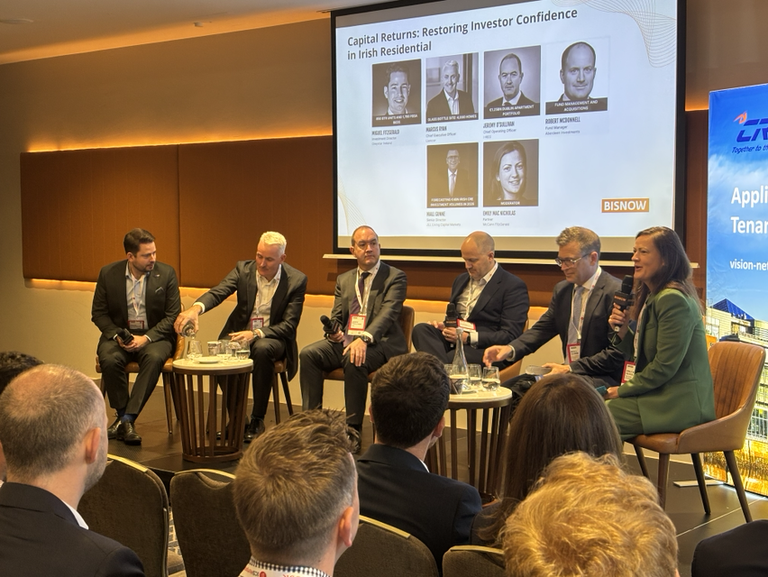
"With something like 10 regulatory changes in the decade from 2016, it was like moving sand. The message now is clear and unambiguous: We need institutional investors coming in,” JLL Living Capital Markets Senior Director Niall Gunne said.
The appeal of the Irish residential market has noticeably increased since regulatory reforms kicked in this March, in part because of the supply and demand imbalance and Ireland’s favourable demographics and population growth, Gunne said.
However, he also reflected that some of the competitive pricing was down to previous challenges in the market.
“Ireland’s appeal is down to a multitude of factors, including that compared with other EU markets, we have the highest yields. But that should not be the case. It is scar tissue from the previous decade,” he said.
Pan-European investor Aberdeen Investments Fund Manager Robert McDonnell stressed that the company “fundamentally really likes Dublin” as he pointed to the living sector as offering a durable income stream growing over the long term.
“Ireland offers strong supply/demand dynamics, a strong economic base, and the sector has grown up a lot over the last 10 years," he said.
"Across Europe, we are seeing operational volatility compared with [stability in] Dublin. The Irish market is driven operationally by less reactive maintenance, and the employment base means that tenants have the earning power to afford the rents."
He stressed that achieving top pricing was about having the right product, right location and high quality in development and operation.
“We look at accessibility, vibrant locations, and affordability of rent for a target demographic,” McDonnell said.
That appeal to international capital is crucial if Ireland is to start addressing its housing shortage, Lioncor CEO Marcus Ryan said. He added that the company — which has an extensive development pipeline — had already seen a major change in investor attitudes.
“Ireland was a no-fly zone,” he said. “There has been a sea change since the new rent regulations, along with other changes. In a European context, we’re probably the best out there in terms of quality and amenities. If you look at Europe, generally, Ireland is No. 1 in terms of fundamentals, so we have to make Ireland the most attractive location. On top of that, yields are probably 100 bps ahead of Europe.”
Ryan said he believed that the government had recognised and intervened to move the market, and he pointed to the international investors who had made acquisitions already.
“A year ago, there was probably €3B to €4B in development opportunities and only a handful of investors chasing that. Now, it’s the opposite. We have to be conscious that we’re a small market and have to make ourselves as attractive as possible,” Ryan said. “Lioncor is on-site with over 1,000 units and for 2027 a pipeline of 3,000 units. We are taking that leap of faith.”
I-RES Chief Operating Officer Jeremy O’Sullivan echoed Ryan’s view on investor sentiment. Ireland's largest rented residential owner is the subject of a £727M takeover offer from Barings.
“As a PLC, we are constantly talking to a mix of investors, and we’re hearing all the time that Ireland is investable again," he said. "The consistent message is stability, policy stability. The regulatory changes were well signalled, and while [the impending changes] hung over the market for a little while, they are operating quite well. What investors want is to be able to keep a line of sight over multiple years. But it’s early days. Ireland is a unique opportunity, but we are a small market, and capital is mobile.”
He reiterated that investors want to see clear liquidity and the opportunity for development to be recycled after five years.
“The government must hold the line,” he said.
Greystar Ireland Investment Director Miguel Fitzgerald agreed and said that for Ireland, it is vital to maintain attractiveness in the face of competition from other European residential markets.
“Ireland is a take-it-or-leave-it market," he said. "International investors don’t have to be here in the same way as Germany, the UK, France, so they need to see an angle. Global events may actually be playing well for us. Currently, Ireland offers UK yields with European financing. Other markets also have growing socio-economic issues,” he said.
Gunne added that he was confident in the direction of the market and the regulatory environment but less so in the pace of investment and development.
“It will take a few quarters to gain confidence, but there is light at the end of a long tunnel,” he said. “What we need to see now is no change, other than improved viability.”