A stable, dependable government with predictable policies, lower transfer tax and more solutions for grid congestion.
That is what Dutch real estate is asking Sinterklaas for this year, according to speakers at Bisnow’s Netherlands State of the Market event, held at KIT, formerly known as the Royal Tropical Institute, in Amsterdam.
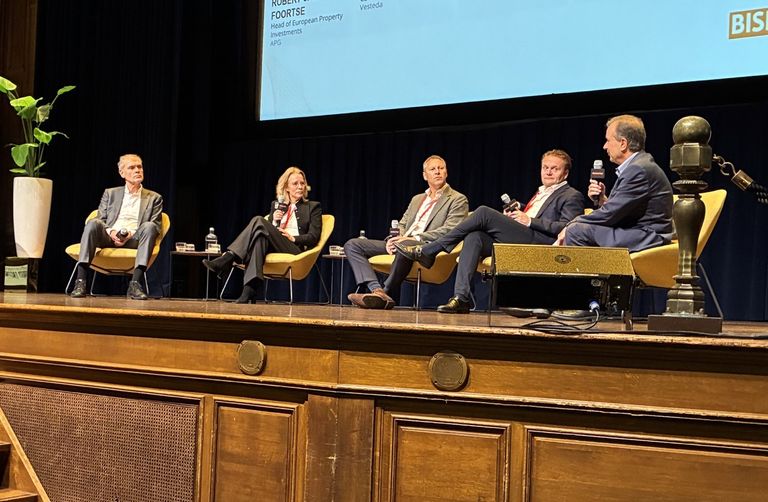
While some of these issues may be a bit trickier to overcome than others, speakers were adamant that addressing them would help bring capital back into the market. Money is there, and investors are keen to deploy it under the right conditions.
“In January our outlook of the Dutch market was fairly positive, and that’s what we saw in the first and second quarter: a lot of traction in the residential market, mainly driven by Dutch institutional investors and family offices,” said Jan Hein Tiedema, head of the Netherlands at Hines, which manages $91B (€83B) in assets across approximately 30 countries.
Commercial real estate investment volume reached €7B in the first half of 2026, up 36% on the same period last year, according to CBRE Netherlands. It is forecast to hit €15B for the full year, which would represent a 15% jump for the full year.
However, the market shifted after summer, and not necessarily for the better.
“With interest rates rising, I see many deals postponed, delayed and renegotiated,” Tiedema said. “We’re facing it ourselves on the selling side as well as on the buying side.”
That same cautious approach is evident in capital allocation, with investors becoming increasingly selective about how and where they allocate money.
Hines had been attempting to sell a residential asset in Amsterdam in September that was initially perceived as a “great deal, with plenty of appetite,” Tiedema said. However, the bids received were below expectations, leading Hines to pull the sale.
With interest rates likely to rise before they fall in the eurozone, investors are relying on income returns to make money, and rents are rising in all sectors for good assets because of limited new supply. So the question arises: Where is capital still going in the Netherlands?
Robert-Jan Foortse, head of European property investments at APG, one of the world’s largest pension investors, said the company had committed about €3B to its residential development partner platforms, including a tie-up with CBRE IM.
“Of that €3B, we’ve allocated roughly €1.5B to actual projects. The NAV at the moment is only €500M, so we have some way to go,” Foortse said, adding that it was looking at forward funding and turnkey development.
The Netherlands is grappling with an acute housing shortage, which is estimated to be at 384,000 homes, or 4.6% of the housing stock, according to the Ministry of Housing and Spatial Planning. As such, many domestic investors are investing in residential property.
But just because there is a lack of supply doesn’t make it a good investment opportunity, Foortse said.
APG has a mandate to invest capital in the Dutch residential market, particularly new development, but finds it difficult to identify the right product with the right risk-return profile.
“Which is interesting, or rather a bit disappointing, because we have the capital and we would like to invest to build those houses, but we can’t make it work,” he said.
For every new development APG backs, it rejects six to 10 of them.
Tiedema echoed this sentiment, saying working in the Netherlands as an international investor requires “a thick skin.” Hines manages capital for the Netherlands, Germany and the Nordic countries, and all three compete for the same pool of capital.
With these markets looking more attractive at the moment, Tiedema said the Dutch market is a difficult sell.
However, the Netherlands only has “to make a few changes to be relatively more attractive” than the countries surrounding it, Foortse said, as the aforementioned countries face their own struggles.
Among those changes needed in the Netherlands? Political stability.
The Dutch cabinet nearly fell apart last week after the VVD clashed with D66 and CDA over a proposed reform of the Box 3 wealth tax system. VVD leader Dilan Yeşilgöz threatened to withdraw from the minority coalition, but after four days of crisis talks, Prime Minister Rob Jetten reached an agreement to keep the cabinet, highlighting the fragile state of the government.
“Every time we meet with the ministry, we say, ‘Can we please have some stability and predictability,’ because that makes it so much easier for international investors to invest because it will just lower their return hurdle,” Foortse said.
“Effectively changing the policy increases risk, and increasing risk raises your discount rates. It’s so simple, and if you maintain stability, return requirements go lower.”
A major blocker for both international and domestic investors is Dutch transfer tax, which does not exist in most European countries of a similar size. For commercial properties, the transfer tax is 10.4%.
Edge CEO Boudewijn Ruitenburg said a developer who buys an end-of-life building, renovates it and then sells it pays the tax twice.
“It’s just ridiculous. Business cases do not work. That is something that the government needs to solve.” Ruitenburg said.
At the end of the day, what international investors are looking for is very simple, said Jan-Willem Bastijn, head of EMEA transactions at CBRE Investment Management. And the fix is within reach.
“They are looking for relative value. And where can I find the best value from a risk-return perspective? If you want to be relatively good, you need to offer growth,” Bastijn said.
Leveraging more than three decades of industry experience, he added that the Netherlands was often the first stop for investors coming from London, as it was predictable, growing and English-speaking, with strong infrastructure, the rule of law and a large domestic capital base.
“In other words, you couldn’t get fired from your investment committee for making a commitment to the Netherlands,” he said.
That appeal has drifted in recent years, he said.
But with “little tweaks … you’re right back up to the top.”