The U.S. multifamily sector is becoming increasingly bifurcated as individual markets grapple with distinctive supply and demand equations.
Though vacancy rates are rising and rents are moderating broadly, the exact story depends on the local market, said Caitlin Sugrue Walter, senior vice president and head of research and innovation at the National Multifamily Housing Council. Places that aren’t building enough multifamily units are seeing stagnant vacancy rates and increasing rents as a result.
“We are really seeing this increasing divergence in markets around the country,” Walter said at the National Association of Real Estate Editors Conference in Miami on June 3.
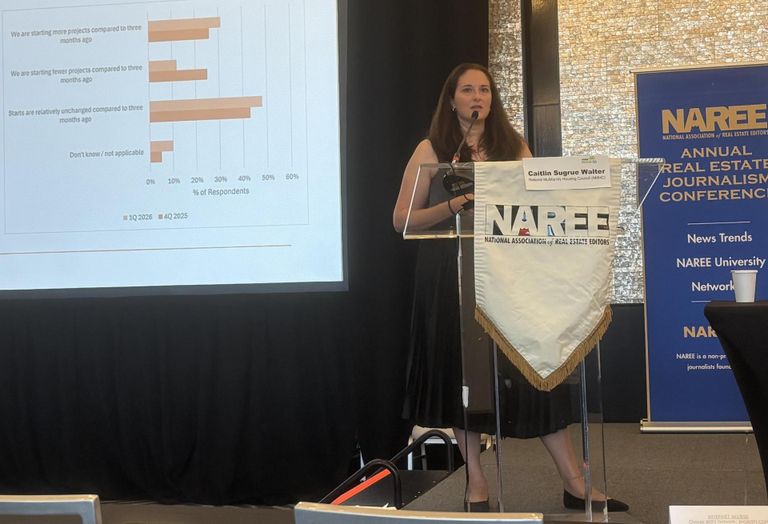
In places with historic levels of supply, such as Phoenix and Austin, the market is working through some of that supply, Walter added.
During Q1 2026, multifamily net absorption in Phoenix reached 6,261 units and, paired with a slower pace of vacancy, helped disrupt a nearly five-year streak of rising vacancy, according to a Cushman & Wakefield report. The vacancy rate declined 70 basis points quarter-over-quarter to 12.1%.
Occupancy in Austin rose 40 basis points to 92.8%, according to a Colliers report. Asking rents, particularly for Class-A properties, rose in Q1, a contrast to the previous 10 quarters.
In April, 23% of respondents to an NMHC survey said conditions in the local markets they watched were tighter than three months prior, up from 7% in January. Roughly half of the respondents said conditions were unchanged from three months before, the same as in January.
There are question marks about how migration patterns will trend in the future, Walter said. But there are still many concessions in high-supply locales, with 17% of apartment units in the U.S. currently offering some form of them.
Class-C apartment buildings are recording the highest concession rates and are also experiencing lagging rent growth and rising costs, like insurance and utilities, Walter said. Without the ability to drive rents, that segment of the multifamily industry is starting to show signs of stress.
New multifamily construction starts are also leveling off throughout the country, and Walter pointed to the increasingly difficult development environment, including issues with labor availability, high material costs and local building regulations.
“For the folks that are building, the impediments to building are not changing, and so it is making it difficult to build to the price points that folks need to, especially in this era of stagnant and declining rents,” Walter said.
Walter said there are 22.4 million cost-burdened renter households in the country — about half of all renters. That includes a substantial subset of people earning $50K to $75K per year as well as people making $20K per year.
Making housing affordable for both groups will take a multifaceted approach, she said.
“We need to allow for more market-rate housing through deregulation,” Walter said. “We need to encourage more tax abatements, we need more streamlined permitting processes … we also need to work on deriving and raising our naturally occurring affordable housing.”