
Nonfarm payroll employment increased by 225,000 jobs in January, the U.S. Bureau of Labor Statistics reported Friday, marking the country's 112th straight month of employment gains.
The unemployment rose slightly to 3.6%.
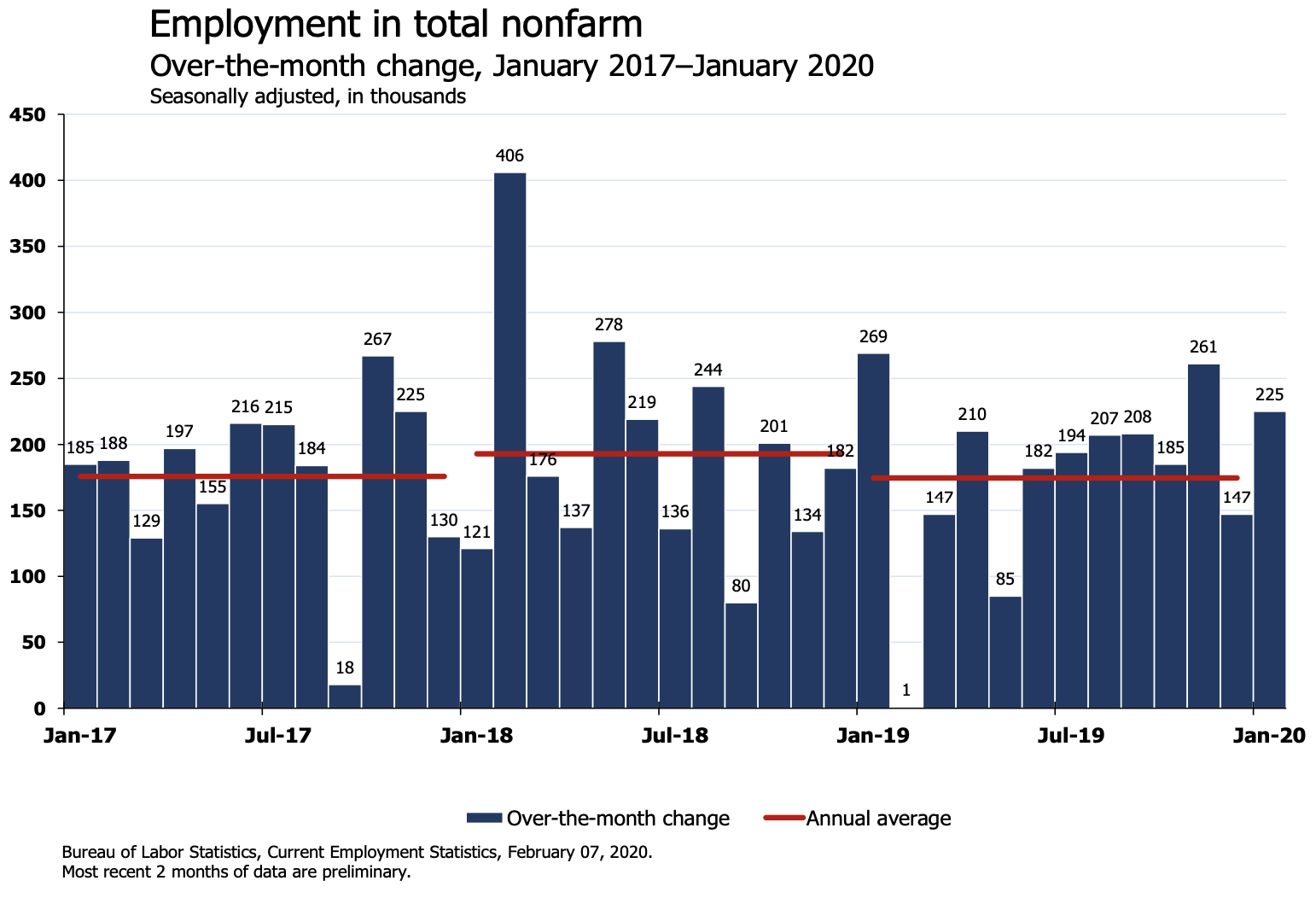
Notable January job gains were seen in construction and healthcare. The construction industry added 44,000 jobs in January after adding, on average, 12,000 jobs a month last year.
Healthcare employment grew by 36,000 jobs in January after adding 399,000 jobs in 2019 and 350,000 jobs in 2018.
Here's how economists and others reacted to January's jobs report on Twitter.
Wooo eh! 225k jobs added!
— Nick Bunker (@nick_bunker) February 7, 2020
Jan #JobsReport from BLS: Payrolls +225K & unemp at 3.6%, up slightly. Wage growth rebounds to 3.1%. The real news this month: benchmark revisions subtracted 514K jobs from Mar 2019 employment level, worst since 2009. Makes 2018-9 growth look much more muted. 1/n#JobsDay
— Daniel Zhao (@DanielBZhao) February 7, 2020
Best news in the jobs report = Labor Force Participation hits 63.4%, the highest of this recovery so far
— Heather Long (@byHeatherLong) February 7, 2020
More Americans are getting jobs and hunting for jobs again. That is a welcome sign, especially with aging Baby Boomers.https://t.co/iJMORZOeYS #jobs pic.twitter.com/i4jp4Ijpxt
Well, this is interesting! With the revisions, employment growth in lower-wage industries was slower than previously thought. But picked up strongly the end of the year pic.twitter.com/QOIXvDxVlT
— Nick Bunker (@nick_bunker) February 7, 2020
Here's the worrying trend in the #JobsReport
— Heather Long (@byHeatherLong) February 7, 2020
Wage growth for rank-and-file workers dipped at end of 2019. It looked like December was a fluke, but January wasn't much better.
Wage growth is now 3.3% a yr. That's above inflation (2.3%), but well below 4% growth of late '90s pic.twitter.com/HwsY1SyeOf
The macro mystery continues! Solid hiring, a low unemployment rate and...slowing wage growth for both supervisors and production workers. Certainly no inflation pressures for the Fed to worry about. pic.twitter.com/n0t4rNfusj
— Dr Julia Coronado (@jc_econ) February 7, 2020
Typically, as the job market closes in on full capacity, job gains tend to slow, much the way you must pour more slowly as you reach the brim of a glass to avoid spillage (inflation, in this analogy). Instead, we're seeing no such deceleration, another sign of room-to-run!
— Jared Bernstein (@econjared) February 7, 2020
The small change in the unemployment rate obscures that there has been a downward trend for white workers over the past few months and an upward trend for African American workers. The two seem to be diverging. @BLS_gov #JobsDay
— Kate Bahn (@LipstickEcon) February 7, 2020
The progress gap is still particularly pronounced among 25-34 year olds. Young men (upper line) are just kind of muddling along, while young women just set a new labor force participation record. pic.twitter.com/f9XKoHlfht
— Jeanna Smialek (@jeannasmialek) February 7, 2020
Overall, 36% of job growth over the last year comes from workers 65 and over.https://t.co/bVMV9o2lSu
— Michael Madowitz (@mikemadowitz) February 7, 2020
Construction had continued gains, +44,000 for January, but manufacturing showed losses, led by a drop of 10,600 in autos and auto parts. Retail trade continued weakness, led by drops in department stores -16,900. And transportation showed gains led by messengers +14,300 @AFLCIO
— William E. Spriggs (@WSpriggs) February 7, 2020
Basically this figure is showing that BLS employer surveys are doing a really bad job sampling industries with lots of business failure and creation. The shift from brick-and-mortar retail to e-commerce seems to have thrown the CES survey a major curve ball last year. https://t.co/X2JksJUfem
— Andrew Chamberlain, Ph.D. (@adchamberlain) February 7, 2020
One huge question mark this #JobsDay is the coronavirus outbreak. Those effects aren't incorporated in the Jan #JobsReport. We don't know how that'll play out, but it's likely to be a drag on trade-exposed industries like #manufacturing in coming months... 12/n
— Daniel Zhao (@DanielBZhao) February 7, 2020
)
)
)
)
)
)
)
)
)
)
)
)