The Chicago Covenants project has released an interactive map of racist restrictions put on Cook County properties in the past century, the first part of a long-term project documenting patterns of housing segregation still visible today.
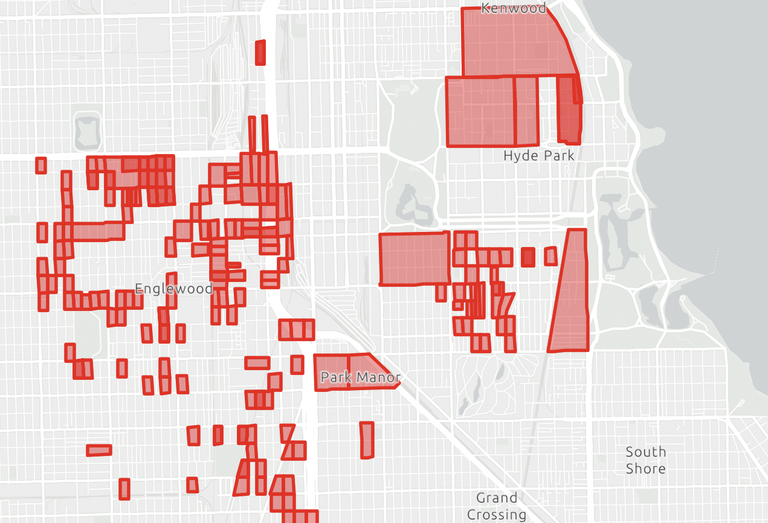
The map, which launched online Tuesday, highlights about 25,000 properties where owners agreed never to sell or rent to Black people during the 20th century, representing about 20% of Chicago.
Featuring an interactive timeline spanning 1928 to 1969, the first iteration of the project shows 300 of 1,000 covenants and restricted plats across 100,000 parcels in the South Side neighborhoods of Hyde Park, Beverly, Englewood, West Englewood and Back of the Yards.
“I've been surprised by how widespread these are," LaDale Winling, the Virginia Tech historian who heads the Chicago Covenants project, told Crain’s Chicago Business. "It's not just one block or two blocks. It's shocking to see how powerful the desire to exclude [Black people] was."
Winling leads a team of researchers that includes research coordinator Maura Fennelly of Northwestern University and students at the University of Chicago.
The map shows that racist covenants once blocked Black buyers and renters from most of the 88-block Hyde Park neighborhood bounded by 47th and 55th streets and Lake Park and Cottage Grove avenues, whereas such covenants were spottier in nearby Englewood.
Clicking on tracts on the map brings up original covenant restrictions like one from the Woodlawn neighborhood that expired in 1948: "No part of said premises shall in any manner be used or occupied by any negro or negroes."
That document does make exceptions for hired help, who were allowed to enter homes from the rear or live in garages and basements, in the case of chauffeurs and janitors.
"It's jarring," Fennelly told Crain's. "The language of servitude is very clear."
The project website explains that two types of covenants were typically found in Cook County: plat restrictions created by developers before lots were even sold and agreement covenants, which were filed by neighborhood groups.
Some covenants explicitly restricted selling property to people who weren't white, and others enacted restrictions on development traits like minimum lot size and home values, which had the same effect of excluding immigrants, working-class people and Black people, the Chicago Covenants project said.
The group is in the process of researching the Kenwood, Woodlawn and Park Manor neighborhoods and will tackle Evanston, Rogers Park and Roseland next.
"These records have been buried in the files of Cook County, but a new collaboration is unearthing the documents to illustrate how racial segregation in Northern cities such as Chicago was not accidental," the Chicago Covenants project said on its website.
"It was a system that was intentionally created, house by house, block by block, and subdivision by subdivision, across the city and across the country."