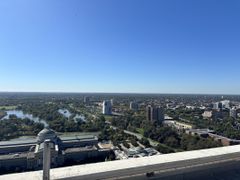
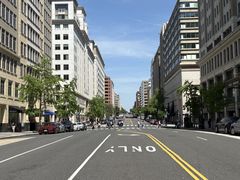
With Washington, D.C.'s southwest federal corridor poised for transformation, concern has been mounting about the lack of a coordinated effort or vision to guide the 230 acres south of the National Mall into their next life.
But a master plan is now underway.
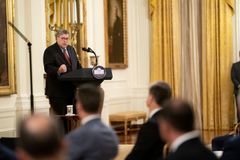
“We're working on the bones of that right now," Diane Sullivan, acting executive director of the National Capital Planning Commission, said at a Thursday morning event hosted by Mayor Muriel Bowser’s administration.
Sullivan, who heads the commission tasked with steering the direction of federal lands in the D.C. area, offered some details about the initial vision and priorities for the revitalized mixed-use corridor.
“We have talked about this opportunity for years, but it's different this time. GSA is making moves, and these moves are key to unlocking the area's potential,” she said onstage at the Downtown Defined event, held at the Ronald Reagan Building and International Trade Center. “So now is the time for the next great plan.”
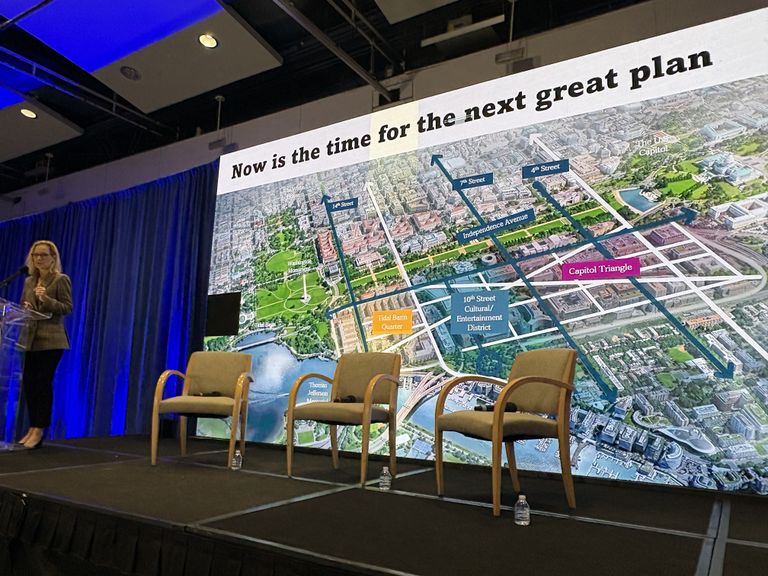
NCPC is working with the General Services Administration, the Deputy Mayor’s Office for Planning and Economic Development, and the DC Office of Planning on the “early stages” of a plan, a NCPC spokesperson told Bisnow in an email after the event, saying that an early iteration of the work is expected to be released in the first half of next year.
Sullivan said the vision would be conducted by three guiding principles: restoring the street layout from its Urban Renewal design to that of the original L’Enfant Plan, expanding the park network to create a path from the Monument to the Wharf, and creating neighborhoods.
“This is 230 acres,” she said. “It's not going to be a single neighborhood.”
A map projected behind her outlined the boundaries for three such neighborhoods that she said are under consideration.
On the westernmost side of the corridor would be the Tidal Basin Quarter, dedicated heavily to residential. The area has multiple office-to-residential conversions underway at the Portals building complex, as well as the Liberty Loan building that the federal government sold earlier this year.
The 10th Street Cultural/Entertainment District would be next door to the east, and Sullivan said it would hold a concentration of museums and cultural institutions. That area has the Spy Museum as well as the Arts and Industries Building, which is set to house a new National Museum of the American Latino. It’s also where the Department of Energy’s James V. Forrestal complex sits, a site long envisioned as a redevelopment opportunity to open a gateway from the Wharf to the Mall.
Capitol Triangle, the farthest district to the east, would be a new hub for federal agencies, Sullivan said, which would ideally congregate closer to the Capitol.
Sullivan also described changes to the major streets and parks running through the neighborhood to enliven the public realm and connect the corridor to D.C.’s other neighborhoods and landmarks.
“Seizing this opportunity is going to require a master plan,” she said. “But more importantly, it requires coordination between the federal government and the District government.”
She added that she has “seen this partnership model before. It was very successful, and we are so excited about bringing that model forward.”
Over the past few decades, the District has secured multiple large parcels of land from federal control, leading to the development of new neighborhoods like Navy Yard and St. Elizabeths East.
It's still unclear if the federal government will follow this exact model for the southwest federal corridor. The GSA so far has been offloading properties one by one. This year, it sold the Regional Office Building for $24.3M to Dalian Development and the Liberty Loan building on the Tidal Basin for $17M to Satvik Raj, who is associated with a single-family home in Vienna, Virginia.
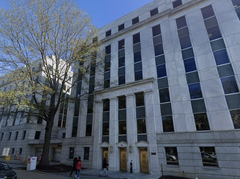
Multiple other federal buildings in the area have been earmarked for disposal, including the Department of Housing and Urban Development’s Robert C. Weaver Federal Building, the Wilbur J. Cohen Federal Building, the Department of Agriculture's South Building and the Department of Energy’s Forrestal Building. DOE employees are currently moving out of Forrestal, and as of July, HUD was 80% done with its relocation from Weaver.