The country’s boom in manufacturing is prompting companies to lease more – and larger blocks – of warehouse and industrial space in Metro Atlanta.
U.S. manufacturers have accelerated their output in recent months as demand for metal and electronic products increases, Bloomberg reported this week. That is spilling over into Atlanta, where industrial landlords are fielding increased tenant demand from manufacturers and companies that service them, panelists said during Bisnow’s Industrial Southeast Summit.
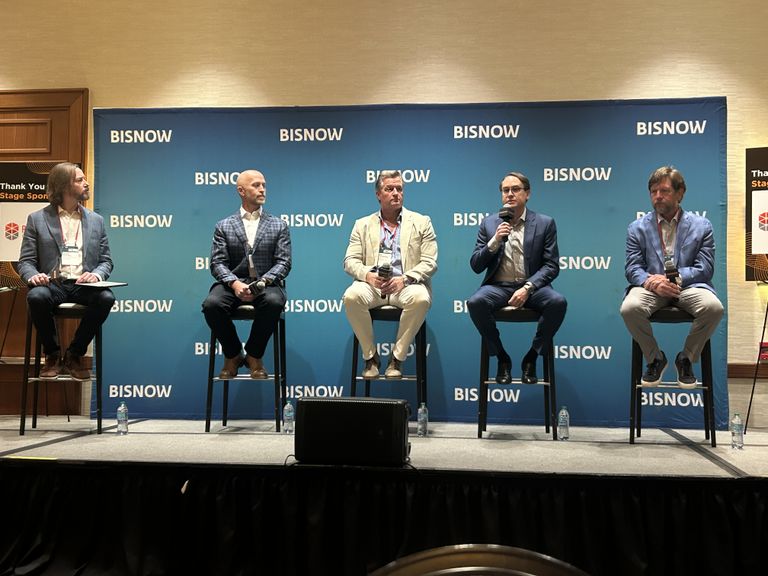
“Just in Atlanta, we've got developments in Covington and the [Interstate] 95 corridor, and over two-thirds of the tenants are manufacturing,” Logistics Property Co. Senior Vice President Sean Fitzsimmons said last week. “So I'm absolutely seeing manufacturing and manufacturing-adjacent tenants driving the market.”
Metro Atlanta industrial landlords tallied record leasing activity in the third quarter. Net absorption reached 6.7M SF — more than double the second quarter — with leasing activity reaching an all-time high of 22.2M SF, according to a CBRE report. Social media platform TikTok, Google and Nike led the way with 1M SF of leasing each during the quarter, followed by Genuine Parts inking 825K SF at the Great Valley Commerce Center off Interstate 75 and Siemens leasing 772K SF at Jackson 85 Distribution Center, according to Cushman & Wakefield.
CBRE said leasing activity is being driven by big-box tenants in third-party logistics, automotive supply chain and infrastructure spaces.
“Nationally and in the Southeast, I think there is a rush for bulk buildings by several different users out there that are trying to keep their market share of space,” Seefried Properties Senior Vice President Doug Smith said during the event at the Wyndham Atlanta Buckhead Hotel & Conference Center. “As much as data centers are going to continue to be the thing we all talk about over the next couple of years, I still think there's a lot of demand by e-commerce users that are out there, and those continue to grow.”
Last month, Audi announced plans for a $4B factory in the middle of Georgia, which will help to pump up manufacturing employment in the state.
Wes Vaughan, managing director of Link Logistics in the Southeast, said his firm is projecting that investments in U.S. manufacturing will create an additional 140M SF of warehouse demand in the U.S. Prologis Research projected that data center demand would account for up to 40M SF of leasing in 2026 alone, according to PwC and ULI’s Emerging Trends in Real Estate report.
“The manufacturing plant is what’s going to get the headlines, but it’s the ecosystem that exists around the plant that is going to lift the industrial demand in our markets,” Vaughan said.
Vaughan also said Link embraces third-party logistical tenants, which are more often seeking shorter lease terms than in the past.
“We embrace those short terms at times because you’re not spending a lot of capital dollars into that building,” Vaughan said. “So long as the credit passes, almost, the sniff test, then you know we’re underwriting these deals.”
The increased activity, especially with tenants taking big-box warehouses, is prompting developers to break ground on new projects this year, said Core5 Industrial Partners President Linda Booker. According to CBRE, developers began 17 new warehouse projects in the third quarter, totaling 4.2M SF. Total industrial space under construction rose to nearly 13M SF, a 105% increase year-over-year.
“In '25, we had hopes that it'd be a great year, and then with the tariff situation, a lot of the tenants kind of put their requirements on hold,” Booker said. “We've been very encouraged by the activity in 2026 compared to 2025.”