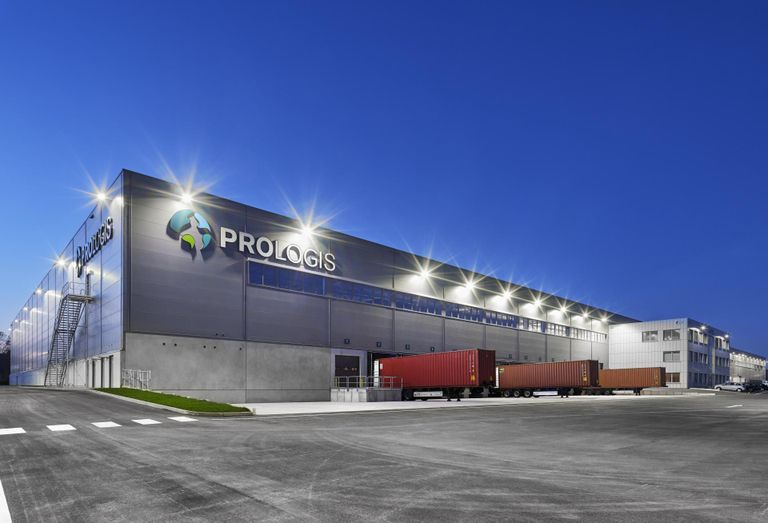
Investment bank BMO downgraded industrial REIT Prologis, one of the world’s largest logistics facilities owners.
The San Francisco-based REIT is historically expensive amid slowing demand for industrial space, BMO said in a report Friday morning, and the potential impact of tariffs proposed by President-elect Donald Trump is an additional risk.
“We believe it screens expensive relative to the 10-yr yield,” BMO analyst John Kim wrote in a research note. “President-Elect Trump's proposed 10% incremental tariffs on Chinese imports adds further uncertainty.”
Prologis beat earnings expectations when it unveiled its third-quarter results in October. But market dynamics resulted in BMO downgrading the stock from “Market Perform” to “Underperform” and cutting its price target from $120 to $104.
Prologis' stock price stood at $112.50 as of 1 p.m. ET Friday, down 1.4% on the day.
Prologis has $72B of assets under management, with more than 5,500 buildings encompassing 1.2B SF across 19 countries, according to a Nasdaq analysis. The REIT's stock price reached a 52-week high of $137.52 on Dec. 14 last year, but it has declined 16.3% since.
Shares of Prologis have declined 10.3% over the past three months, according to the Nasdaq analysis.
Days before BMO’s report was released, Prologis backed out of purchasing a sports facility for $24M in Oakland, California. It didn't provide detailed reasons for the decision, only that it felt the acquisition was “not going to work out.”
Demand for industrial has been slowing since the pandemic-era boom in construction and demand from tenants. Industrial vacancy rates in the U.S. reached 6.4% in Q3 — well above the 3% vacancy rates seen two years earlier, though almost in line with the long-term average of 7%, according to Cushman & Wakefield’s Q3 report.
But BMO isn’t hopeful that demand for industrial space will get stronger in the near future. Amazon had driven demand in 2020 and 2021, absorbing 168.3M SF, or 22% of the market share in that period. This year, the bank estimates the e-commerce giant absorbed just 36.5M SF of industrial space as it shifted toward warehouse ownership rather than leasing build-to-suit warehouses.
“We see demand remaining tepid,” Kim wrote. “Industrial leasing demand is -56% y/y, and we don't see a short-term rebound with Amazon expanding modestly.”