
The commercial real estate investment pipeline from Canada to the U.S. isn’t broken, but it has sprung some leaks.
A year of tariffs and White House ribbing about becoming a state have alienated Canadians, and the country’s institutional investors have dialed back their U.S. real estate bets. The result is a plunge in cross‑border deal volume and an early sign that political posturing is reshaping capital flows.
“Everything that happened has encouraged and incited businesses and Canadians to look at diversifying their investments,” said André Brin, CEO of World Trade Center Winnipeg, an organization promoting international trade that's part of a network with a presence in nearly 100 countries.

Canada-to-U.S. commercial real estate transaction volume fell 32% year-over-year to $5B for the 12 months that ended in March. The year’s total is less than half the average invested by Canadians in each of the last five years, according to Colliers' first-quarter Global Capital Flows report.
Canadians raised roughly the same amount of cash last year to invest abroad, $13.4B in all, but the 37% capital allocation into U.S. assets was a sharp dip from the 54% of Canadian capital raised the prior year, according to Colliers data.
Canadians aren’t entirely walking away from U.S. assets, but the dip in investment reflects a cultural push to rely less on their southern neighbor that has taken hold on Main Street and in C-suites.
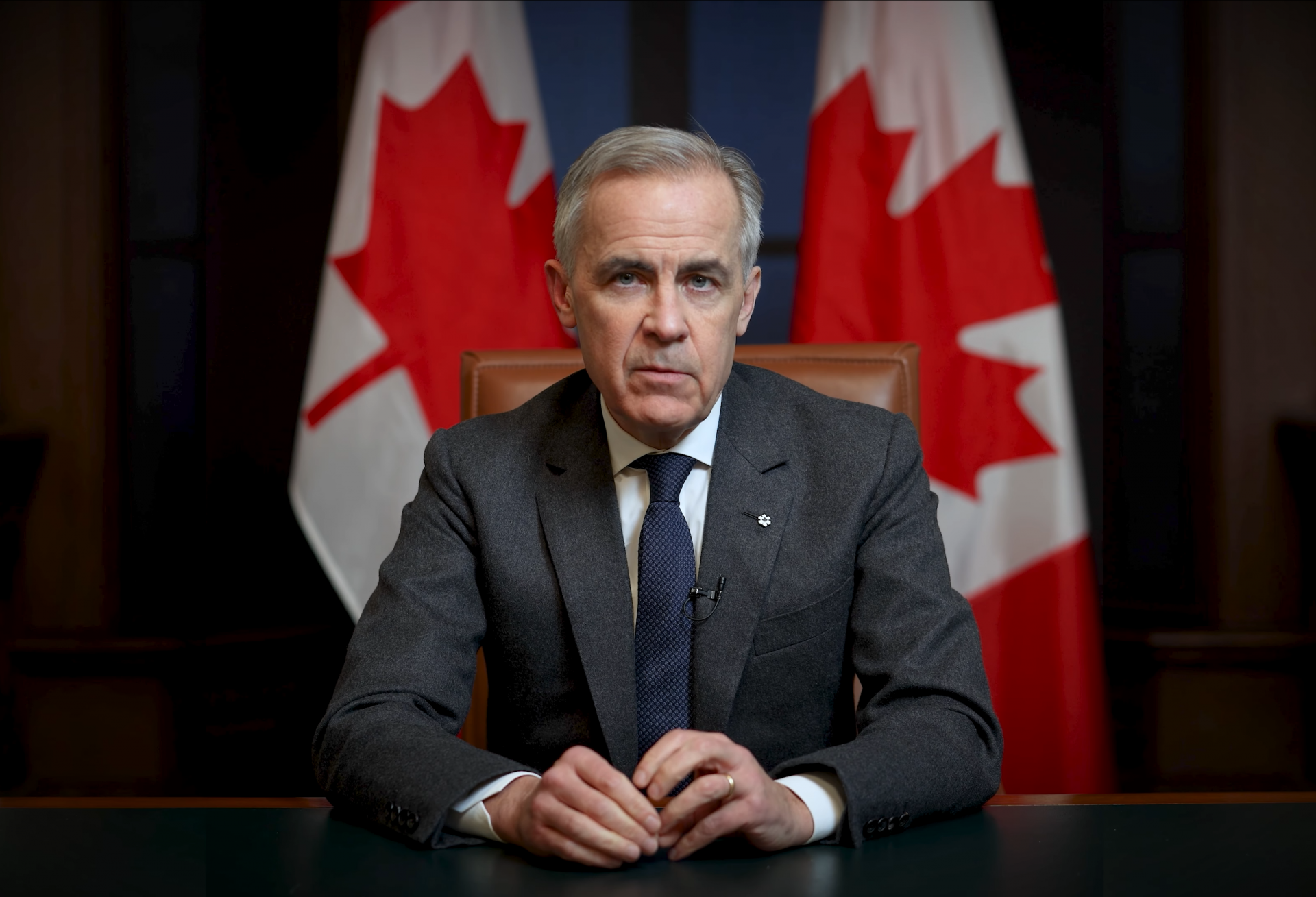
“Many of our former strengths, based on our close ties to America, have become our weaknesses,” Canadian Prime Minister Mark Carney, one of President Donald Trump’s vocal critics on the global stage, said in video address to constituents last month.
The message has been paired with policy moves, like a new sovereign wealth fund launched last month, that are meant to create more distance between Canada and its largest trade partner.
“The U.S. has changed, and we must respond,” Carney said in the video.
The call to action is especially prescient for U.S. real estate investors in Canada, traditionally the largest source of global capital going into U.S. assets. Canadian investors spent $73B on American assets from 2019 to early 2025, four times more than any other country, according to data from JLL.
Trump hadn’t even taken the oath of office for a second time before he promised a 25% tariff on Canada and Mexico, and the countries were erecting new trade barriers even before the “Liberation Day” press conference last April that expanded tariffs to practically every country on the planet.
The volatility inevitably added a drag on cross-border real estate deals but has in some ways settled down since February, when the U.S. Supreme Court ruled against the White House’s legal reasoning for the tariff regime.
“Investors and businesses are looking for predictability, certainty and stability. This was not a year where doing trade with the U.S. was full of certainty, stability and predictability,” Brin said. “That paused things, and people looked elsewhere for other opportunities.”
Canada has led the globe in investment into the U.S. for each of the last three years and is the only country to appear in each of the last three first-quarter lists. Last year, Sweden and Israel overtook Norway and Japan to make the list.
The jockeying on the leaderboard reflects the broad appeal of U.S. real estate assets on a global scale, and the dip in southbound capital streams was more than offset by other sources. Investors spent 24% more on U.S. real estate year-over-year through March, $25.9B compared to $20.9B, despite the five largest capital sources raising $400M less combined capital than the prior year.
Economic volatility is not confined solely to the U.S. borders, even if its policymakers are driving much of the noise. The U.S. conflict with Iran has sent prices up globally and led to attacks on Gulf data centers and hotels, parts of Europe are facing economic malaise as the Russia-Ukraine war drags on, and China still has some 90 million empty or unfinished apartments after its real estate market collapsed.
Institutional investors are typically long-term holders of assets with long track records of placing capital around the globe. From that perspective, U.S. assets continue to look attractive to Canadian funds, in part because of the relative ease of doing business across the border, said Andrew Yam, who joined American Landmark in February to lead the firm’s push deeper into institutional management.
“In my personal experiences, those Canadian institutional investors are actively traveling across the U.S. — I’ve seen them in multiple investment meetings and conferences,” said Yam, who has spent his first few months at American Landmark pitching investors in Asia, Latin America and Canada.
Despite the volatility, and in some ways because of it, the U.S. still has a lot to offer foreign real estate investors, Yam said.
“For them to allocate capital, everything is relative,” he said. “It’s because of the volatility or uncertainty in the global situation we actually see that there is a stronger demand for investors to look at U.S. real estate.”
Back in Winnipeg, there’s some resignation that cross-border trade isn’t coming roaring back. The U.S. will continue attracting capital, Brin said, but the push for diversification is likely to be sticky.
“Elbows up,” a hockey term used to describe punishing an opponent, has in many ways become the country’s negotiating position. The slogan went viral after actor Mike Meyers mouthed the words while wearing a shirt emblazoned with “Canada is not for sale” at the close of a March 2025 episode of Saturday Night Live.
Carney has adopted the slogan, which could give it some extra weight in the commercial real estate world. The Liberal Party technocrat and former central banker left his role as chair of the board at Canadian investment giant Brookfield Asset Management to run for prime minister.
U.S. assets promising high returns will continue to attract Canadian dollars, but the push to diversify isn't just about dollars, it has been wrapped in patriotism, Brin said.
“There's also a perspective that Joe Public in Canada wants to see businesses go elsewhere, too, and wants to see that we're not as reliant on an economy like the U.S. as we were,” Brin said.
)
)
)
)
)
)
)
)
)
)
)
)