Tiltwall construction has become a common construction method for large, single-story buildings like distribution and data centers — not so much for four-story buildings on tight urban sites.
But that’s what Skanska did for the Harris Health Central Fill Pharmacy in Houston.
“Before this project … if a client said, ‘Hey, we want to do four-story tiltwall panels,’ I might have said, ‘That might not be the best option,’” Skanska Project Executive Ben Johnson said.
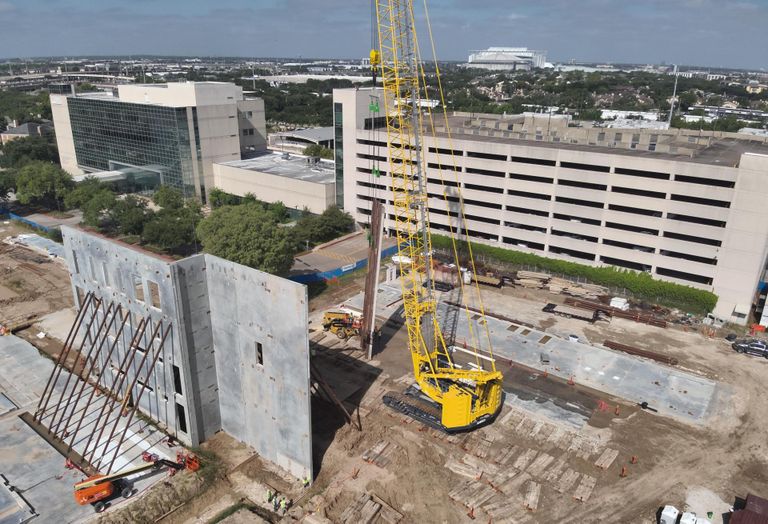
Tiltwall construction uses concrete panels that are cast on the construction site, then lifted, or tilted, into place. Those panels are typically in the range of 18 to 20 feet tall, but this project used panels taller than 70 feet, Johnson said.
The project was particularly challenging due to the space constraints. The casting process forms concrete walls horizontally. The 145K SF building required 61 panels, the heaviest weighing about 87 tons.
“That’s going to take up a lot of real estate,” Johnson said.
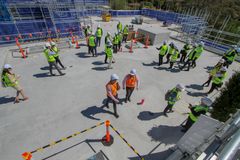
The site of the Harris Health Central Fill Pharmacy, southeast of the Texas Medical Center on Holly Hall Street, is neighbored by Harris Health’s Smith Clinic on one side and a FedEx distribution center on the other. FedEx, being “excellent neighbors,” allowed Skanska to use part of its lawn and parking lot for the tiltwall construction process, Johnson said.
“Had they not allowed us to do that, we would have had to come up with a different plan,” he said. “That plan probably would have cost us a lot more time and potentially more money.”
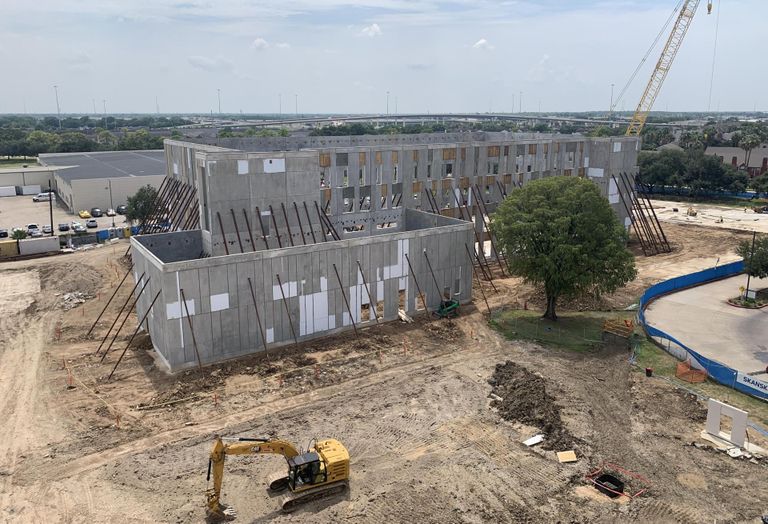
Skanska’s team held numerous meetings with MSD Building Corp., the tiltwall erector, and Baker Concrete Construction, the concrete subcontractor, to iron out logistics. It was determined that only one subcontractor could be present on-site at a time for safety reasons and space limitations.
Still, the tiltwall method brought efficiency, Johnson said. Unlike traditional construction that builds a frame then fills in with curtain wall or steel to protect the building from external elements, tiltwall construction completes the facade of a building in one process, speeding up construction timelines.
A four-story, 145K SF building would typically take about two years to complete, but Skanska expects this project, which began in November, to be completed by August 2026, Johnson said.
The building will house the robotics necessary for Harris Health’s automated pharmacy.