Are data centers being built fast enough?
That was the question posed in a JLL blog highlighting that demand for data centers exceeds supply, despite their construction outpacing that of all other commercial real estate sectors.
Even with more than 1,500 new data centers in various stages of development nationwide, many operators and users would probably say they need to be built faster.
With construction timelines typically ranging from six months for a small facility to three years for a hyperscale center — not even counting additional time spent on tasks like site selection, design and permitting — it’s no surprise that prefabrication is growing in popularity. This approach allows building components to be manufactured off-site in a controlled factory environment and then assembled on-site by a trained crew.
“The advantage of a prefabricated solution is speed, speed, speed,” said Doug Bevier, executive director of development for Clark Pacific, a provider of prefabricated systems for building design and construction. “Additionally, a lot of sites are in greenfield locations away from urban density, and so you don't have a ton of access to labor on the jobsite.”
Further driving urgency is data centers’ growing appetite for power, which is causing many owners to build their own on-site energy infrastructure, whether it consists of diesel generators, battery systems or other solutions to provide primary or backup power. And they need this infrastructure up and running quickly.
“You've got huge industrial demand for power, but utilities can't move fast enough for people to scale up their manufacturing facility or data center in a short period of time, so they’re looking for alternatives,” said Jon Mohle, director of product innovation for Clark Pacific. “They also tend to go vertical to save space and because of the sheer distance required to run all of the wires. By pulling it all together into an on-site structure, they can densify the power generation and make it more efficient.”
'Easy For The User'
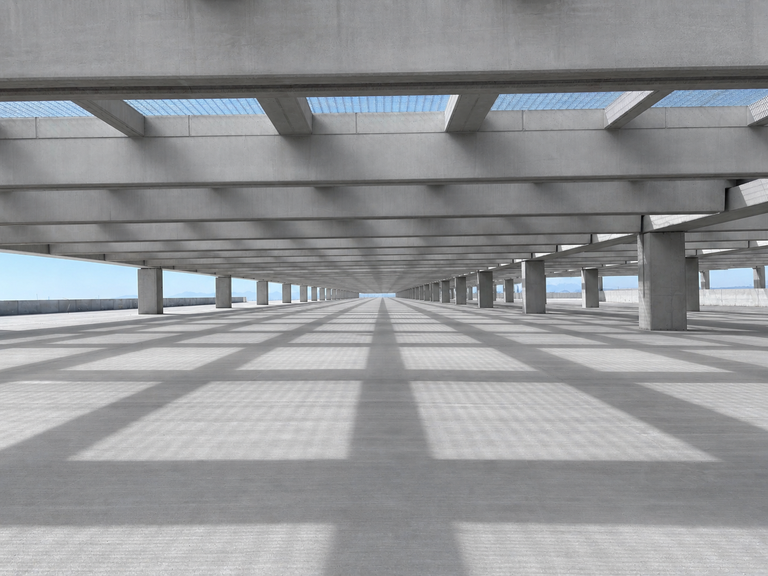
To assist data centers in their need for speed, Clark Pacific’s AccelGen product line offers precast structural components such as columns, beams and floors that are designed and manufactured to meet a client’s specific criteria for the platforms or enclosures they need to house their power equipment.
Prefabricated assembly is advantageous for structures that need to be open and well-ventilated to allow for airflow and heat rejection. It also eliminates the need for numerous load-bearing structural members that can interfere with the placement of equipment and cables, Bevier said.
“With traditional field construction methodologies, you end up having a lot more interior columns, diagonal braces and stuff like that, which tends to get in the way of electrical pathways and equipment such as generators, fuel cells, batteries and switchgear,” he said. “Our systems are fast to build, and their interiors don't have a lot of stuff in the way, which makes it really easy for the user.”
Scaling Up Quickly
AccelGen is available in either platform or enclosure configurations to meet a user’s needs depending on equipment type, OEM requirements, local climate, and permitting and site criteria.
The AccelGen platform configuration is for power equipment that will benefit from an open structural support system rather than an enclosed building. Mohle said it is ideal for applications that require heavy-load structural support, easy service access, drainage, screening or coordinated electrical interfaces.
AccelGen’s enclosure configuration is an option if weather-protected housing, acoustic control, fire separation, secure access or coordinated ventilation openings are priorities.
Whether the customer selects the enclosure or platform option, AccelGen can help them accelerate the installation of equipment to meet their power needs across multiple locations.
“Prefabrication uses a kit of parts with a standardized design, and this lends itself to a simplified approach for operations that are scaling up as quickly as they can, which is difficult if they take a custom construction solution on every job site,” Bevier said. “Clark Pacific’s centralized solution is faster, requires fewer people and can be rolled out nationwide as data centers scale up to match demand.”
This article was produced in collaboration between Clark Pacific and Studio B. Bisnow news staff was not involved in the production of this content.
Studio B is Bisnow’s in-house content and design studio. To learn more about how Studio B can help your team, reach out to studio@bisnow.com.