The Bay Area may be known for its tech giants, but the area also has a deep-rooted history with aerospace and defense. That history is serving as the foundation for a huge new project already gaining traction with potential tenants.
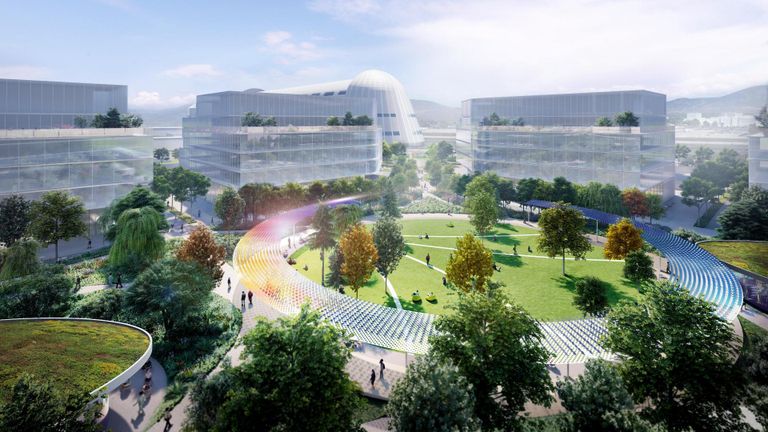
It has only been a few months since SKS Partners, NASA and the University of California, Berkeley announced plans for a new research park outside Mountain View. And it will be awhile before anything materializes, as the Berkeley Space Center is expected to break ground in 2026.
That hasn’t stopped the phones from ringing, however.
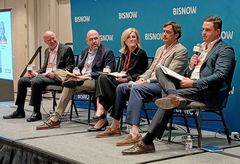
“We’ve had about 100 expressions of interest to us and UC Berkeley,” Tim Smith, director of project management at SKS Partners, told Bisnow.
The project, a 1.4M SF campus consisting of office, research and development, and academic spaces, is still in the planning phase, and while SKS Partners hasn't begun leasing out the space, it has brought on CBRE as its broker.
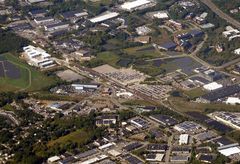
Berkeley Space Center will be on the Mountain View-Sunnyvale border in the NASA Research Park, adjacent to Moffett Field.
With public and venture capital interest in aerospace, longstanding aerospace staples like NASA's Ames Research Center at Moffett Field are ideal for testing developing technologies.
And while people might think of Texas or Alabama when it comes to testing rockets, not all technologies need a literal launchpad.
“Those companies will want to come test their stuff at Moffett Field,” Smith said, noting that the new Berkeley Space Center will be next to the Ames Research Center.
Additionally, Bay Area investors are interested in this industry. The VC funds invested in defense and aerospace technology are largely concentrated in the Bay Area. Six of the 10 VC funds reshaping aerospace, according to IndustryWired, are based in the Bay Area.
The last decade has brought a surge of investment to the sector. In 2021 alone, $10B in public and private funding flowed to space companies.
There is also a history of aerospace engineering in the Bay Area.
The microchip industry in Silicon Valley grew up next to the Ames Research Center, Smith said, working hand in hand to scale down the necessary chip technology to function and fit on a rocket during the first space race.
That legacy remains, with not only the NASA research facility but also Lockheed Martin and several other tech companies near the new Berkeley Space Center.
The Berkeley Space Center will also serve as a place for education and entrepreneurship to collide, with the participation of Berkeley SkyDeck, an accelerator program that has relaunched its air and space track for startups to apply.
“It will move those innovations that happen in the classroom into the entrepreneurial space,” Smith said.