Owners of new apartment buildings in D.C. are having a difficult time raising rents as the number of units seeking their first tenants is the highest it has ever been.

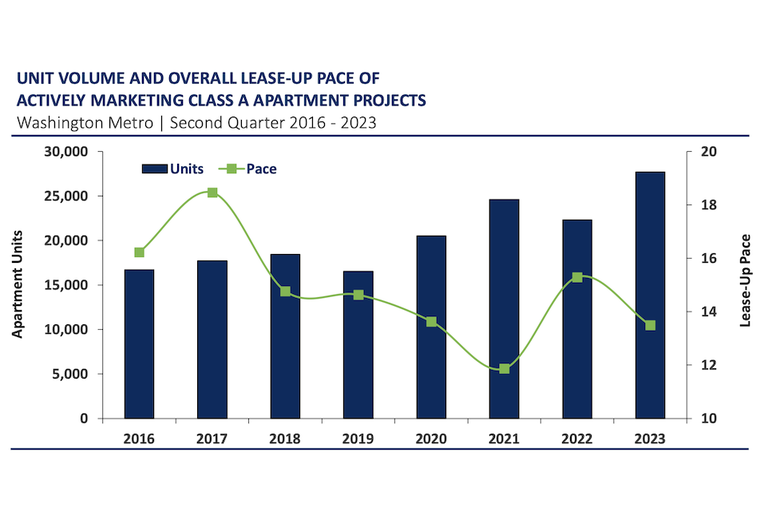
The number of Class-A apartments actively leasing up in the D.C. area hit a record level in the second quarter of 27,697 units, according to Delta Associates, which has been tracking the market since the 1990s.
Given the timelines of apartment developments, the glut of new supply hitting the market now is a result of the conditions that occurred two years ago, when the construction market heated up after the 2020 freeze.
"Covid upended the market, and the impact from the pandemic is still being felt today three years later," Delta Associates President Will Rich said. "The delay in starts in 2020, with a ramp-up in activity happening in late 2020 and early 2021 has led to a lot of new projects coming online over the past six to nine months, causing this record number of units available in the market right now."
The number of projects on the market is up significantly from the second quarter of 2022, when 22,315 Class-A units were actively leasing. Over that same period, the per-project lease-up pace has dropped from 15 units per month to 13.
Of the 20 major markets CBRE tracked in its national Q2 multifamily report, the D.C. market had the second-most new apartments completed in the 12 months ending June 30. Its 17,300 units trailed only New York City's 27,400 units, and D.C.'s total was higher as a percentage of overall inventory, 2.8% compared to New York's 1.1%.
The result of this record supply surge and rising vacancy is a slowdown in rent growth.
Class-A apartment rents in the District increased by 1.6% in the 12 months ending June 30, while the larger Metro area experienced 2.9% rent growth, according to Delta Associates. That is below the market's long-term average rent growth of 3.8%.
These figures represent effective rents, meaning they take into account concessions that landlords offer, such as months of free rent at the start of a lease.
"With the increase in competition, concessions are playing a bigger role in the marketplace, so that impacts the effective rents," Rich said.
The market has seen demand remain in line with long-term averages, but it is down from the prior two years. The D.C. Metro area recorded net absorption of 7,943 Class-A apartments in the 12 months ending June 30, according to Delta Associates, down from 11,072 units in the prior year and 13,918 units in the year before that.
Looking ahead, the competition from new supply isn't expected to ease during the next year. Delta Associates found 17,721 units are scheduled to deliver over the 12 months starting July 1, a 14% increase from the prior year.
This increase comes in part from construction picking up in Northern Virginia and suburban Maryland, Rich said. He identified the National Landing area around Amazon HQ2 and the Bethesda submarket as two that are contributing to the rise in scheduled apartment deliveries.
"The competitive market conditions will continue over the next year or so, and it won’t be limited to D.C.; it will also affect suburbs as well," Rich said.
Many of the projects delivering over the next year likely obtained their construction financing prior to March 2022, when the Federal Reserve enacted the first of what have now been 11 interest rate hikes. The rapid rise in rates has made it harder for developers to secure construction loans and has led to a slowdown in starts that will eventually affect D.C.'s apartment market dynamics.
"You’ll see that there will probably be a slowdown in deliveries in 2025 and 2026 because of the high interest rate environment we're currently in," Rich said.
"That will help with getting more substantial rent growth, as well as lowering vacancy," he added.