:no_upscale():quality(75))
Fortune released its 64th annual Fortune 500 list this week, recognizing 500 of the largest companies in the country, according to total revenues in their respective fiscal years. These companies account for two-thirds of U.S. gross domestic product and brought in $12.8 trillion in revenue last year, as reported by Fortune Magazine.
Bisnow combed through the list to identify the 15 highest-ranking real estate companies, hotels, retailers, institutional real estate investors and construction firms to make the cut.
398. Blackstone — $7.1B (Prev. rank 503)
The New York-based private equity giant and one of the largest real estate managers in the world with more than $120B worth of properties under management recently acquired hotel conglomerate LaSalle Hotels for $4.8B. This acquisition took place shortly after Blackstone sold its 15.8 million shares in Hilton Worldwide Holdings, valued at $1.3B, for which Bloomberg reports it will finish up with $14B in profit when all is said and done.
356. Jones Lang LaSalle (JLL) — $7.9B (Prev. rank 391)
The global brokerage and services firm, which like Blackstone was a big riser on this year's list, has its fingers in every sector of real estate, from retail to industrial, leasing to investment, and is one of the most prolific brokerage firms in terms of research output. JLL has also been investing heavily in a breadth of tech solutions to help its clients cover their real estate needs, such as its new global PropTech business JLL Spark and workplace planning and budget tool JLL InSite.
324. Hilton Worldwide Holdings — $9.1B (Prev. rank 241)
The third-biggest hotel company on this year's Fortune 500 list, Hilton's tumble into the 300s isn't the worst news, considering much of it was due to its split into three companies that was completed in January 2017. What was left is a smaller, more profitable company — 261.8% more profitable than last year, according to Fortune.
280. MGM Resorts International — $10.8B (Prev. rank 297)
:no_upscale():quality(75))
MGM Resorts International gained in both total revenue and net profits over the past year, continuing its fairly steady climb up the list over the past two decades. Looking ahead, its next major move will be the opening of Park MGM, the redeveloped and rebranded Monte Carlo casino right on the Las Vegas strip.
237. BlackRock — $12.5B (Prev. rank 255)
The world's largest fund manager has some major real estate holdings on behalf of its clients, such as a large stake in publicly traded retail owner PREIT and a sizable portfolio of real property. The firm also made major waves in the New York market back in 2016 when it announced its intention to move its headquarters to 50 Hudson Yards. Construction on the most expensive office building in New York history is ongoing.
230. Lennar — $12.6B (Prev. rank 260)
:no_upscale():quality(75))
The Miami-based homebuilding company branched into multifamily development in 2011, and hasn't looked back, with ongoing projects from the Chicago area to the Bay Area and in several other states. In 2014, it launched Lennar Commercial, which it claimed would focus on the "development, investment and management of retail, mixed-use and commercial properties."
207. CBRE — $14.2B (Prev. rank 214)
:no_upscale():quality(75))
CBRE is, quite simply, the biggest commercial brokerage and investment manager in the world, boasting a market cap of $16.1B. With its tentacles extending into every facet of real estate, its stock experienced a significant jump in value for the year ending March 31, which analysts attribute largely to the global expansion of these firms’ underlying businesses beyond the traditional brokerage model to include corporate outsourcing, PropTech investment and a variety of global business lines.
164. AECOM — $18.2B (Prev. rank 161)
:no_upscale():quality(75))
The highest-ranking construction firm on this year's Fortune 500, AECOM grew even larger in 2017 when it acquired Oakland-based Shimmick Construction, which is involved in many California infrastructure projects.
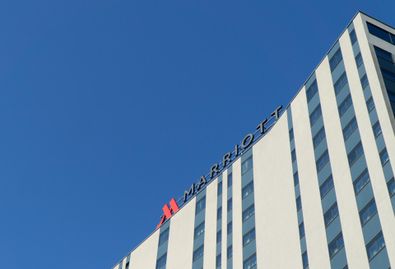
127. Marriott International — $22.9B (Prev. rank 163)
:no_upscale():quality(75))
The largest hotel conglomerate on the Fortune 500, Marriott recently paid nearly $5B to swallow up one of its biggest competitors in the timeshare industry. Of course, that is only a small part of Marriott's empire, which includes such prestigious brands as Ritz-Carlton and Renaissance Hotels. Marriott is also attempting to address the hotel industry's biggest disruption in years by expanding into home-sharing.
38. Freddie Mac — $74.7B (Prev. rank 39)/21. Fannie Mae — $112.4B (Prev. rank 20)
:no_upscale():quality(75))
The two mortgage giants remain in conservatorship since they were bailed out by the federal government during the Great Recession, but both have paid back more than they received and remain privately owned. The Trump administration has made overtures about cutting government ties, which has sent both's stock prices tumbling despite revenue growth, according to Fortune.
8. Amazon — $177.9B (Prev. rank 12)
We still don't know where Amazon HQ2 is landing (though some think they have an idea), but the search has had a transformative effect on how cities try to recruit businesses. And that says nothing of how its e-commerce model has revitalized industrial real estate and thrown brick-and-mortar retail into chaos. The tech giant's Amazon Web Services is a dominant force in the data center market. Amazingly, the company increased revenue by 30% in the past year, catapulting it into Fortune's top 10 for the first time.
7. CVS Health — $184.8B (Prev. rank 7)
:no_upscale():quality(75))
The pharmacy giant completed some big moves in 2017, such as the acquisition of Target's pharmacy business. But its biggest move yet is still to come, as it attempts to take over Aetna for a reported $66B, creating an unprecedented healthcare giant that would offer an assortment of healthcare services, including health insurance, pharmaceutical retail and walk-in medical clinics. If approved the merger would create the second-largest company in America.
4. Apple — $229.2B (Prev. rank 3)
Apple pulled in the most profits of any company on the Fortune 500 last year at over $48B, and its Apple Stores have revolutionized the concept of experiential retail. Its massive usage of data centers and office space has also proved hugely influential in commercial real estate. Looking ahead, that influence is sure to keep growing, as Apple is also searching for a second national headquarters (albeit in a much different way than Amazon).
3. Berkshire Hathaway — $242.1 B (Prev. rank 2)
:no_upscale():quality(75))
Warren Buffett's investment vehicle slipped below Exxon Mobil for the second overall spot, but remains a model of investing for countless acolytes of the "Oracle of Omaha." Though it owns small percentages of a few real estate-related companies, it owns a large percentage of construction and materials companies and operates its own (gigantic) realty firm, Berkshire Hathaway Home Services, which has its own commercial real estate arm.
1. Walmart — $500.3B (Prev. rank 1)
:no_upscale():quality(75))
The winner and still champion for the sixth year in a row, Walmart has been aggressive in its attempts to compete with Amazon to dominate the global retail market, though it experienced a 27.7% year-over-year decline in profits last year.
Just like Amazon, Walmart's activity has made waves in commercial real estate, such as its conversion of some of its Sam's Club wholesale retailers into distribution centers to facilitate its e-commerce shipping. The company is also in talks to acquire Humana, which would make it the largest health insurer in the country, creating ripple effects on healthcare real estate that cannot fully be understood quite yet.