Years after the pandemic-era supply chain crisis has faded for much of the economy, data center developers are still battling equipment shortages and long, unpredictable lead times, a bottleneck that threatens to delay projects amid an artificial intelligence data center arms race.
Equipment shortages persist as a major source of delays and uncertainty in an industry where developers are already struggling to keep pace with unprecedented demand. And delays can be costly, with hyperscalers and other tenants writing substantial penalties into contracts for missed delivery dates.
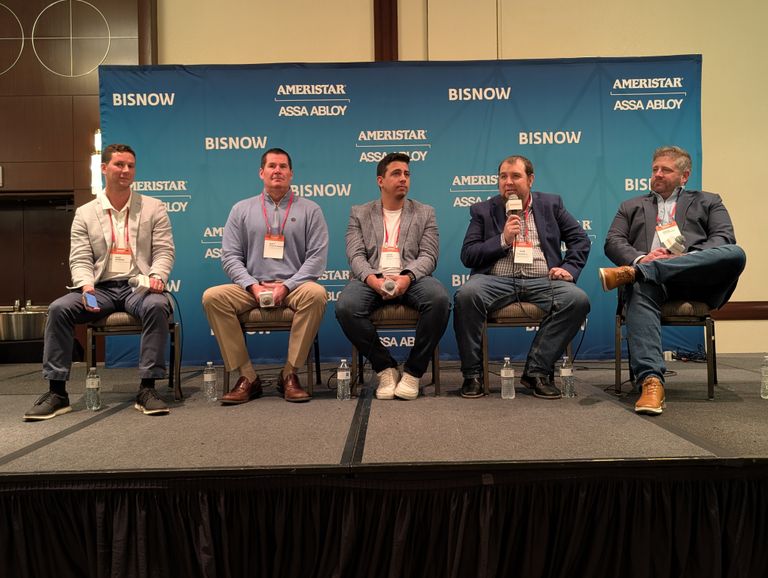
The supply chain pinch is still being felt across nearly every part of the development process, from natural gas turbines and transformers to cooling systems and basic construction materials, industry insiders said at Bisnow’s Data Center Investment Conference and Expo: Central in Dallas this month.
Sophisticated developers are finding ways to navigate many of these constraints, panelists said, but even then there are trade-offs. Strategies like stockpiling equipment or ordering long-lead items before designs are finalized require significant upfront capital and can raise project costs.
And while some panelists expressed frustration that shortages tracing back to the pandemic nearly seven years ago have persisted for data centers long after easing in other industries, there is broad recognition that the procurement landscape isn’t returning to normal as long as the sector continues on its stratospheric growth trajectory.
“There were discussions about how long Covid would impact us, and I don't know if we're ever going to go back to pre-Covid,” said Sam Caddell, CyrusOne’s senior director for facilities engineering and operations systems. “There are still impacts on lead times — from raw materials all the way down.”
The most significant lead times are for equipment involved in getting power to data center project sites, panelists said.
Gas turbines can take a decade or more to be delivered, a bottleneck that is currently contributing to yearslong timelines for grid connections and limiting developers’ ability to pursue on-site and behind-the-meter power as an alternative to utility interconnection queues.
Transformer shortages are felt even more broadly, with panelists citing lead times of up to three years for equipment required on virtually every large-scale project. Similarly, backup generators can take more than a year to procure.
The supply chain pinch extends well beyond power infrastructure. Chillers and other cooling system components routinely carry lead times of 12 to 18 months, panelists said, as do switchgear, uninterruptible power supply, or UPS, systems and other critical electrical and networking equipment integral to data center operations.
Manufacturers said they simply can’t keep up with the flood of demand, even as they scramble to scale up production.
“We're about to bring on a brand-new chiller factory. We'll have four chiller factories that can supply this market, and even then it's not enough,” said Dara Sanii, a director at cooling equipment provider Carrier Applied West.
It’s not just complex equipment that is facing shortages. Even basic hardware and construction materials are seeing significant delays. Optical fiber can take six to eight months to arrive, and structural steel roughly a year. Meanwhile, contractors continue to encounter unexpected delays for relatively simple components like conduits and medium-voltage cables.
These same hardware shortages also factor into delays in the production of more complex data center systems. Manufacturers say pumps, evaporators, fans, coils and heat exchangers used in cooling equipment are routinely sold out for a year or more, while basic components like breakers can slow the production of electrical systems.
“The capacity the industry's taking down is outstripping the ability of the entire supply chain to keep up,” Johnson Controls Vice President Matt Kightlinger told DICE: Central. “It is absolutely an issue industrywide, all the way down to the component level.”
Some of the pressure on the data center supply chain has been eased by delays elsewhere, panelists said. Projects derailed by grid constraints or local opposition have freed up equipment that had already been allocated, pushing scarce components back into the market.
Even so, preventing procurement from becoming the pinch point on a project has required developers to rethink how they buy equipment and plan construction. Panelists said the ability to manage these constraints has become a key differentiator between firms that can actually deliver projects on schedule and those that cannot.
One common strategy has been to stockpile long-lead equipment years in advance, effectively creating a strategic reserve of transformers and other critical equipment that can be deployed across multiple projects. It’s an approach that SkyBox Datacenters Executive Vice President Gordon Kellerman compared to “Covid panic-toilet-paper-buying.”
But it's a strategy only open to major developers with deep balance sheets and large project pipelines, who can commit capital well before they know exactly where the equipment will ultimately be used.
“We are definitely trying to buy multiple years out. That’s one of the advantages of having been around for a little longer and having a little more capital,” CyrusOne’s Cadell said. “I worked for a startup data center company, too, for a little bit, and this is a bigger challenge there.”
Sophisticated developers are also sharing demand forecasts with suppliers as far as three years in advance, giving manufacturers greater visibility to plan production capacity. This also allows developers to reserve some of that capacity or negotiate priority access without making the same level of speculative capital deployment required to purchase the equipment outright.
“It’s certainly good for us, because we then know where we really need to invest, because we're making big capital investments in both our supply chain and our manufacturing facilities,” Johnson Controls’ Kightlinger said. “The really smart, mature [developers] are sharing a lot more information compared to what they have in the past, and they're buying further out to make sure they have those reservations in place so they can go build their gigawatt sites.”
Yet even the most sophisticated planning can’t eliminate every supply chain risk. Developers and contractors say they increasingly encounter shortages of components that were never considered long-lead items and thus weren’t purchased in advance. David Pickett, vice president of engineered systems at McGough Construction, pointed to medium-voltage cables as an example.
Once readily available, these cables have periodically become difficult to source over the past year, at times preventing projects from moving forward.
The rapid evolution of AI infrastructure adds another layer of uncertainty. Data center designs are now revised multiple times during development to accommodate new generations of hardware or shifting tenant strategies. These changes can render equipment ordered months earlier obsolete or create the need for new long-lead items after a project’s schedule has already been set.
Developers are responding by designing facilities for greater flexibility, panelists said, limiting the extent to which a change in one system forces redesigns elsewhere and ensuring critical infrastructure can work with equipment from multiple suppliers. Some operators are also installing temporary chillers, generators and uninterruptible power supply systems when planned equipment is delayed, although panelists said this is expensive, inefficient and leaves facilities operating below optimal performance.
Industry leaders told DICE: Central that the best defense against supply chain uncertainty is early coordination across the entire project team. Bringing developers, contractors, subcontractors, distributors and manufacturers into the process from the outset can uncover potential shortages earlier, ensure smaller components are not overlooked and identify suppliers or contractors that have equipment already stockpiled.
This kind of early engagement has been a key element of past projects for veteran developers that successfully navigated the rough supply chain waters with relatively little disruption, Decima International Senior Director of Construction and Quality Steven Wright said.
“We talked about every step of the project, how we were going to approach it, how do we design for it, and how do we make sure we have the right equipment,” Wright said. “We have to be partnering together and working from beginning to end on this. Otherwise, we're just pushing issues down the road until they become stoppages.”