The future Inglewood NFL stadium hasn't even been built, yet it's already building a buzz in sports and real estate circles alike.
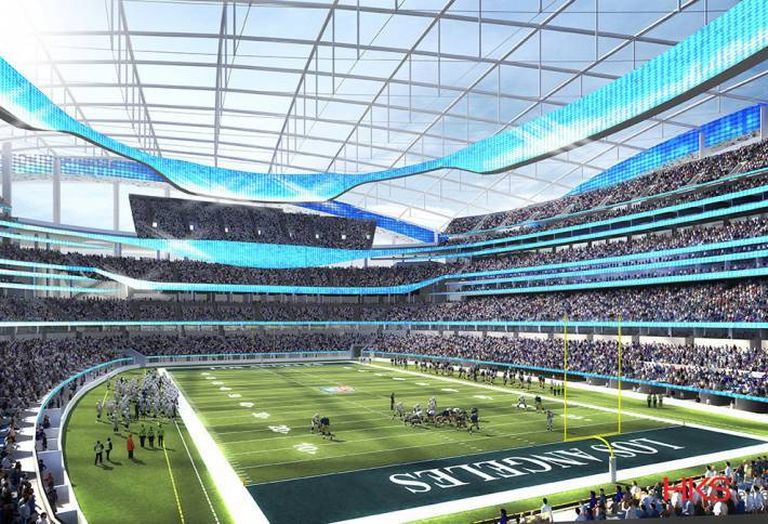
With an estimated cost ranging from $1.86B to $3B, the so-called City of Champions Stadium will be the world's most expensive sports arena, creating a ripple effect so profound it will boost the neighborhood's subpar property values along the way.
Or so says Rams owner Stan Kroenke, who received a $1B loan from JP Morgan to begin construction this January. The underlying assumption, of course, is that neighborhoods around NFL stadiums have homes that are more expensive, both in sales and rental value.
But is this a fair hypothesis? It's a question that's been debated heavily, including in a 2010 study by a team of economics professors at the College of the Holy Cross.
Most recently, real estate site Trulia released its own research, investigating the current value of real estate within a two-mile radius of existing NFL stadiums.
They found that, of the 31 neighborhoods around the nation’s pro football stadiums, about two-thirds have higher housing values than houses in non-stadium neighborhoods.
For instance, buyers near Lincoln Field, home to the Philadelphia Eagles, should expect to pay 44.3% more than for the average Philly home. Rents are also 8.9% higher.
Oddly enough, the five stadiums built in the past 10 years share a common characteristic: none of them have had a significant impact on property values.
Prices near MetLife Stadium (built in 2010)—shared home of the New York Giants and New York Jets—are only 6.7% higher than the broader Meadowland area.
And in Dallas, homes around the Cowboys' AT&T stadium have actually lost value compared to the rest of the region since the venue opened in 2009.
"The neighborhood surrounding the stadium, rather than the stadium itself, is the determining factor," says David Weidner, managing editor for Trulia's housing economics research team.
Critics of stadium construction often point out that football stadiums are relatively isolated from a central business district, with most only used for eight home games during the year, Forbes reports. Therefore, the presence has little impact on lifting the fortunes of homes nearby.
But Kroenke's City of Champions Stadium could be different. He's pitched the stadium as more than just a sports venue, but a year-round commercial neighborhood.
The 300-acre development will feature 890k SF of retail space, 780k SF of office space, a 300-room hotel and even 2,500 homes. "We think it’s going to boost property values," says Sandra Green-Murray, a real estate agent with Playa Marina Properties in LA.
Inglewood property values are currently 8.9% lower than the greater Los Angeles region. "This is an area with a lot of property that can be developed," Green-Murray says. We’re expecting lots of growth."